What varieties of crabapple are there and how are they cared for and managed?
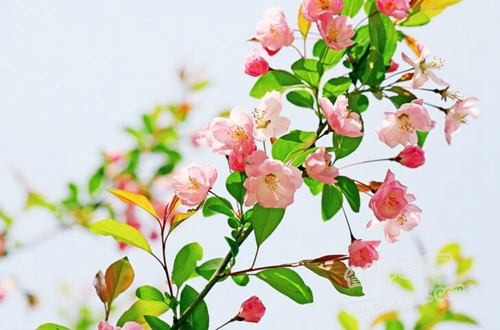
Crabapple originated in our country and is widely cultivated north of the Yangtze River basin. It has a long history and is a traditional famous flower of our country. It is often planted in classical gardens, frequently forming independent scenic spots named after the flower, such as "Crabapple Spring Dock". Architectural decoration also often uses crabapple flower patterns in the design of doors, windows, courtyard walls and pathways, seen everywhere, all giving people enjoyment of beauty.
The most delicate and graceful among the crabapples is the Midget crabapple (Malus micromalus). There are also quite a few other kinds that can be enjoyed both for their flowers and their edible fruit, such as the Hall crabapple (Malus halliana), which is a flower-viewing variety; the Eight-ribbed crabapple and the Red crabapple, which have abundant flowers and large fruit, with extremely high yield per plant - a single 10-year-old crabapple can produce over 100 jin of fruit. So planting crabapple not only beautifies the courtyard environment, with flowers to view in spring and fruit to view in autumn, but also brings economic returns, and is therefore deeply loved by the people.
Europe, America and Japan have developed horticultural industries and have bred many new and superior crabapple varieties. In recent years the Beijing Botanical Garden has introduced multiple new crabapple varieties from the United States, such as the Jewel crabapple, with a short and dense tree form, pinkish-white flowers and small red fruit; the Diamond crabapple, whose new leaves are tender red, with rose-red flowers, small dark red fruit, and abundant flowers and dense fruit; and the Flame crabapple, with white flowers and deep red fruit that persists.
Crabapple likes light and is not very shade-tolerant; too much shade reduces flowering. It is strongly cold-resistant and resistant to wind, and has no strict requirements for soil, growing well even in weakly alkaline soil, though the soil should not be too compact. Crabapple is drought-tolerant and averse to waterlogging, so the soil must have good permeability and must not hold standing water. In order to make crabapple bloom abundantly year after year and prevent an obvious alternate-bearing (on-year/off-year) phenomenon, a ring-shaped fertilizer application should be carried out every autumn and winter to increase soil fertility so that the flower buds are plump; otherwise there will be insufficient nutrients and sparse flowering.
Crabapple has strong branching ability and is tolerant of pruning. In winter, crowded branches, overlapping branches and water sprouts should be carefully removed; other branches are generally given light pruning, and heavy pruning is not advisable.
Crabapple requires the soil to maintain appropriate moisture; watering should follow "wet then dry" - as long as it is not excessively dry and does not hold standing water, it can grow vigorously.
Crabapple is propagated by sowing, grafting, division, root cuttings, buried roots and layering. However, to preserve the fine characteristics of flower-viewing varieties, grafting should be used. The rootstock used for grafting is mostly Siberian crabapple (Malus baccata), apple seedlings and wild crabapple, etc. Select 1-year-old small seedlings as rootstock. Bud grafting is done in August, and branch grafting in early April in spring.
When does the crabapple bloom? In which month is the crabapple flowering season?
The crabapple flower is elegant in form, blooming like brocade, with diverse colors, and is especially beautiful after blooming. Many people ask when the crabapple blooms and in which month its flowering season is. When the crabapple blooms you can enjoy the flowers, and you can also cut branches to put in a vase for viewing or make bonsai, etc. Crabapple generally blooms in April-May and bears fruit in August-September. Below is an explanation of when the crabapple blooms and its care methods; let's take a look together.When does the crabapple bloom? When does the woody crabapple bloom?
Woody crabapples basically bloom in spring, while the herbaceous ones are begonias, some of which also bloom in spring, summer and autumn. The flowering period of each crabapple differs slightly; below let's look at the blooming times of various crabapples: Midget crabapple blooms in April, Hall crabapple blooms in March-April, Spearleaf crabapple blooms in March-April, Chinese quince-leaf crabapple blooms in April, and Wax begonia blooms in spring and autumn.
In which month is the crabapple flowering season?
Crabapple generally has already bloomed from mid-April to May. Crabapple is a common name in our country for certain plants, divided into many kinds such as Midget crabapple, Spearleaf crabapple, Hall crabapple, Chinese quince-leaf crabapple and Wax begonia. Taxonomically, these crabapples belong to different families or genera; some are herbaceous and some woody, some shrubs and some trees.
3. Pruning: It is best done in early spring, cutting out dead and weak branches and diseased and pest-infested branches to keep the crown open and airy and allow light through.
4. Pest and disease control: The main pests and diseases include crabapple rust, for which Bordeaux mixture or triadimefon should be sprayed promptly. For decay disease, spray Bordeaux mixture or lime sulfur mixture. For aphids, fenitrothion or dimethoate can be used for control. For hawthorn spider mite, dicofol can be used for control
5. Transplanting: Generally, large seedlings to be planted should have a soil ball, while small seedlings should retain some native soil depending on the situation. After planting, tending and management should be strengthened, and the soil should be kept loose and fertile. Every autumn and winter, a batch of pond silt or fertile soil can be replaced and banked around the root zone. After leaf fall and before sprouting in early spring, carry out one pruning, cutting out dead and weak branches and diseased and pest-infested branches to keep the crown open and airy and allow light through. To promote vigorous flowering of the plant, water sprouts should be cut back to reduce the nutrient consumption of sprouting, so that the retained axillary buds can obtain more nutrients and form more flowering and fruiting branches. Fruiting branches and intermediate branches need not be pruned. During the growth period, if the growing tips can be pinched promptly to limit vegetative growth early, the effect will be even more pronounced. For potted stump specimens this control should be applied even more so.
Care tips for several flowers
Flowers are mainly divided into two types: cold-resistant and cold-fearing. Most flowers and trees from tropical and subtropical regions will stop growing and enter dormancy below 10°C, otherwise their branches and leaves are easily damaged by freezing or they may freeze to death. For plants such as Norfolk Island pine, Milan (Aglaia odorata), clivia, jasmine and bromeliads, and for flower-colored cacti planted directly in pots, room temperature should be kept at 3°C-5°C; while for banyan, palm bamboo, rubber tree, aloe, schefflera, epiphyllum and orchid cactus, the lowest room temperature should be 1°C-3°C; Chinese rose, azalea, osmanthus and sago palm are cold-resistant plants, and even placed outdoors or on a balcony they can generally overwinter safely; while cold-fearing plants such as Milan (Aglaia odorata), spider plant and money tree must be moved indoors. Below are winter care tips for some common flowers:
Spider plant: drought-tolerant but not cold-tolerant, with strict soil requirements; it generally grows best in well-drained, loose and fertile sandy soil. The optimum growth temperature is 15°C-25°C, and the overwintering temperature is 10°C. In winter, move it indoors and water thoroughly once every four days, preferably at noon; when watering, the water temperature is best the same as the air temperature, which can prevent the roots from freezing.
Pothos: it likes a warm, humid and semi-shaded environment; the suitable temperature is 18°C-21°C during the day and 20°C-23°C at night. In winter, as long as the indoor temperature is not lower than 15°C, pothos can overwinter safely. If the temperature is below 10°C, it easily causes leaf drop and affects growth.
Aloe: it likes bright sunlight and higher temperatures, but avoids intense direct sun. In winter the lowest temperature must not be below 2°C, and it should be moved indoors promptly. Although aloe likes moisture, it cannot be watered every day; you can wait until the soil is very dry before watering again.
Ornamental kale: it can withstand heavy snow and low temperatures of minus 11°C, adding a touch of green to the severe winter; introduced to the north, it is indeed an excellent open-ground herbaceous flower for winter.
Crabapple: the most suitable growth temperature is 15°C-22°C; it likes a warm, humid and semi-shaded environment, and avoids high temperatures and waterlogging; under short-day conditions the flowering period can be advanced, and the short daylight of winter meets its needs.
Anthurium: the most suitable growth temperature for potted anthurium is 20°C-30°C, with a minimum temperature of 14°C. Air humidity is the key to successful anthurium cultivation; therefore, foliar spraying should be done many times throughout the year, so that it can continue to bloom continuously.
Azalea: in winter azaleas usually enter dormancy, but if the balcony or room temperature reaches a certain level, for example between 15°C-25°C, even Satsuki azaleas will end dormancy and bloom continuously. In winter azaleas need little water; generally water once every 4 to 5 days.
Geranium: it likes sunlight, loves warmth, is slightly drought-tolerant and fears waterlogging. In daily management, prune branches and pinch growing tips, and after flowering remove the spent flowers to promote the growth of new flower buds. Indoors, as long as the temperature reaches above 15°C and does not drop below 8°C at night, and water is given when dry, it can bloom joyfully all winter long. At around 10°C it can maintain an evergreen state.
Tillandsia cyanea: its small purple flowers can bloom from autumn all the way to the following spring. It requires loose, well-drained leaf mold or peat soil, keeping the potting soil moist and the light ample, and the winter temperature not lower than 10°C.