What are the reasons why money tree cuttings are difficult to root and survive?
How do you care for a money tree? Here's a book for you, "868 Ultimate Flower-Growing Tips," and you'll never worry about failing to grow a money tree again! How to get this book
lixiayuanyi
↑↑↑↑↑↑Long-press to copy → open WeChat → tap the "+" in the upper right corner → tap Add Friends → paste and search → when "This user does not exist" appears, tap "Search" below → tap the first result and follow → reply "money tree" and you'll get it.
The main reason money tree cuttings are difficult to root and survive is failure to master a practical, workable cutting method. Cuttings are best taken between April and May or between September and October, when the temperature is around 20-25°C.
Cut the large pinnate compound leaves of the money tree into short sections, each with 1-2 leaflets, and insert them into a substrate of plain sand and vermiculite mixed in equal parts, to a depth of about 1/3 of the section length, leaving only the leaflets above the substrate. After spraying thoroughly with water, place them in a shaded spot. Depending on the temperature and how wet or dry the substrate is, mist the leaf surfaces 1-2 times a day to keep the cutting substrate nicely moist; it must never be overly wet, otherwise the cuttings easily rot. To reduce the number of mistings, you can also cover them with plastic film to retain moisture. After 20-30 days, the base of the cuttings forms callus tissue and differentiates roots, and afterward slowly forms swollen tubers.
Only after 8-10 months do shoots sprout from the tubers and produce pinnate compound leaves. If you soak the base of the cuttings for 3-5 seconds in a solution of 100 mg/L indolebutyric acid or No. 1 ABT rooting powder, it can promote rooting and also helps the formation of adventitious buds. A single leaf inserted in vermiculite will, after about 10-14 days, form a small bulbous stem with fleshy roots at the base of the petiole; afterward the bulbous stem keeps swelling and grows latent buds, and after another 2-3 months of cultivation while maintaining an ambient temperature of 25-30°C, it can send out pinnate leaves and grow into a small plant.
How long do money tree cuttings take to root? 4 techniques to improve rooting
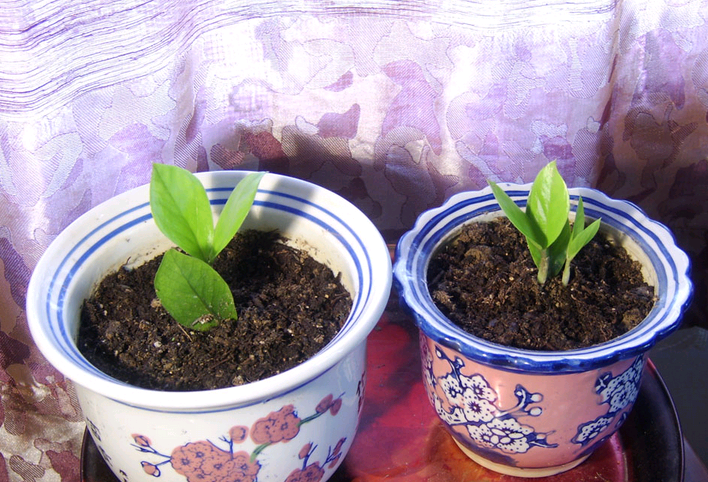
How long do money tree cuttings generally take to root when propagated by cuttings? If a reasonable and correct cutting method is used, money tree cuttings generally root in about 15—20 days.
For money tree cuttings, you must choose robust, well-growing plants as cuttings. Cuttings are generally taken between April—May or September—October, when the temperature is around 20-25°C. Taken at this time, money tree cuttings generally need only 15—20 days for new roots to sprout.
Techniques for making money tree cuttings root quickly: 1. Take cuttings at a temperature of around 20°CYou must grasp the timing of taking money tree cuttings each year, as it not only affects rooting but is also the key to whether the cuttings survive. It is recommended to take money tree cuttings between April—May or September—October, when the temperature is around 20—25°C. Cuttings taken at this time not only root quickly but also have a high success rate.
2. Soak in rooting solutionThe secret to why most flower enthusiasts' money tree cuttings root and survive easily is that before planting they soak the base of the cuttings in rooting solution, which disinfects and sterilizes them and also promotes root sprouting. It is recommended to soak the base of the cuttings for 3—5 seconds in a solution of 100 mg/L indolebutyric acid or No. 1 ABT rooting powder, which can promote rooting and also helps the formation of adventitious buds.
For difficult-to-root types, dilute 30—50 times and dip for 3—6 seconds; for easy-to-root types, dilute 100—150 times and dip for 3—6 seconds, then plant the cuttings.
3. Cover with plastic wrap to retain moistureIf flower enthusiasts find that even after soaking in rooting solution their money tree cuttings still do not root quickly, then you may be missing this important step: wrapping the money tree cuttings with plastic wrap, which keeps the moisture in the potting soil from being lost and retains moisture. This is because rooting requires moisture but cannot have waterlogging, and the effect of plastic wrap coverage exactly matches the moisture needs for rooting, and it also reduces the number of times you need to mist during the money tree cutting period.
4. Keep them in a cool, shaded place for careBeginners taking money tree cuttings think the cuttings need plenty of sun to root, but that is not the case, because freshly planted money tree cuttings have no roots yet, and if exposed to sun right away, the cuttings will die, let alone root. We should keep the money tree in a ventilated, cool place for about 20 days; roots sprout more easily under weak light.
Money tree cutting propagation methods and precautions
Money tree cutting propagation methods: 1. Cutting soilThe cutting soil can be a mixed substrate of river sand and vermiculite, or soil mixed with fine sand, peat soil, perlite and river sand in a 3:1:1 ratio.
2. Choosing cuttingsFlower enthusiasts can choose a single small leaf, a section of leaf rachis with 2 leaflets, or just a section of leaf rachis.
Generally speaking, in terms of rooting results, cuttings with a leaf rachis plus leaflets root faster, have a higher sprouting rate, and more easily form larger tubers.
A single leaf generally takes 10~14 days for a small rooted bulbous stem to form at the base of the leaf, and after 2-3 months of cultivation it can grow into a small plant, but under normal circumstances the seedling formation rate is not high.
3. Cutting methodThe money tree cutting method is simple. Flower enthusiasts can directly insert the cuttings to a depth of 1/3-1/2 of the section length, leaving only the leaflets above the substrate, then spray thoroughly with water and place in a shaded spot. Maintain an ambient temperature of 25°C-27°C, and depending on how wet or dry the substrate is, mist the leaf surfaces 1-2 times a day.
Just keep the substrate slightly moist; it must never be overly wet, otherwise the cuttings will rot and the cutting will fail.
4. Cutting precautionsThe soil used for cuttings must not be too wet; too wet easily causes the cuttings to rot. When the cuttings have formed a certain amount of roots, the middle of the root gradually swells to form a small bulbous tuber, and the tuber gradually enlarges.
Some of the more tender cutting leaves, after being potted, will turn yellow and die due to high temperatures or poor water management, but the tuber can survive; older mature leaves and cuttings with a whole leaf stalk can also stay green and vigorous.
A small number of tubers can sprout and grow new leaves in the same year, but their growth vigor is weak and growth is slow; the following year the tuber will grow thick new shoots and grow normally.