How to Grow Tulips in Water? Methods and Care Tips Explained
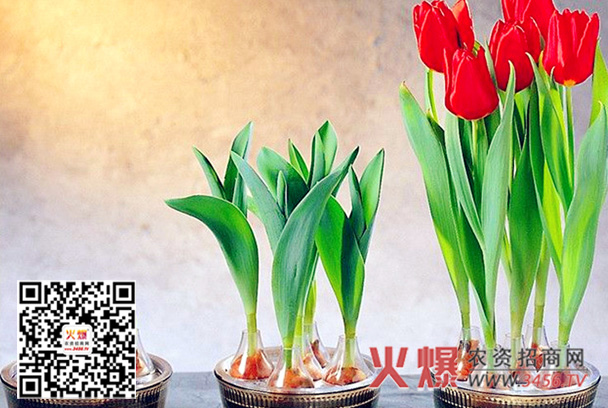
Tulips are also very well suited to water culture, especially bulbs that have already undergone cold treatment, since the time from planting to flowering is short. Water-cultured tulips are highly decorative and very easy to set up.
(1) Water culture container
The diameter of a tulip bulb is about 3-5 cm, so it is best to have a container that is narrow in the middle and wide at both ends, so that the bulb sits right in the center. You can buy a holder from a flower shop, or make one yourself, for example by using the narrow upper part of a mineral water bottle. According to the diameter of the bulb, cut off the corresponding part of the bottleneck, then invert it inside a wide-mouthed bottle, and your tulip water culture container is ready.
(2) Bulb disinfection
Peel off the outer skin of the bulb and soak it in a fungicide solution for disinfection, for example soaking it in a 600-fold dilution of chlorothalonil for 20-30 seconds, or using thiophanate or potassium permanganate solution.
(3) Water culture
Place the disinfected tulip bulb in the neck of the mineral water bottle and add clean water so that the water surface just touches the basal plate of the tulip bulb. If the water level is too low and the basal plate cannot reach the water, that will not work; if the water level rises above the basal plate, the bulb is prone to rot, which also will not work.
(4) Temperature and light
That is, the regulation of temperature and light. First place the bulb in an environment between 5-10°C, or wrap the bulb in damp absorbent cotton and then place it in the refrigerator's cold storage compartment to root, keeping the temperature at about 5°C. After 7-10 days, once you confirm that the root system has developed well, move it indoors to a temperature of 15-18°C. Indoor light must be sufficient, otherwise it is prone to leggy growth.
(5) Changing the water
After finding that clean white roots have grown, adjust the water level so that 2/3 of the root system is submerged in water, or soak it in a nutrient solution rich in phosphorus and potassium fertilizer. Depending on the temperature, change the water every 3-5 days, and change to a dilute nutrient solution every two weeks, and slowly flower buds will appear.
When growing tulips in water, choose some dwarf varieties, so that the plant shape produced by water culture is even more beautiful.
How to Grow Tulips in Water, Methods for Water-Cultured Tulips
How to grow tulips in water? Friends who know about tulips should know that the earliest water culture of tulips was carried out by some growers in Denmark and southern Sweden in the 1970s. So, do you understand the cultivation methods for water-cultured tulips?
1. Bulb selection: Water-cultured tulips require cold treatment of the bulbs, as follows: before the end of October, control the temperature at 9°C, then gradually lower it, and from December to January keep the temperature at about 2°C with humidity of 85-95%. Tulip bulbs need to be tightly wrapped in scales, undamaged, and harvested relatively late. Otherwise, it will cause the plant to become shorter, weight loss, yellowing of the root system, failure to flower, cracking of the bulbs, and so on.
2. Planting method: When planting, press the tulip bulbs down so that they stick onto the pins of the water culture tray. In order to protect the central flower bud from damage, the part of the bulb where the pin pierces should be the surrounding part of the bulb. Remove bulbs showing symptoms of infection, and immediately add water to the tray after planting.
3. Nutrient solution: Place the tray in a rooting room at 5°C with a small amount of air movement, and replenish water in a timely manner. Tap water or rainwater with a conductivity value of 1.5 ms/cm can be used. For varieties prone to leaf cracking, water with a conductivity value of 2 ms/cm should be used during the rooting stage.
4. Care: When the tulip roots grow to 4 cm, place the tray on a relatively flat ground in the greenhouse, and remove diseased bulbs or bulbs that have not sprouted. At this stage, ensure the water level reaches the overflow outlet, keep the temperature at 16-18°C, and maintain humidity at 60-80%. At the end of the planting period, the frequency of watering can be reduced to half of the previous amount. Before harvest, sufficient water should be provided to the plants, which can extend the tulip flowering period.
The market prospects for water-cultured tulips are very broad, and the selling price is naturally not low either. Therefore, if you learn a skilled technique for water-cultured tulip horticulture yourself, you can be self-sufficient in tulip materials for your home. So, through the above introduction by the editor, do you now understand how to grow tulips in water? If you do, then hurry up and start cultivating water-cultured tulips!
Water-Cultured Tulips Tulips: Cultivation Methods for Water-Cultured Tulips
Inthe Netherlands, the emergence of water-cultured tulips was marked by a historical event. Because people's demand for water-cultured tulips continued to grow, in 1988 the Dutch government issued a bill on plant protection, and from then on water-cultured tulips embarked on a formal path. By early 2002, water-cultured tulips in the Netherlands had reached 40% of total production, which shows the market value and profit potential of water-cultured tulips. How do you grow water-cultured tulips? Come and learn the cultivation methods for water-cultured tulips.
[Recommended reading] Lily Kalanchoe Globe amaranth Gardenia Clivia Guzmania Balloon flower Mulberry Winter jasmine Mimosa
Tulips: Cultivation Methods for Water-Cultured Tulips
——————————————————————————————————————————————
[Plant profile]
——————————————————————————————————————————————
Chinese name:Tulip
Scientific name:Tulipa gesneriana
Aliases:Foreign lotus, dry lotus, grass musk, tulip fragrance, red-blue flower, purple described fragrance
Family:Liliaceae Liliaceae
Genus:Tulipa genus Tulipa
Origin and distribution:Native from southern Europe and western Asia all the way to northeastern China in East Asia
Morphological characteristics:Perennial herbaceous plant. Leaves are long elliptic-lanceolate or ovate-lanceolate. Flower stems are 6-10 cm tall, flowers are solitary at the top of the stem, large and upright, forest-like, and the base is often dark purple. Tepals are obovate, bright yellow or purplish red, with yellow stripes and spots. Flower colors include white, pink, carmine, purple, brown, yellow, orange, and so on, in varying shades, single-colored or multi-colored. Flower shapes include cup-shaped, ovate, bell-shaped, bowl-shaped, spherical, funnel-shaped, lily-flowered, and so on, with both single and double forms. The flowering period is generally March to May, with early, middle, and late types.
Cultivation Methods for Water-Cultured Tulips
——————————————————————————————————————————————
▲Bulb selection: Water-cultured tulips require cold treatment of the bulbs, as follows: before the end of October, control the temperature at 9°C, then gradually lower it, and from December to January keep the temperature at about 2°C with humidity of 85-95%. Tulip bulbs need to be tightly wrapped in scales, undamaged, and harvested relatively late. Otherwise, it will cause the plant to become shorter, weight loss, yellowing of the root system, failure to flower, cracking of the bulbs, and so on.
▲Planting method: When planting, press the tulip bulbs down so that they stick onto the pins of the water culture tray. In order to protect the central flower bud from damage, the part of the bulb where the pin pierces should be the surrounding part of the bulb. Remove bulbs showing symptoms of infection, and immediately add water to the tray after planting.
▲Nutrient solution: Place the tray in a rooting room at 5°C with a small amount of air movement, and replenish water in a timely manner. Tap water or rainwater with a conductivity value of 1.5 ms/cm can be used. For varieties prone to leaf cracking, water with a conductivity value of 2 ms/cm should be used during the rooting stage.
▲Care: When the tulip roots grow to 4 cm, place the tray on a relatively flat ground in the greenhouse, and remove diseased bulbs or bulbs that have not sprouted. At this stage, ensure the water level reaches the overflow outlet, keep the temperature at 16-18°C, and maintain humidity at 60-80%. At the end of the planting period, the frequency of watering can be reduced to half of the previous amount. Before harvest, sufficient water should be provided to the plants, which can extend the tulip flowering period.
"Conclusion:The market prospects for water-cultured tulips are very broad, and the selling price is naturally not low either. Therefore, if you learn a skilled technique for water-cultured tulip horticulture yourself, you can be self-sufficient in tulip materials for your home.
【More plant encyclopedia】
Aloe Jasmine Radiation-absorbing plants Pennywort Potted landscape making Drug plants Mistletoe Indoor flowers Money tree Lucky bamboo
Water-cultured lucky bamboo Potted landscape making Anthurium Mint Living stones Geranium Garden Christmas cactus Peace lily Snake plant Kunlun snow chrysanthemum
Water lily Flower pot Violet Magnolia Winter jasmine Mimosa Blue enchantress Water-cultured cyclamen Alocasia Peace lily Lucky bamboo
Jade plant Fragrant wood Chinese rose Money tree flowering Snow-in-summer Hydrangea Bambusa multiplex Mosquito repellent plant Rubber tree Buddhist pine Fuchsia
Ivy Cymbidium Jade plant Bowl lotus Orange jasmine