How to Grow Pothos in Water? Detailed Methods and Steps
Pothos (Epipremnum aureum) is an evergreen herbaceous plant in the Araceae family, genus Epipremnum, also known as golden pothos. It is native to the tropical rainforest regions of the Indonesian archipelago. It prefers warm, humid environments, with an optimal growing temperature of 15-25°C, and can safely overwinter above 10°C. It is now widely cultivated in China, easy to grow, and suitable for indoor cultivation and ornamental display. In southern China, it can also be planted in courtyards under tall trees, allowed to climb and grow upward.
Pothos is well suited to water culture. Cut off branches and insert them into water, arranging them in varying lengths for a pleasing shape; roots will form in about 20 days. You can also wash the roots and grow it in water. After washing the roots, trim them appropriately, cutting off overly long roots and rotted or diseased roots to encourage new root growth. In the early stage of water culture, change the water once a day. After the plant is established, change the water once every 7-10 days, and periodically spray the leaves with potassium dihydrogen phosphate to keep the foliage bright and colorful.
Pothos has leaves of alternating yellow and green, with an elegant leaf shape, and adds a distinctive charm when used to decorate a room. Small plants can be placed on flower stands or on top of cabinets for trailing cultivation, while large plants can be grown into a totem-pole style to decorate living rooms, bedrooms, and more.
How to Grow Pothos in Water (with multiple pictures) - Introduction to Water Culture Methods for Pothos
Water-cultured pothos is one of the very best indoor decorative water-cultured plants, a climbing vine with ornamental foliage. Its stems are slender and soft, and its leaves are delicate and elegant. Place a nested pot high on top of a cabinet and let its vines hang down gracefully, or after the trailing vines grow too long, loop and hang them into a ring, like a green relief sculpture. Previously, many beginner flower enthusiasts asked how to grow pothos in water. Next, let's look at the water culture method for pothos.
Growing pothos in water is very simple. Simply put, just cut a few pothos branches and put them in water, then place them in indirect light (do not place them in direct sunlight). There is no need to change the water every day; just add water when the level drops. If you want to be a bit more refined, flower enthusiasts can add ceramsite or similar material to the water culture container to hold the pothos branches in place.
As for water-cultured pothos, I have seen pothos stuck in a mineral water bottle in an office, and I have also seen ceramsite placed in a small potted plant set up by a vendor. Overall, water-cultured pothos is very easy to care for, but compared with pure water culture, the water culture method with peat and ceramsite placed inside is more prone to root rot.
In fact, just look at the pictures below and you will know how to grow pothos in water. There is no fixed method; flower enthusiasts can improvise freely. Just remember to place it in indirect light. Even if root rot or similar problems occur during water culture, promptly clean up the rotted parts, and you can continue growing it in water.
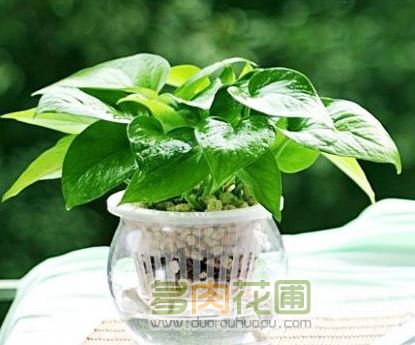
1. The water-cultured pothos in the picture below is rather elaborate, with ceramsite for holding the branches in place and water culture trays, etc. This is generally the style of vendors - it has to look good to sell well!
2. The water-cultured pothos below is more casual - a drink bottle, a water cup. The pothos does not look very vigorous. The problem is that the placement environment is unsuitable. When pothos faces strong light, it is often prone to sunburn and wilting.
3. Water-cultured pothos in a glass cup - simple, materials easy to find, and plain water is enough.
4. In the pothos in the picture below, you can see the roots. It should have been grown in water for some time, so the roots are very long. In this case, it is best to expose 1 cm of the roots to the air, which helps the roots breathe.
5. A common method on office desks, very easy to keep alive.
Notes on water culture care:
Water-cultured pothos grows relatively fast and is easy to cultivate and manage. During cultivation and management, in summer you should spray the plant with water more often and add nutrient solution once every 10 days to keep the leaves green and fresh. For potted seedlings, when the plant grows 30 cm up the cultivation pole, it should be pruned off; when fallen lower leaves reach 30%-50%, it should be discarded and replanted. Like potted pothos, water-cultured pothos also needs regular pruning. Cut off overly long and tangled stems and branches to maintain an orderly, well-spaced appearance. The water used for water-cultured pothos is a very critical part. You can use tap water, well water, clean river water, etc., but the water should be left to sit for one or two days before use.
Summary: The above is an introduction to the care methods for water-cultured pothos. We hope it is helpful to everyone.
How to Grow Pothos in Water (with multiple pictures)
As for how to grow pothos in water, it can be explained either simply in a general way or step by step in a methodical manner. However, so that flower enthusiasts can see the practical essentials, this article only picks out the important points of the pothos water culture process, and the remaining space will include different sample pictures of water-cultured pothos for flower enthusiasts to refer to and learn from.Growing pothos in water is very simple. Simply put, just cut a few pothos branches and put them in water, then place them in indirect light (do not place them in direct sunlight). There is no need to change the water every day; just add water when the level drops. If you want to be a bit more refined, flower enthusiasts can add ceramsite or similar material to the water culture container to hold the pothos branches in place.
As for water-cultured pothos, I have seen pothos stuck in a mineral water bottle in an office, and I have also seen ceramsite placed in a small potted plant set up by a vendor. Overall, water-cultured pothos is very easy to care for, but compared with pure water culture, the water culture method with peat and ceramsite placed inside is more prone to root rot.
A flower enthusiast said, I was looking for how to grow pothos in water, but I do not see specific steps. Look at the pictures below and you will know how to grow pothos in water. There is no fixed method; flower enthusiasts can improvise freely. Just remember to place it in indirect light. Even if root rot or similar problems occur during water culture, promptly clean up the rotted parts, and you can continue growing it in water.
1. The water-cultured pothos in the picture below is rather elaborate, with ceramsite for holding the branches in place and water culture trays, etc. This is generally the style of vendors - it has to look good to sell well!
2. The water-cultured pothos below is more casual - a drink bottle, a water cup. The pothos does not look very vigorous. The problem is that the placement environment is unsuitable. When pothos faces strong light, it is often prone to sunburn and wilting.
3. Water-cultured pothos in a glass cup - simple, materials easy to find, and plain water is enough.
4. In the pothos in the picture below, you can see the roots. It should have been grown in water for some time, so the roots are very long. In this case, it is best to expose 1 cm of the roots to the air, which helps the roots breathe.
5. A common method on office desks, very easy to keep alive.