Detailed Guide to Making a Pothos Bonsai: Methods and Techniques
Pothos bonsai can be made in column, hanging and waterfall styles, briefly described below:
(1) Column style. Use a small dragon jar, large flower saucer or oil basin filled with soil. In the middle, stand a wooden stick or bamboo pole about 1 m high and 5-6 cm in diameter. A pillar of the house can also be used. Tie palm bark or palm tree bark around the outside of the pole. Around the pole, plant 4-5 pothos plants of similar size with sturdy stems and leaves, preferably plants that have already been propagated by cuttings, have rooted, and are ready to be transplanted into pots, so that they take shape more quickly. In addition to routine care, as they grow, promptly guide the new aerial roots on the stem nodes to cling to the pole, and at the same time make sure the pothos on the pole grows full and uniform, forming a green cylinder.
(2) Hanging style. Use pots of various sizes filled with soil, plant 1-3 pothos plants in the pot, and hang or place them in a high spot indoors. As they grow, the stems and leaves hang down along the rim of the pot, swaying in the wind and bringing the whole room to life. If grown in a small pot, put it in a porcelain decorative pot and hang it indoors or in a doorway; if grown in a wall-mounted pot, it can be hung on a wall or window door.
(3) Waterfall style. Use a flower trough and plant one pothos every 15 cm. The flower trough is 80-100 cm long. Then hang it on a wall or place it on a wall top, balcony or other spot. Depending on the hanging or placement location, one or several flower troughs can be hung or placed. As the pothos grows, the stems and leaves hang down like a green waterfall falling from the sky, full of charm. The flower trough can also be placed at the foot of a wall, letting the pothos vines climb up along ropes stretched on the wall; against the backdrop of the pothos stems and leaves, a white or light-colored wall is also like a waterfall falling from the sky.
How to Make a Pothos Bonsai
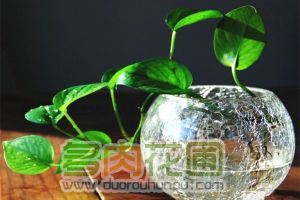
Materials to Prepare for a Pothos Bonsai
A fine vase: buying one at a flower shop costs too much money; it is better to go to a convenience store and buy a bottle of yogurt, pick a nice-looking bottle, and you can both drink the yogurt and grow the plant, getting two benefits in one.
Scissors: these are essential; when cutting pothos, it is best to use scissors, not your hands.
Someone else's pothos: it does not matter if you do not have your own, just a few leaves and stems will do.
Pretty stones: flower shops sell them; use them to decorate your vase.
How to Make a Pothos Bonsai
First, wash the prepared bottle clean and fill it with water for later use; two-thirds full of water is enough. Set it aside and let the water settle for a while.
Use scissors to cut a few stems and leaves from the pothos; be sure to choose ones with emerald-green leaves and tender buds on the stems, as they are easy to root.
Put the prepared small stones in the vase, but do not put in too many; a single layer spread across the bottom of the bottle is enough. They are very pretty in all colors, and these stones can also lock in the moisture in the vase.
Insert the pothos stems and leaves into the vase, change the water once every three days, and after they have rooted, change the water once a week.
If the plant is not growing well, you can go to a flower shop and buy some nutrient solution, and add a few drops every half month or month; then your pothos leaves will become emerald green. Placed on an office desk, it is full of oxygen.
Pothos Bonsai: A Tiny Potted Plant to Experience Spring Colors
When first growing pothos, most people plant it in pots, because pots are convenient to transport and will not dirty the indoors. Although growing pothos in pots is fine, everyone also needs to understand some knowledge about pothos bonsai; below, the editor of No. 1 Home Network introduces the relevant content.
The first requirement for growing pothos is the soil; try to get some soil from rural fields, then add some animal manure (such as chicken manure), and mix in as many dead leaves as possible, because pothos roots and stems prefer loose soil; in this way, the dead leaves can both serve as fertilizer and make the soil loose and breathable.
Everyone knows that for a newly renovated house, pothos is the first-choice plant. Because pothos is a very good air purifier, and pothos is easier to grow when the air is relatively humid. So pothos is generally suitable for growing indoors. Pothos does not like direct sunlight and cannot be kept in the sun for a long time; it can be placed in the sun at intervals to let it enjoy some sunlight.
Pothos likes water relatively much, so water it regularly. The amount of water should be enough to soak the roots thoroughly, and often use a spray bottle to spray mist-like water onto the leaves and the backs of the leaves to keep them moist.
You can plant a tree trunk in the pothos pot and let it grow upward along the trunk, or you can hang it in a higher place and let its vines hang down; I think this looks quite nice and adds a lot of charm to the home.
Take the hanging vines and cut off the stems and leaves with small fine roots to plant in a pot, or insert them into water, cultivate them carefully, and after some time, there will be another beautiful scene.
The pot size for a pothos bonsai needs to be changed frequently, because pothos grows very fast; if it is not changed often, it may not have enough space to grow, which will limit its growth and cause problems such as deformity. For more indoor plant knowledge, please pay more attention to No. 1 Home Network.