What to Do When Anthurium Leaves Turn Brown and Necrotic? Causes and Control Methods
The causes of browning and necrosis of the leaves of small anthurium seedlings may include two possibilities:
One is bacterial leaf spot disease. In the early stage of infection, water-soaked irregular brown to dark brown spots appear between the leaf veins, surrounded by yellow halos. In severe cases, the lesions merge into large spots, and the leaves wilt, curl, and hang on the short stems. Check the dead and rotting tissue. If it gives off an unpleasant fishy odor and is accompanied by yellow bacterial ooze, it can be confirmed as leaf spot disease caused by bacterial damage.
Control method: In the early stage of the disease, use 72% agricultural streptomycin sulfate soluble powder at 4000 times dilution, or medical streptomycin sulfate at 3000 times dilution, and spray the plants once every 7 to 10 days.
The second is fungal black spot disease, which often causes symptoms such as necrosis of leaf tissue, wilting, and rotting. The pathogen or its modified forms, such as small black spots and black mold, can be observed with the naked eye. It generally develops relatively slowly and mostly manifests as wet rot, without a fishy odor.
Control method: In the early stage of the disease, spray with 40% phosethyl-Al or iprodione wettable powder at 400 times dilution, or spray with 45% amobam aqueous solution at 800 times dilution, or spray with 75% chlorothalonil wettable powder at 1000 times dilution. The sterilization effects are all relatively good.
Measures to Prevent Anthurium Leaves from Turning Yellow
Anthurium, also known as flamingo flower, red flamingo lily, red spathe taro, lampstand flower, Anthurium andraeanum, etc., is a perennial flower of the genus Anthurium in the Araceae family. It is native to the tropical rainforests of Central and South America. Its flowers are bright and eye-catching, bloom continuously throughout the four seasons, are covered with a waxy layer, and have a long vase life. At first glance they look like artificial flowers. The flower form is unique and beautiful, and it is a famouspotted flowerand cut flower variety, deeply favored by consumers. However, during cultivation, it often grows poorly and develops yellowing leaves due to various factors.
1. Overwatering:Watering too much and too frequently will keep the potting medium too wet for a long time, or even waterlogged, causing some fibrous roots to rot, hindering normal respiration and nutrient absorption, and causing leaves to gradually turn yellow and fall off. Preventive measure: water normally.
2. Uneven fertilization:Too little fertilization, or not repotting or changing the soil for a long time, leads to a lack of nitrogen and other nutrients in the soil, causing weak branches and leaves, with thin and yellow leaves. In addition, excessive fertilization can also cause new leaves to become thick and uneven, while the tips of old leaves dry out and turn scorched yellow and fall off. At this time, fertilization should be stopped immediately, watering should be increased, and part of the old soil should be removed and replaced with new culture soil, followed by normal management.
3. Unsuitable temperature:If the indoor temperature is too low in winter, the leaves will turn yellow; if the room temperature is too high, the plant will transpire excessively, and the roots will not supply enough water and nutrients, which will also cause the leaves to turn yellow. Preventive measure: keep the temperature in the greenhouse relatively stable.
4. Unsuitable soil:In most areas of northern China, the medium and water contain relatively high levels of salt and alkali. Because the medium lacks the soluble iron that the plant needs to absorb, the leaves will gradually lose green color and turn yellow. Preventive measure: use oxalic acid, etc., to treat the medium and the water used for watering flowers.
5. Dry air:When the air indoors is too dry in winter when growing flowers, symptoms often appear such as dry and yellow leaf tips, scorched leaf margins, or scorched spots on the leaves and curled edges. Preventive measure: according to the growth characteristics of anthurium, appropriately increase air humidity.
6. Excessive shading: AnthuriumIf it is placed in a shaded area or a place with insufficient light for a long time, it will lead to weak growth, thin and yellow leaves, and no flowering or very little flowering. Preventive measure: according to the growth characteristics of anthurium, appropriately increase light intensity.
7. Damage from pests and diseases:Leaf spot disease caused by infection with fungi, bacteria, and other pathogens can easily cause local necrosis of leaves and yellowing of leaves; after infection by mosaic virus, yellow-green mottled patches will appear on the leaves; after damage by pests such as scale insects and red spider mites, the leaves will also become locally withered and yellow, or the entire leaf will wilt and fall off. Preventive measures: for fungal diseases, agents such as azoxystrobin, difenoconazole, and flusilazole can be used; for bacterial diseases, agents such as agricultural streptomycin can be used; for viral diseases, agents such as Virus A and Virus Special can be selected; for scale insects, agents such as methidathion can be selected; for red spider mites, abamectin and others can be selected for control.
What to Do If Anthurium Roots Rot and What Happens with Insufficient Light
Everyone likes anthurium quite a lot in daily life, and the flowers it blooms are red, which is very auspicious. But when growing anthurium, how does it end up developing root rot, yellow leaves, and insufficient light? What should be done about this?
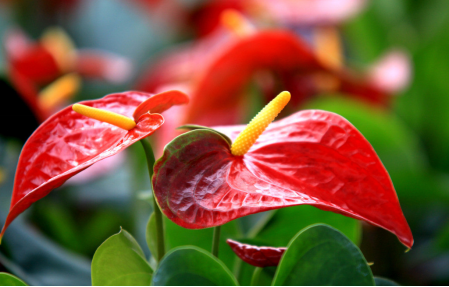
As an indoor potted plant, anthurium is a rare colorful variety, and its care is relatively simple. However, if you do not understand its habits well enough, it is easy for anthurium to develop various problems, such as leaf disease and yellowing, disease, or even direct death.
Anthurium is suitable for growing in a warm, humid environment with good drainage. It is afraid of drought and strong direct sunlight, but insufficient light will hinder flowering.
Anthurium has relatively high temperature requirements, and especially low temperatures can cause root rot. Below 10°C it will suffer cold damage, or even die.
Anthurium likes moisture but is averse to waterlogging. If water accumulates at the bottom of the pot, it will cause root necrosis, so it is necessary to choose loose and breathable potting soil.
If you kill anthurium by accident, that is also quite sad. The price of anthurium is still quite expensive, and few flowers can sell for this price. If the roots rot, you should check whether the anthurium soil is waterlogged. If there is insufficient light, just take it outside to get some sun.