What are the care tips for cyclamen? Master these key points
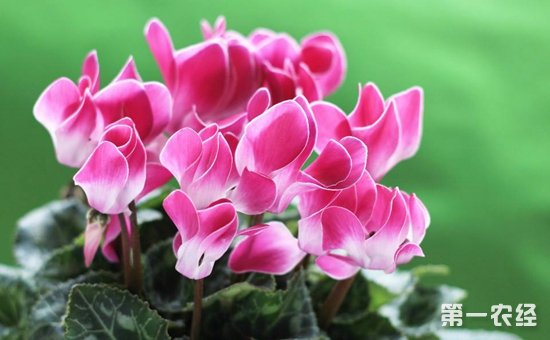
Cyclamen, also known as bunny ear flower and radish begonia, has bright colors, peculiar flower shapes and a long flowering period, and comes to market at New Year's Day and Spring Festival.
Cyclamen likes cool, humid conditions and dislikes high temperatures; the suitable growing temperature is 15-25°C. Too high a temperature easily causes leggy growth and rot, and during the dormant period the temperature should not exceed 30°C; it likes loose soil with good drainage and aeration. Its main care methods are:
1. Repotting and changing the soil. Every year in July to August, cyclamen enters dormancy and all its leaves drop off. After the weather turns cool in September, new buds sprout. At this time, it should be repotted and the soil changed in good time to loosen the soil, add fertility and replenish various trace elements. When changing the soil, take care to damage the new roots as little as possible; only remove the dead old roots, then soak the tuber in a 0.1% potassium permanganate solution for disinfection for 10 minutes, then place it in a 5-10 mg/L gibberellin solution to soak for 15 minutes, take it out, let it dry, and replant it in the pot. This can break dormancy and prompt it to wake up. When planting, it should be shallow rather than deep, so that 2/3 or 1/2 of the tuber sits above the surface.
2. Removing flowers and thinning leaves. Before the full flowering period, the 1-2 flower buds that open early must be removed in good time to prevent excessive consumption of nutrients. After autumn begins, it enters the peak growing season. At this time, the young leaves on the tuber will quickly grow into a dense cluster once they see light, causing the young buds below to delay development due to lack of light, so the leaves in the middle of the leaf cluster should be thinned appropriately.
3. Supplementing light, increasing humidity and keeping warm. During the peak growing season, sufficient light and suitable humidity and temperature are needed, especially after the flower buds form, when a suitable temperature must be guaranteed. The suitable temperature during the flowering period is 15-20°C. Since this is exactly the autumn and winter seasons, the pot must be moved into a warm shed for cultivation. To ensure flowering at New Year's Day and Spring Festival, a 100-200 watt incandescent bulb can be placed 80-150 [units omitted in source] from the plant to supplement light and raise the temperature. At the same time, water management must also be strengthened, that is, in addition to normal watering, spray clean water on the leaf surface once every 3-5 days to increase air humidity and keep the leaf surface clean.
4. Preventing and controlling pests and diseases. The main diseases are leaf rot, soft rot and gray mold. Their prevention and control methods: first, pay attention to improving cultivation and enhancing the plant's disease resistance; second, disinfect the potting soil and flower pots, and detoxify the seeds (tubers); third, when diseases are found, spray with 800 times captan solution, 100 times streptomycin solution, or 800-1000 times carbendazim. The main insect pests are aphids and mites. Omethoate emulsifiable concentrate at 1500 times can be sprayed to control aphids, and 40% dicofol at 1000-1500 times can be sprayed to control mites.
How to care for cyclamen? Key points of cyclamen care techniques for the four seasons
There is a fairy guest coming from the clouds. Cyclamen is a commonly grown flowering plant with a beautiful meaning, very suitable for indoor cultivation. However, cyclamen likes warmth and light, and is neither cold-tolerant nor high-temperature-tolerant, so the changes of the four seasons are a great challenge for cyclamen. To grow cyclamen well, care through the four seasons is indispensable. So, next let's introduce the key points of cyclamen care techniques for the four seasons.
Image; key points of cyclamen care techniques for the four seasons
I. Spring care for cyclamen
In spring, light and temperature are both quite suitable, making it a good time for cyclamen to grow. Generally in April of spring, flowering enters its final stage. At this time, repotting can be done, and the potting soil can be changed during repotting. The soil can be made by mixing leaf mold with garden soil, but it needs to be disinfected, and it is best to add a little base fertilizer.
As for fertilizing, it does not need to be too frequent. A compound fertilizer can be applied once in early May. For watering, keep the soil moist, and clean water is best.
II. Summer care for cyclamen
In summer, because the temperature is relatively high, the cyclamen plant may have already entered a semi-dormant state. At this time, ventilation needs to be maintained, and water should often be sprinkled on the plant and the ground to lower the temperature.
In summer, the light is strong, so shading needs to be done in good time. When the temperature is high and evaporation is great, water can be given once a week. Because growth becomes slow, it is best not to fertilize.
Image: key points of cyclamen care techniques for the four seasons
III. Autumn care for cyclamen
Autumn and spring are relatively similar, with mild light and suitable temperature, so autumn is also very suitable for cyclamen growth. Autumn is also a suitable season for repotting cyclamen.
In addition, as autumn progresses and gradually deepens, generally in October, cyclamen needs to be brought indoors for care, keeping the indoor temperature at around 15°C. For watering, just water when the soil is dry and let it dry between waterings. In summer, the old leaves and yellow leaves of cyclamen also need to be removed.
IV. Winter care for cyclamen
When winter comes, cyclamen begins to bloom. It is said that the temperature needs to be kept between 15°C——18°C, and at least not lower than 10°C. When growing it, be careful not to place the flower pot near a radiator. Do not water too frequently, and also pay attention to the water temperature; it is best if it is close to room temperature. Be careful not to pour water on the tuber.
In addition, because cyclamen consumes nutrients when flowering, nutrients need to be replenished in good time, and a balance of elements must be ensured. To make it flower well, more phosphorus and potassium fertilizer should also be applied.
The above is the full introduction to the key points of cyclamen care techniques for the four seasons. I hope it can be helpful to everyone!
Techniques for growing cyclamen indoors. Indoor cyclamen care
It rained moderately today, and I immediately felt the chill of early spring, but indoors it is still relatively warm, so the plants in our office should still be fairly satisfied with the temperature. Back to the point, today we are talking about the issue of growing cyclamen indoors.Cyclamen growth habits:
Cyclamen likes warmth and humidity, so when growing cyclamen indoors, it is essential to ensure that the environmental humidity and temperature are appropriate.
In winter and spring, indoors is relatively dry, and most places in the north have heating or air conditioning. If cyclamen is too close to heating equipment, humidity evaporates too much, which will still cause cyclamen to lack water;
In addition, too much watering will make the roots of cyclamen unable to breathe smoothly, or because the temperature is suitable for bacteria to reproduce and cause disease, it is also easy to decline and even die;
But if the indoor temperature is too low, it is also easy to freeze and kill the flowers.
So what should be done to grow cyclamen indoors?
1. Water must be controlled well, following the principle of watering as soon as it dries, and watering thoroughly when watering;
2. When watering, try to avoid splashing onto the flowers and leaves; water the roots;
3. Keep the indoor temperature well controlled between 10-25°C;
4. Try not to fertilize during the flowering period;
5. Keep a certain distance from heating and air conditioning.
Summary: When growing cyclamen indoors, especially in the north, it is essential to ensure the humidity of its living environment, otherwise it is very easy to cause cyclamen to lack water.