Clivia Growing Tips: How to Water and Fertilize
To grow Clivia well, watering and fertilizing are key. Clivia has well-developed fleshy roots that can store a fair amount of water. Too much watering easily causes root rot, while too little watering will affect new leaf growth, root development and flower stalk (scape) emergence. The amount of water given should be adjusted according to specific conditions. In general, the following principle can be followed: for small pots with small plants, high temperatures, good ventilation, fast evaporation and well-aerated soil, water more; otherwise, water less. Generally, water requirements are low during the seedling stage and high during the flowering period. In spring and summer, water more, generally once a day.
In autumn, water once every 1-2 days. In winter, when temperatures are low, water less, generally once every 5-7 days. When watering Clivia, do not wait until the potting soil is completely dry; water when it is half dry, so that the potting soil stays consistently moist top and bottom, which benefits its growth and development. For watering, magnetized water, rainwater, snow water and river water are better; tap water can also be used, but it should be stored for 2-3 days before use. When watering, it is best to use a watering can and spray evenly. Be careful not to let water get into the heart of the plant, to prevent heart rot and rot of the flower stalk. Any water that flows into the heart of the plant should be removed promptly. Newly repotted plants should not be watered immediately, to avoid infection of root wounds; wait 2-3 days and then water thoroughly.
Clivia likes fertilizer, but too much or too little fertilizer will affect its growth and flowering. With excessive fertilizer, new leaves easily turn yellow, and in severe cases the fleshy roots rot; with insufficient fertilizer, the leaves are narrow and thin, pale in color and lack luster, the flowers are small, and the flower color is not vivid. With reasonable fertilization, Clivia leaves are upright and emerald green, glossy, broad and thick, and the flowers are large and brightly colored. When fertilizing Clivia, the "light fertilizer, frequent application" method should be used, and never apply concentrated fertilizer or raw fertilizer. Spring is the peak growing season for Clivia, when nutrient requirements are relatively high. In addition to applying base fertilizer when repotting, during the growing period generally apply a thin cake fertilizer solution about once every 10 days to promote new leaf growth.
In summer, when the weather is hot, generally do not fertilize, to avoid root rot. In autumn, apply a thin fertilizer mainly based on phosphorus fertilizer once every 7-10 days, to help flower stalk emergence and flowering. If conditions permit, when the flower stalk is emerging, spray a 0.1% potassium dihydrogen phosphate aqueous solution, which can make the flowers large and brightly colored and increase the seed-setting rate. In winter, Clivia grows slowly and the root system's absorption capacity is weak, so fertilizing should generally be stopped; however, for some plants about to bloom and for seedlings, under room temperature conditions above 15°C, a liquid fertilizer can be applied once every 2 weeks to help flowering and seedling growth.
An Introduction to Clivia Growing Methods - How to Water Clivia
Clivia is a choice for many people growing flowers indoors. This flower is relatively easy to cultivate. First, choose good potting soil, and it can be placed near a window indoors, with fertilizer and water managed according to the temperature characteristics of each region. Below, let us look in detail at an introduction to Clivia growing methods and how to water Clivia.
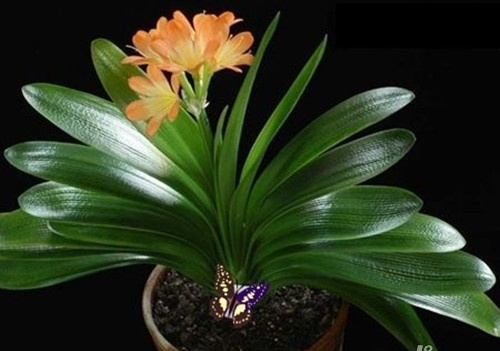
How to Grow Clivia
How to Grow Clivia - Shade from Sunlight
In summer, Clivia should be placed in a well-ventilated environment without direct strong light. Clivia is a medium-light flower, suitable for the soft light of spring and autumn, and not suited to harsh sun exposure. In summer, it is best to place the potted plant under a shade frame, with sunlight coming through the gaps of the shade frame so that the plant receives weaker light. If it can be placed in a spot that blocks direct sunlight at noon but still receives sunlight in the morning and evening, that is ideal. Generally, summer shading should reach 60%-70% or more.
How to Grow Clivia - Lower the Temperature and Increase Humidity
In summer, place Clivia in a ventilated spot. If the ambient temperature is above 35°C, water in the soil evaporates too quickly, causing Clivia's water and nutrient supply to fall short of demand. Therefore, it is best to place the Clivia pot on a water pool or water basin (raised on a wooden board), and frequently spray water around the plant and on the leaf surfaces to improve the temperature and humidity environment for Clivia, so that it can grow in a micro-environment below 25°C with humidity reaching 60%-70%, which helps it pass the summer safely and can promote Clivia's summer growth.
How to Grow Clivia - Water Moderately
Clivia originated in the primeval forests of South Africa, which led to its special characteristics in form and physiological function. Clivia has broad leaves with a tender texture, requiring relatively high soil water content and relatively high air humidity. In the hot summer, Clivia grows slowly and the root system absorbs little water, but the leaf surfaces evaporate a great deal of water. Therefore, Clivia must not lack water; otherwise the fleshy roots shrink, the leaf shape becomes thin and weak, and the plant loses its luster. When watering, adhere to the principle of watering when half dry, and watering thoroughly when you do water. But do not water as soon as the surface soil looks dry. Otherwise, if the potting soil remains wet for a long time, root rot and yellow leaves are very likely. When watering, be very careful not to let water run into the leaf heart, to avoid heart rot, which leads to "beheading."
How to Grow Clivia - Control Fertilization
In summer, temperatures are high, and Clivia is in a semi-dormant or dormant state. Therefore, fertilization should be controlled, and as little as possible or none should be applied. This is because during this period its root absorption capacity is weak; if fertilizer is applied, or applied slightly too much, the fertilizer accumulates around the root system for a long time and easily causes root rot and stem rot. However, during this period, if the temperature of Clivia's growing environment is lowered below 25°C, then some thin liquid fertilizer can be applied appropriately to promote its growth and shorten its dormancy period; if the temperature drops below 20°C and the humidity also meets the requirements, then fertilizer can be applied as usual.
Clivia Watering Methods
The temperature and humidity at home, the size of the flower pot, the permeability (aeration) of the flower soil, the season and other conditions all differ, so the watering interval should not be fixed as only one value. The length of the interval should be considered according to changes in the environment.
To judge whether it is time to water, I will tell you a few little tricks:
1. Tap. Lightly tap the pot at the 1/2 to 1/3 point. A crisp sound means the flower soil's water is already insufficient, so watering is needed. A dull sound means the water is sufficient and watering is not needed.
2. Weigh by hand. Before watering, lift the flower pot to feel its weight. Water. After watering, lift the flower pot again to feel the weight. Over time, with some experience, one lift of the pot tells you whether it is time to water.
3. Probe. This is the most direct method. Insert a finger about 1/3 into the flower soil to feel the moisture. If moist, no watering is needed. If wet, get ready to water. If there is still a slight dampness, it is time to water.
The above is the relevant introduction in this article. I believe that after reading it you also have a simple understanding of this. If needed, you can continue to follow No.1 Home Network to learn more information.
Clivia Watering Methods
[Common Questions] Clivia Watering Methods
[Expert Answer]
Image: Clivia
●Tips for judging whether Clivia needs watering:
1. Tap. Lightly tap the pot at the 1/2 to 1/3 point. A crisp sound means the flower soil's water is already insufficient, so watering is needed. A dull sound means the water is sufficient and watering is not needed.
2. Weigh by hand. Before watering, lift the flower pot to feel its weight. Water. After watering, lift the flower pot again to feel the weight. Over time, with some experience, one lift of the pot tells you whether it is time to water.
3. Probe. This is the most direct method. Insert a finger about 1/3 into the flower soil to feel the moisture. If moist, no watering is needed. If wet, get ready to water. If there is still a slight dampness, it is time to water.
4. Insert. Insert a chopstick at the edge of the pot. If there is visible water on the chopstick, no watering is needed; otherwise, watering is needed.
●How often should Clivia be watered?
Clivia has fleshy roots, and the root system has a certain water-storage capacity, so it is relatively drought-tolerant. But drought tolerance does not mean it can go without water. Improper dry-wet management is the main reason Clivia is not grown well. A soil water content of 15%-20% is relatively suitable; if the water content reaches 30%, then after a slightly longer time the roots will inevitably rot. Watering should be determined by the size of the seedling and the season and weather. Generally, in April and May, gradually increase from watering once every 2-3 days to once a day; after the beginning of autumn, gradually reduce from watering once every 1-2 days to once every 3-4 days.
●How much should Clivia be watered at one time?
The amount of water can be based on the following principles: for small pots with small plants, high temperatures, good ventilation, fast transpiration, vigorous growth and well-aerated soil, water more; otherwise, water less. Many people think that because Clivia easily rots at the roots, both watering and fertilizing should be kept to a small amount, which results in Clivia being short of water and fertilizer year-round and growing slowly. Experience has shown that Clivia must have "heavy water and heavy fertilizer," and one should not wait until the potting soil is completely dry before watering; water when the potting soil is half dry, so that the potting soil stays consistently moist. If the potting soil is too dry and cannot be watered thoroughly at one time, place the flower pot in a water basin, with the water depth at 1/3 of the flower pot. Let the potting soil soak slowly.
[Editor's Summary]
Clivia is a common ornamental flower in daily life, but in Clivia cultivation, watering is the hardest thing to master. A slight mistake easily causes Clivia root rot. The First Agricultural Economics editor has introduced to you in this article the tricks for judging watering, the watering time, and the amount of water, hoping it will be helpful to you.