How to grow a potted money tree? A detailed guide to cultivation methods
The money tree (P. aquatica Aubl.), also transliterated as Malabar chestnut from its English name Malabar chestnut, belongs to the Malvaceae family as a perennial evergreen large tree, native to Mexico, Venezuela and other places, with an upright main trunk, whorled branches, and palmately compound leaves with 5 to 7 leaflets, the leaflets being oblong to obovate with long petioles. The flowering period is from May to November, the flowers are white-green with 5 petals, large and beautiful, with slender filaments; after flowering it produces slender oval capsules, the fruit is hard with 5 longitudinal lines and contains 10 to 20 seeds, and the seeds taste like peanuts after being roasted, hence the name "American peanut". In recent years it has developed from a fruit tree into a popular indoor ornamental plant worldwide, and it is extremely sought after in the flower and tree markets of the south.
The main ornamental value of the money tree lies in its thick stem circumference and flat-spreading leaves; whether for garden landscaping or household display, it has a very exotic flavour, generous yet elegant. Its vitality is extremely strong and it grows easily. The author once bought more than ten trees from Hainan, protecting the roots with only wet straw and mud, and after being left aside for half a month during the journey they still grew vigorously when planted; rooting is also very easy, and if all the leaves and roots are cut off leaving only the branches and trunk, they will not wither even after being left for a week. Although the money tree is easy to manage, if it is not managed properly the results will be half the effort for double the work, so the following points should be noted when growing a money tree:
It is not demanding about light, and can grow well in full sun, half-day sun or shade. Indoors it can be placed in any corner, but the direction of the pot should be turned often to avoid the phototropic response affecting its shape.
It likes a warm climate, with an optimum growing temperature of 15°C to 30°C, and should not go below 5°C when overwintering. Because household plants are not old enough, they rarely flower.
Generally it is not strict about soil, and sandy loam that drains well and is rich in humus is best. Garden soil, decomposed organic matter and river sand can be mixed in a 2:1:1 ratio as potting soil.
Watering should be done just enough to keep the potting soil evenly moist; in summer water once every 2 to 3 days, in spring and autumn once every 4 to 5 days, and you can also spray water on the roots and stems daily.
In addition to base fertilizer, apply a top dressing once every 2 to 3 months; organic fertilizer or compound fertilizer is better. During the growing season there is no need to apply nitrogen fertilizer to prevent excessive growth; applying more P and K fertilizer can strengthen the plant, making the stem circumference plump and full and improving its ornamental value.
Cuttings are rarely used for propagation; generally it is grown from seed. The specific method: sow mature fresh seeds in a seedbed, maintain the temperature, and they will germinate after 7 to 10 days; transplant the seedlings when they grow to 3 to 5 leaves, and plant them shallowly in pots with the swollen roots exposed. The branches can be tied and shaped, commonly with three to five stems braided together, and the branches can be braided into unusual shapes, with the stems at varying heights and the leaves kept in distinct, well-arranged layers.
For potted plants, pruning and repotting should be done once every 1 to 2 years, and care should be taken not to let the weak top shoots grow excessively, otherwise the whole plant will be weakened and the roots and stems will not be thick. Yellowing leaves should also be removed promptly so as not to affect the ornamental effect. The pot diameter should be increased year by year, and fertilizer and new soil should be added to promote growth. In summer watch out for scale insect damage; during the peak hatching period of the larvae, spray 50% dichlorvos emulsifiable concentrate at 600 to 800 times dilution or 40% omethoate emulsifiable concentrate at 1000 times dilution, and the insects can also be scraped off in combination with pruning.
What are the cultivation methods for a potted money tree and what points should be noted
When it comes to the potted money tree, many businesspeople take a great interest in it, because the potted money tree symbolizes wealth. The method of growing a potted money tree is relatively simple, and its adaptability is also very strong. So, what are the cultivation methods for a potted money tree? What points should be noted?
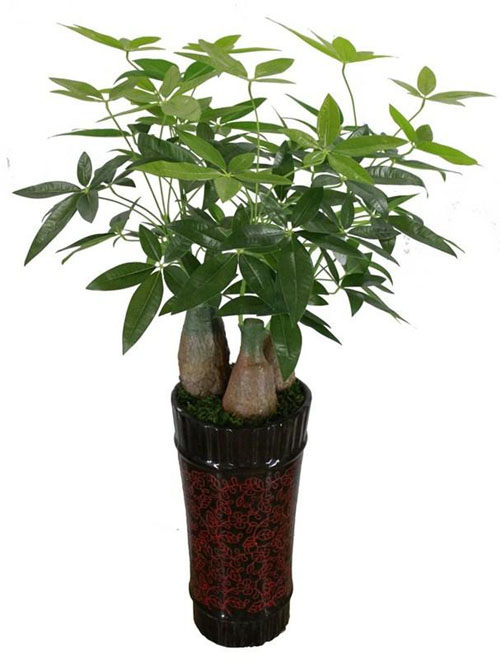
The main methods and points to note for a potted money tree are: during the growing period keep the potting soil moist, and do not water until it dries; its swollen stem can store a certain amount of water and nutrients. The pot should drain freely, and it is better to keep it dry than wet; it must not be waterlogged, because if there is too much water and it accumulates, growth will be poor or the roots and stems will rot. But the soil should not be too dry either, especially on clear days when the air is dry, when appropriate spraying is needed to keep the leaves oily green and glossy.
During the growing period, apply diluted decomposed manure water or organic nitrogen, phosphorus and potassium fertilizer, or compound fertilizer, once or twice a month; for general indoor ornamentals, fertilizing is not necessary. However, apply compound fertilizer in the pot once every 1 to 2 months, about 6 to 8 grams per pot, and diluted application is best; avoid concentrated fertilizer, and apply more phosphorus and potassium fertilizer to make the stem swell. Alternatively, spray fertilizer on the leaves once or twice, using Green Vigor + Plant Treasures + 0.2% monopotassium phosphate, to make the leaves thick and dark green; spraying once every 10 to 15 days can keep the leaves green and glossy. In winter it should overwinter in a warm, shaded place, the temperature should not be lower than 5°C, the soil should not be too dry, and on clear days when the air is dry, spray appropriately. In spring, prune the branches and leaves once to encourage new growth.
The money tree is highly adaptable, liking light yet tolerating shade, and grows well in full sun, half-day sun or shade. But if grown in a dark place for a long time, its vigour will decline. In early summer it is best to shade it by 50%, so that strong sunlight does not scorch the leaf tips and margins. For indoor ornamental cultivation, it should be placed where there is some scattered light, and it should not be kept there continuously for more than 30 days; if it shows signs of declining vigour and excessive growth, it should gradually be exposed to sunlight, and must never suddenly be exposed to strong light, to prevent it dying from not adapting.
The above is an introduction to the relevant cultivation methods for a potted money tree; we hope the above content is helpful to you.
How to grow a small potted money tree: cultivation methods for a small potted money tree
The money tree is a plant everyone likes to grow. Besides large potted money trees, there are also small potted ones. If we consider only habit, the small potted money tree is the same as the large one, with a growing temperature between 18 and 30°C. Next, the editor of Shengduoduo Decoration Network will give everyone a detailed introduction to the cultivation methods for a small potted money tree.In fact, caring for a small potted money tree is simple yet highly difficult. When you first buy it and casually spray a little water, it looks fine, but after a long time you will find that the money tree gets worse and worse and the roots begin to rot. Although watering is already well controlled, the roots still wither and rot. This is mainly because, firstly, the money tree's root system is extremely underdeveloped, and secondly, the pot easily accumulates water, ultimately causing the roots to wither and rot. Below is a summary of several key points for money tree care:
Temperature: For growing a small money tree indoors, the minimum winter temperature needs to be kept at 15-18°C; below this temperature the leaves turn yellow and fall off, and below 10°C it easily dies. Note here that temperature alone is not enough; moderate ventilation is also needed.Light: The money tree is a strongly sun-loving plant and is grown in the open ground in Guangdong and other places, but the small money tree has fairly strong shade tolerance and can be enjoyed indoors in a place with weak light for 2-4 weeks in a row, after which it should be placed in a place with strong light.
Water: The small money tree needs sufficient water during the high-temperature growing period, but it has fairly strong drought tolerance and will not suffer if not watered for several days; however, water accumulation in the pot must be avoided, and watering should be reduced in winter. In short, water less and spray more.
Repotting: For repotting a small money tree, it can be repotted in spring as needed.