How to Propagate a Money Tree? A Detailed Guide to Common Propagation Methods
The money tree, also known as Malabar chestnut, is a tropical evergreen small tree of the Bombacaceae family, native to Mexico in Central America. It prefers warmth and was originally cultivated as a fruit tree, but since flowering and fruiting are unreliable, in China it is mainly grown as a landscaping and ornamental plant. It is a sun-loving plant and drought-tolerant. Its shade tolerance is also extremely strong, making it a good indoor ornamental plant. The plant has strong plasticity and can be trained into different shapes as needed, such as single-trunk, braided, mini, and bonsai types.
The money tree is mainly propagated by sowing. Ripe seeds collected are best sown within 2 days, and the suitable germination temperature for the seeds is 22-26°C; they sprout 3-4 days after sowing. After 6-12 months, seedlings are selected according to plant height to produce braided money trees of different heights (60-150 cm). After braiding, they are planted out in deep, well-drained loam, and some barnyard manure can be mixed in at planting. After planting, apply topdressing once every 2-3 months.
The suitable temperature for money tree growth is 20-30°C. Low temperatures below 10°C easily cause leaf drop, so in China field planting is more suitable in Hainan and the Zhanjiang area of Guangdong, and it can be promoted as a water-saving agricultural project. Generally, it can be harvested after 1-2 years of planting. At harvest, cut off the branches and leaves and store and transport by grade; the storage and transport temperature is 15°C in winter and spring, and 20°C in summer and autumn. The harvested money trees are semi-finished products and need to be potted, and only after regrowing branches and leaves can they be sold on the market.
Money Tree Propagation Methods and Money Tree Propagation and Care Management
Because of its tenacious vitality, unique ornamental value, and auspicious name, the money tree is very popular. Below, I will share with you the money tree propagation methods and money tree propagation and care management.
Money tree propagation methods:
Money tree propagation methods are generally divided into three types: seed propagation, cutting propagation, and grafting propagation.
1. Money tree seed propagation
Seed propagation of the money tree is one of the most common and simplest propagation methods. The reasons for using seed propagation are: the seedlings are uniform, the roots are straight and the seedlings are neat, the number of seedlings produced is large, and the thick "radish-head" shape can develop at the lower part, improving the ornamental value.
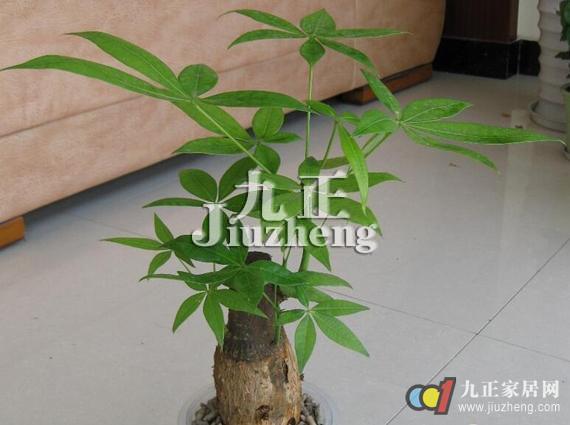
2. Money tree cutting propagation
For money tree cutting propagation, it can be done year-round in the south, and from May to August in the north. Cut the severed shoot tips and branches into 10-15 cm lengths and insert them into coarse sand, but this has the disadvantages of no swelling at the base and no straight growth. The money tree grows rapidly, and after a period of growth, the branches often become too long, affecting the ornamental effect. Generally, overly long branches can be shortened at any time during the growing period, or shortened in spring along with cutting propagation, to maintain a good plant shape. Money tree cutting propagation is easy to root, but after the propagated seedlings grow up, the root crown does not thicken and swell, and the ornamental value is poor, so it is rarely used.
3. Money tree grafting propagation
The money tree generally flowers and sets fruit 8 years after sowing. If you want it to flower and fruit earlier, you can choose 2-year-old braided seedling rootstocks as the rootstock, and select 1-year-old vigorous branches from trees that have already flowered and fruited as the scion. In mid-to-late February, using the cleft grafting method, the survival rate reaches 80%. After grafting, the money tree flowers the following year, which can advance flowering and fruiting by 5 years.
Money tree propagation and care management:
The money tree is not strict about light and can adapt to strong sunlight or low-light rooms; it is best grown in a shade shed. During the peak growing period, apply 1-2 cm of decomposed cake fertilizer per pot, then cover with 1 cm of growing medium. Applying an appropriate amount of multi-element compound fertilizer and phosphorus-potassium fertilizer helps the stem base swell. It is relatively cold-tolerant; when watering, it is better to keep it dry than wet. The high temperature and high humidity of summer are very favorable to the money tree, and this is the period of fastest growth. In winter, it must not go below 5°C, and it is best to maintain 18-20°C. Use a moderate amount of water in the growing season, water less in winter, water only when dry and let it dry between waterings, and frequently spray the leaves to keep them moist, and it will grow vigorously.
How to Propagate a Money Tree, Money Tree Propagation Methods
The money tree is a potted indoor plant grown for its stems and foliage. It is artificially processed into three-braid or five-braid forms and has high ornamental value. Money trees are generally produced in southern regions, while they are relatively rare in the north. Therefore, I provide you with a sand-culture softwood cutting method so that money trees can be successfully grown in the north. Below, I will introduce it to you:
1. Seedbed preparation
Choose a nursery site with deep, fertile soil, and make a bed surface 1 m wide; the length depends on the quantity. A north-south orientation is preferable. Deeply plow the bed surface, remove the topsoil, and tamp it firm. Lay a 3 cm thick layer of gravel on the lower layer, and on top spread 10 to 15 cm of fresh river sand and furnace slag. The moisture level should be such that it forms a ball when squeezed in the hand and crumbles when released. Spray the bed surface with 40% formalin at 400 times dilution, soaking to a depth of 3 to 5 cm, and cover with plastic film for 3 days to disinfect the soil.
2. Cutting collection
Select vigorous semi-lignified branches of the current year, and cut them on a cloudy day or a windless morning. Cut them to a length of 6 to 7 cm, with the lower cut made at a slant below a leaf or axillary bud. The cut should be smooth to favor callus formation. Generally, each cutting should carry two palm leaves; be careful not to damage the leaves, so as to favor photosynthesis.
3. Fine cutting
Money trees are cut from late June to early August. Choose cloudy summer days or early morning or late evening, and insert the cuttings as soon as they are cut. When cutting, place half of the cutting in No. (I) ABT rooting solution at 25M and soak for 20 to 24 hours, then remove and rinse clean with water. Use a small wooden stick to make holes in the bed surface, then insert the cuttings along the holes, and seal and press the holes firm. Shorter cuttings can be inserted straight, and longer cuttings can be inserted at an angle. The insertion depth should be enough that they do not topple over, generally 3 to 5 cm. After inserting, water thoroughly in time, straighten any tilted cuttings, and cover well with plastic film.
4. Seedling stage management
After cutting, ventilate once every 3 days. From June to August, temperatures are high and water evaporates quickly, so spray water once in the morning and once in the evening. Keep the temperature between 23 and 25°C and the humidity at about 80% of field water capacity. To promote lignification of the seedlings, spray 0.2% potassium dihydrogen phosphate before the end of August. To prevent fungal infection, spray the bed surface once every 7 days with thiophanate-methyl or carbendazim. Generally, callus tissue forms in about 15 days, and rooting begins in about 30 days.
5. Seedling transplanting
Before potting the seedlings, first prepare nutrient soil by mixing 3 parts leaf mold, 1 part sand, and 2 parts garden soil, then plant. When transplanting, be careful not to damage the roots. The depth should be based on the original base of the plant. After planting, water thoroughly and place in a shaded area, avoiding direct sun exposure. Afterward, water daily according to the condition of the potting soil, following the principle of watering only when dry and letting it dry between waterings.
The money tree propagation methods I have provided above have the advantages of fast propagation speed, high survival rate, and saving time and labor. I hope you will act quickly and give it a try!