What are the key points for attention in cultivating and caring for the money tree
The money tree, also known as Malabar chestnut, Guava chestnut, etc., is an evergreen tree of the Bombacaceae family. It was first introduced to Taiwan, China as a fruit tree, but it turned out that "planting flowers with care yields no blooms." Yet "a careless willow shades all," and as a fruit tree it was not widely promoted, but as a potted ornamental it became very popular, and was soon exported to Japan and South Korea. In the 1990s it poured into the mainland in large quantities. With its graceful, slender bearing and its trunk like a coiled dragon, it is beautiful and elegant, standing out uniquely. Coupled with a good name implying "great fortune and prosperity, wealth rolling in," it is welcomed by people from all walks of life, and quickly became widespread on the mainland, widely cultivated.
The money tree is native to Mexico, Venezuela and other places. It likes warmth and humidity, with a suitable growing temperature of 20-32°C, and the overwintering temperature must not be lower than 5°C. It likes sunlight but fears scorching sun; it is drought-tolerant and also fairly shade-tolerant, and is not strict about soil, suitable for placement in various indoor settings. Money tree seeds are large, like chestnuts, so spot sowing is used, with a substrate made of half vermiculite (or garden soil) and half peat. Under suitable temperature conditions, germination occurs 7-10 days after sowing.
When the seedlings grow 3-5 leaves, they should be transplanted into pots. Plants propagated from seed-grown seedlings have a swollen base of the stem, giving high ornamental value, but at present they rarely set seed domestically. At home, cuttings can be used for propagation, but the stem base of cutting-grown plants does not swell, which is a slight flaw. Cuttings are generally taken in combination with pruning, selecting plump young branches about 20 cm long with 3 buds, inserted into sand or vermiculite, shaded and kept humid; at 20-25°C, roots form in about 3-4 weeks. Money tree plants are generally rather tall, so to prevent them from being top-heavy, when potting or repotting, choose a larger plastic pot, usually with a diameter of 25 cm and a depth of 30-35 cm.
For placement in the home, a plant height of around 1.5 m is more suitable; if too tall, it will instead look oppressive in the home. Repot once every 2 years, carried out in April when moving it outdoors. Since the plant continuously grows larger and thicker, when repotting it is advisable to switch to a pot one size larger, and remove dead roots and part of them. The potting soil uses 3 parts garden soil, 1 part river sand, 1 part wood shavings, plus a small amount of soybean cake as base fertilizer. When potting, plant it shallowly; do not bury the swollen root base in the soil. When moving it outdoors, overwintering-damaged branches can be boldly pruned; if the plant is too tall, it can also be heavily pruned to reduce the height. Its sprouting ability is very strong, so do not fear that new branches and leaves will not emerge after pruning. (Money tree cultivation methods and points for attention)
For a multi-stemmed money tree, the stems can be pruned so they are slightly staggered, so that after sprouting the branches and leaves are clearly layered and the crown shape is fuller. After moving outdoors in April, as the temperature rises, sprouting and growth accelerate, and the amount of watering increases accordingly, but how much to water depends on the weather and the placement location. The money tree trunk stores a lot of water, so it has strong drought tolerance. When the potting soil is too dry, old leaves will turn yellow and drop, but it will not die; at this time water promptly. Generally, in places with good light such as a balcony, water once every 1-2 days in April-May.
After June, move it to a semi-shaded place until September, otherwise under strong light the leaf edges will scorch and the leaf color will fade from green to pale. During this period, not only must water be sufficient, but water should also be sprayed on the leaves to increase air humidity and keep the leaves clean. In addition, alternately apply topdressing such as urea and potassium dihydrogen phosphate, 1-2 times a month, until stopping in October, which helps the stem base swell.
If it is placed in an indoor corner, where light and ventilation are poor, when watering pay attention to checking whether the potting soil is dry or wet, and follow the rule of not watering until dry. According to practice, even in summer watering once a week is enough, and in spring and autumn the watering interval should be longer. Many homes now have wooden floors, so watering requires special care; otherwise excess water will overflow from the saucer and soak the floor. In addition, too much water standing in the saucer is also harmful: water will continuously be drawn into the potting soil through capillary action, and the potting soil will remain moist all the time, which is unfavorable for root growth. In severe cases the plant will suffer root rot and die, and this point is often overlooked.
Too strong sunlight in summer is unfavorable to the money tree, but too weak light in corners such as the living room is also not good. In places with insufficient light, the sprouted branches are thin and weak, and especially long, ruining the original tree shape. If conditions permit, place it as close to a window as possible or regularly (about every half month) take it to the balcony to receive light. On the other hand, it can be tidied up by pruning to keep the crown neat rather than messy, while also promoting branching so the crown becomes fuller.
In late October, outdoor money trees should be moved indoors to a sunny spot. If the branches are too dense, some can be thinned appropriately for easier storage. In winter, it is best to keep the room temperature above 10°C; below 5°C the leaves will freeze, and especially the cold wind from gaps in doors and windows at night is most harmful to the money tree's safe overwintering. You might as well wrap the plant in a large plastic bag, which can effectively protect it from the cold. In winter, when watering, better dry than wet; just keep the soil slightly moist. If the points for attention in money tree cultivation and care still cannot meet your requirements, you can also look at how to grow a money tree well.
Money tree cultivation How to grow a money tree? The complete guide to money tree cultivation and care methods
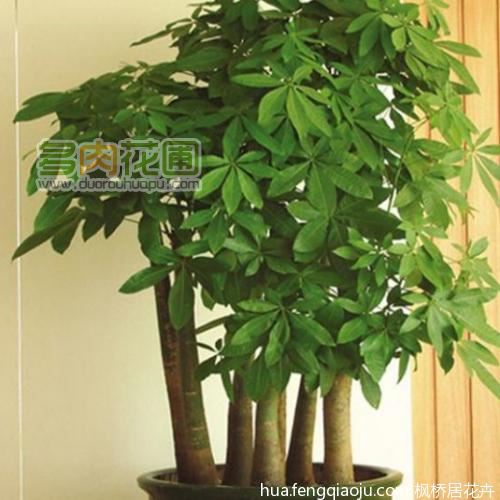
Money tree pictures and information: http://hua.fengqiaoju.com/?album-read-id-715.html
If you want the money tree to grow well, besides watering, you must also ensure a supply of fertilizer. When fertilizing the money tree, just master the principle of light fertilizer applied frequently. For example, for a money tree planted in a flower pot with a diameter of 20 cm, if applying biological fertilizer, only 20 grams at a time is enough; if applying chemical fertilizer, mix it at a ratio of 3 per thousand and pour it into the pot. The method of spraying fertilizer on the leaves can also be used. Fertilize once about every 20 days.
Finally, pay attention to creating a ventilated environment for the money tree. If it is not ventilated for a long time, the money tree is prone to pests.
Malabar chestnut, also called Guava chestnut, money tree. It is an evergreen small tree of the Bombacaceae family. Native to Mexico and Costa Rica. Palmate leaves, with 7-11 leaflets, oblong to obovate. There is a horticultural variety, the variegated money tree. Because the name money tree is deeply welcomed by merchants and ordinary citizens, plus its beautiful plant shape, bright green leaf color, and hammer-shaped trunk, it is suitable for indoor arrangement and beautification after potting, so in recent years it has developed very quickly in China's flower market. During festivals, hotels, restaurants, merchants and citizens all rush to buy it, seeking good luck and good fortune.
Key points for money tree cultivation
1. Temperature. The minimum winter temperature is 16-18°C; below this temperature the money tree's leaves turn yellow and drop; below 10°C the money tree easily dies.
2. Light. The money tree is a strongly sun-loving plant, and is grown in the open ground in places such as Hainan Island. But the money tree has fairly strong shade tolerance, and can be enjoyed indoors in a place with weak light for 2-4 weeks in a row. Then place it in a place with strong light.
3. Water. The money tree needs sufficient water during the high-temperature growing period; but its drought tolerance is fairly strong, and it will not be harmed if not watered for several days. The money tree must never have standing water in the pot; reduce watering in winter.
4. Air temperature. During the growing period it likes higher air temperature; a small amount of water can often be sprayed on the leaves.
5. Repotting the money tree. It can be repotted in spring as needed.
The hand tree, commonly known as the money tree, is an evergreen shrub or small tree of the genus Pseudopanax in the Araliaceae family, with an upright stem, large alternate leaves, long petioles, palmately compound leaves, with 9-12 leaflets, each leaflet 12-15 cm long and about 6 cm wide. Because its tree shape and leaf shape are peculiar and its common name is auspicious, and because it is taken to signify good omens, recently more and more people have introduced and cultivated it.
This flower is native to Australia and some islands in the Pacific Ocean. It is suited to a warm, humid, well-ventilated environment, likes sunlight, and is also slightly shade-tolerant, growing best in loose, fertile, well-drained soil.
Potted money trees should be repotted once every 1-2 years, carried out in spring when moving them outdoors, and necessary pruning should be done on yellow leaves and thin, weak branches to encourage new shoots. Watering should follow the principle of alternating dry and wet. In spring and autumn, adjust the watering frequency according to sunny or rainy weather and dry or wet conditions; generally water once a day, and when the temperature exceeds 35°C, water at least twice a day. During the growing season, fertilize twice a month. For newly grown leaves, also pay attention to spraying water to maintain higher environmental humidity; from June to September, shade is needed, maintaining a light transmission rate of 60%-70% or placing it in a spot with bright scattered light. After moving indoors in winter, the temperature should not be lower than 5°C; keeping it around 10°C is better. Water once every 5-7 days, and ensure fairly sufficient light. In addition, during the growing season, if ventilation is poor, red spider mites and scale insects are likely to occur, so observe carefully. When pests are found, remove them promptly or spray pesticide.
How to grow a money tree? The complete guide to money tree cultivation and care methods
Money tree pictures and information: http://hua.fengqiaoju.com/?album-read-id-715.html
If you want the money tree to grow well, besides watering, you must also ensure a supply of fertilizer. When fertilizing the money tree, just master the principle of light fertilizer applied frequently. For example, for a money tree planted in a flower pot with a diameter of 20 cm, if applying biological fertilizer, only 20 grams at a time is enough; if applying chemical fertilizer, mix it at a ratio of 3 per thousand and pour it into the pot. The method of spraying fertilizer on the leaves can also be used. Fertilize once about every 20 days.
Finally, pay attention to creating a ventilated environment for the money tree. If it is not ventilated for a long time, the money tree is prone to pests.
Malabar chestnut, also called Guava chestnut, money tree. It is an evergreen small tree of the Bombacaceae family. Native to Mexico and Costa Rica. Palmate leaves, with 7-11 leaflets, oblong to obovate. There is a horticultural variety, the variegated money tree. Because the name money tree is deeply welcomed by merchants and ordinary citizens, plus its beautiful plant shape, bright green leaf color, and hammer-shaped trunk, it is suitable for indoor arrangement and beautification after potting, so in recent years it has developed very quickly in China's flower market. During festivals, hotels, restaurants, merchants and citizens all rush to buy it, seeking good luck and good fortune.
Key points for money tree cultivation
1. Temperature. The minimum winter temperature is 16-18°C; below this temperature the money tree's leaves turn yellow and drop; below 10°C the money tree easily dies.
2. Light. The money tree is a strongly sun-loving plant, and is grown in the open ground in places such as Hainan Island. But the money tree has fairly strong shade tolerance, and can be enjoyed indoors in a place with weak light for 2-4 weeks in a row. Then place it in a place with strong light.
3. Water. The money tree needs sufficient water during the high-temperature growing period; but its drought tolerance is fairly strong, and it will not be harmed if not watered for several days. The money tree must never have standing water in the pot; reduce watering in winter.
4. Air temperature. During the growing period it likes higher air temperature; a small amount of water can often be sprayed on the leaves.
5. Repotting the money tree. It can be repotted in spring as needed.
The hand tree, commonly known as the money tree, is an evergreen shrub or small tree of the genus Pseudopanax in the Araliaceae family, with an upright stem, large alternate leaves, long petioles, palmately compound leaves, with 9-12 leaflets, each leaflet 12-15 cm long and about 6 cm wide. Because its tree shape and leaf shape are peculiar and its common name is auspicious, and because it is taken to signify good omens, recently more and more people have introduced and cultivated it.
This flower is native to Australia and some islands in the Pacific Ocean. It is suited to a warm, humid, well-ventilated environment, likes sunlight, and is also slightly shade-tolerant, growing best in loose, fertile, well-drained soil.
Potted money trees should be repotted once every 1-2 years, carried out in spring when moving them outdoors, and necessary pruning should be done on yellow leaves and thin, weak branches to encourage new shoots. Watering should follow the principle of alternating dry and wet. In spring and autumn, adjust the watering frequency according to sunny or rainy weather and dry or wet conditions; generally water once a day, and when the temperature exceeds 35°C, water at least twice a day. During the growing season, fertilize twice a month. For newly grown leaves, also pay attention to spraying water to maintain higher environmental humidity; from June to September, shade is needed, maintaining a light transmission rate of 60%-70% or placing it in a spot with bright scattered light. After moving indoors in winter, the temperature should not be lower than 5°C; keeping it around 10°C is better. Water once every 5-7 days, and ensure fairly sufficient light. In addition, during the growing season, if ventilation is poor, red spider mites and scale insects are likely to occur, so observe carefully. When pests are found, remove them promptly or spray pesticide.