How to encourage anthurium to sprout for division? Mastering these methods is key
The anthurium grows vigorously and flowers normally, but no shoots have emerged from the base, so division propagation cannot be carried out. How can it be prompted to produce basal shoots?
First, before growth begins in spring, use a slightly smaller flowerpot to limit the plant's vegetative growth and encourage it to produce shoots at the root crown, making division propagation easier.
Second, artificially damage the plant's growing point - the terminal bud. After its spathe has withered, pierce the growing point with a thicker veterinary needle, or cut off the terminal bud with a sharp knife. These two measures can effectively promote the sprouting of shoots at its base. Note that the wound from artificially piercing or cutting off the growing point must never come into contact with dirty water, to prevent the wound from rotting, which would cause the shoot promotion to fail or part of the plant to die.
When the induced young shoots have grown 2 to 3 leaves, combine this with repotting by removing the mother plant from the pot, cutting off the daughter plants with a small knife, and potting them separately. For some species with many stem nodes, since aerial roots can form at each node, 3-4 leaves can be used as one cutting unit. To promote lateral buds to sprout from the lower leaf axils, several days before cutting the stem node, make a preliminary cut 0.5 cm deep to encourage new buds to sprout early from the leaf axils above the cut; for more upright species, cutting propagation can be carried out.
How to encourage anthurium to sprout for division
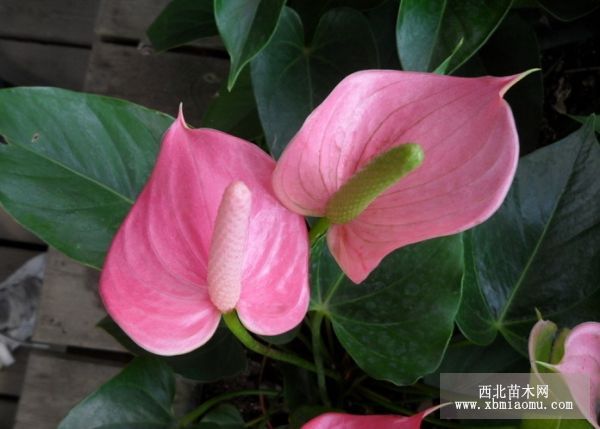
Anthurium, formerly named: flamingo lily (scientific name: Anthurium andraeanum), is a perennial evergreen herbaceous plant of the Araceae family and Anthurium genus. It is a famous cut flower. Native to the tropical rainforests of southwestern Colombia in South America. Height 40~50cm. Stemless. Leaves bright green, long elliptic-cordate, with long four-angled petioles. Flower stems rise above the leaves; spathe broad cordate, with a wavy surface and various colors; spadix yellow, upright. Flowers year-round. There are many cultivars, such as 'Dense-leaved Anthurium', 'White Anthurium' and 'Red Anthurium'. Growth room temperature 20~30°C, growth stops at 10°C. Not tolerant of dryness, requires 80% relative humidity. Medium-sized potted flower; can last half a month in water, making it a high-grade cut flower.
World scientific research on anthurium has already reached a relatively in-depth stage, with Europe at a higher level, Asia next, and Africa poorer. The Netherlands holds a leading position in systematic research on anthurium. China began introducing and cultivating it in the 1970s.
How to encourage anthurium to sprout for division
First, before growth begins in spring, use a slightly smaller flowerpot to limit the plant's vegetative growth and encourage it to produce shoots at the root crown, making division propagation easier.
Second, artificially damage the plant's growing point——the terminal bud. After its spathe has withered, pierce the growing point with a thicker veterinary needle, or cut off the terminal bud with a sharp knife. These two measures can effectively promote the sprouting of shoots at its base. Note that the wound from artificially piercing or cutting off the growing point must never come into contact with dirty water, to prevent the wound from rotting, which would cause the shoot promotion to fail or part of the plant to die. When the induced young shoots have grown 2 to 3 leaves, combine this with repotting by removing the mother plant from the pot, cutting off the daughter plants with a small knife, and potting them separately. For some species with many stem nodes, since aerial roots can form at each node, 3 to 4 leaves can be used as one cutting unit. To promote lateral buds to sprout from the lower leaf axils, several days before cutting the stem node, make a preliminary cut 0.5 cm deep, so that new buds can sprout early from the leaf axils above the cut; for more upright species, cutting propagation can be carried out.
How to divide anthurium with illustrations
How to divide anthurium 1. Remove the mother plant from the potFirst, be sure to pour a small amount of water into the flowerpot, mainly to make the soil clinging to the pot wall separate from the original pot, then take the anthurium mother plant out of the original pot together with the soil, remembering to remove it by turning the pot upside down.
You need to support the upside-down plant and pot soil with one hand, and with the other hand insert your fingers into the drainage hole at the bottom of the pot and pull upward, so the plant can be easily taken out without damaging it.
2. Remove old soil from the rootsAfter removing the anthurium from the pot, place the anthurium plant together with the pot soil on the ground, then gently scrape away the moistened soil around the plant. During the operation, be careful to avoid damaging the anthurium's root system. Of course, tools can be used to help clean the soil.
3. Division methodAfter pulling off most of the soil clinging to the anthurium mother plant, the root system is basically exposed. Remember to straighten out the root system and divide the anthurium, splitting the mother plant into several divided seedlings. During the division process, be careful to avoid damaging the plant.
4. Potting and transplanting the divided anthuriumRemember to choose robustly growing young plants for transplanting, as the survival rate is high. After selecting the divided anthurium seedlings, transplant them according to the normal potting method for potted plants.