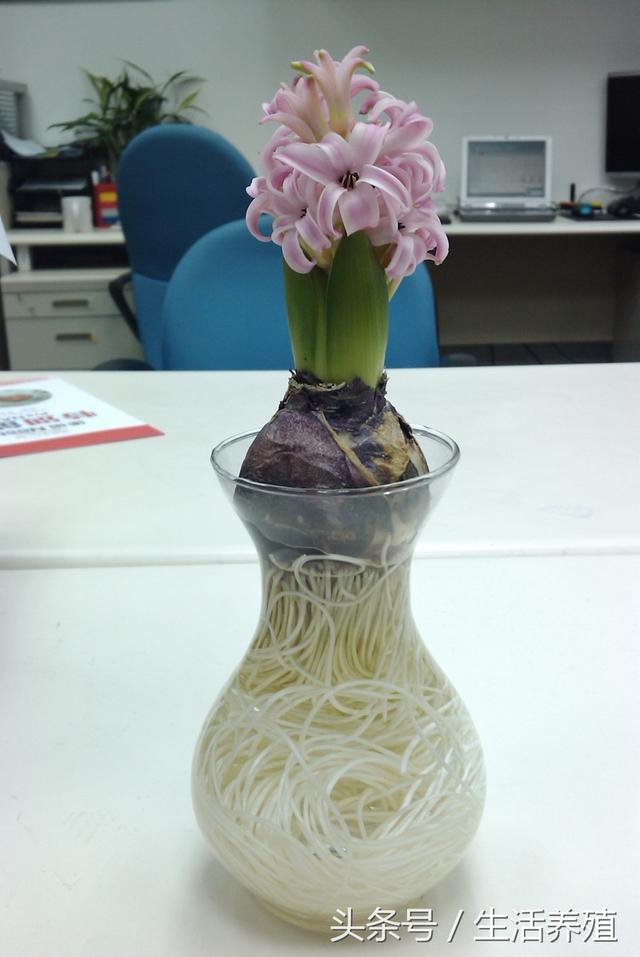
How to grow hyacinths at home? A quick and simple method
[Aliases] Dutch hyacinth, five-colored hyacinth
(Morphological characteristics)HyacinthaceaeHyacinthus, a perennial herb of the genus Hyacinthus, with a spherical bulb covered by a membrane in purple-blue or light green. Leaves basal, 4-6 in number, strap-shaped and lanceolate, with rounded obtuse tips, thick, fleshy and glossy. The scape is 15-45cm tall, hollow, bearing a raceme with 6-12 flowers or more than 10-20 flowers; the florets have small bracts, are slanting or drooping, bell-shaped, swollen at the base, with the tips of the lobes curling outward; the flower color was originally blue-purple, and includes white, pink, red, violet, blue, violet-purple and other colors in varying shades, single or double. The flowering period is April-May. The capsule is spherical.
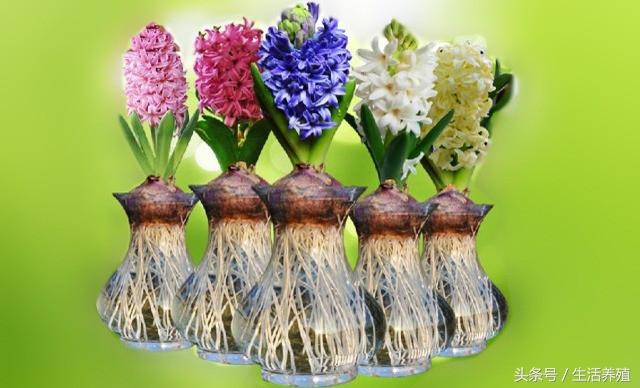
The main cultivated varieties are:
① Roman hyacinth: early-maturing, with slender and weak plants and upright leaves that have longitudinal grooves. Each plant produces several scapes; the flowers are small, white or pale blue-green, suitable for forcing. Native to
southern France.
② Large-trumpet pale white hyacinth: the outer skin of the bulb is violet. Its appearance is very similar to the previous variety, except that the corolla tube is enlarged and the growth is robust. Native to Italy,
③ Provence hyacinth: the whole plant is slender and weak, with dark green leaves that have deep longitudinal grooves. The flowers are few and small, and loosely arranged; the base of the flower tube is swollen and the lobes are tongue-shaped. Native to southern France, Italy and Switzerland.
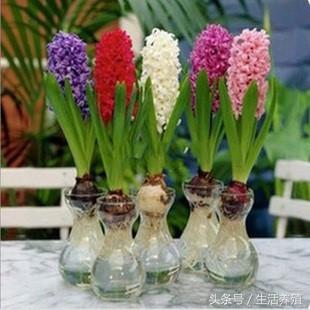
[Habits] Native to Eastern Europe, South Africa and the Asia Minor region, it is now cultivated in many countries around the world, with the Netherlands cultivating the most, where it is an important export product. It prefers a sunny, cool and humid environment and well-drained sandy loam soil, and is highly cold-resistant and tolerant of partial shade.
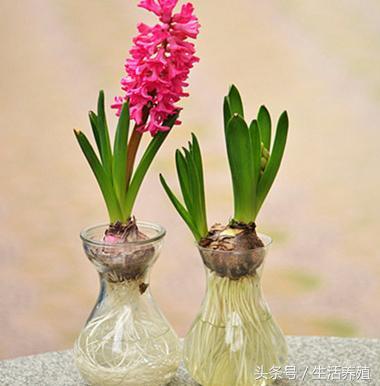
[Propagation and cultivation] Mainly by bulb division. Before planting in autumn, separate the naturally produced daughter bulbs around the mother bulb and plant them separately. However, division should not be carried out immediately after harvest, so as to avoid the wounds left after separation rotting during summer storage. For varieties that naturally produce few daughter bulbs, artificial cutting can be used, that is, on a sunny day in August, cut the base of the bulb into a radial or cross-shaped incision about 1cm deep, and apply sulfur powder at the incision to prevent rot; place the bulb upside down in the sun to air-dry for 1-2 hours, then spread it flat indoors to dry. Afterward, many daughter bulbs can form at the cut part of the bulb, and they can be planted separately in autumn. To breed new varieties, sowing propagation can also be used. The cultivation and management methods are basically the same as those for tulips. For forcing, varieties suitable for forcing should be selected, with large and plump bulbs. Hyacinths can also be forced in water, that is, use a specially made glass bottle, fill it with water, and place a bulb sized to fit the mouth of the bottle on top, without letting it leave gaps or letting the lower part of the bulb touch the water surface. Then place the bottle in a dark place to let it root; after one month, many white roots will appear and the scape will begin to emerge; at this point move the bottle to a lighted place to let it bloom. During water culture, change the water every 3-4 days.
[Pest and disease control] Yellow rot: occurs from the flowering stage to the bulb harvest stage. The pathogen lives in the soil and can be transmitted through wounds; it invades the leaves and produces water-soaked lesions along the leaf veins, which gradually turn yellow and brown. It can invade the bulb, making its interior fill with yellow mucus and rot. Control methods: first select healthy bulbs, avoid continuous cropping in areas where the disease has occurred, disinfect the soil with formalin, and spray 6:6 Bordeaux mixture during the growing period. White rot: invades the stems, leaves and bulbs before flowering, causing them to become water-soaked and to rot and soften. Continuous cropping should be avoided, soil should be disinfected, and care should be taken not to injure the bulbs. Sclerotinia disease: invades from the bulb. Yellowish shallow striped spots or round lesions appear on the leaves, and the affected parts produce light blue mold spots, with small black sclerotia visible on the surface. Select healthy, plump, large bulbs and remove diseased plants. Mosaic virus: the virus is transmitted through seed bulbs; after invasion, vertical light green or yellow striped spots appear along the leaf veins, and in severe cases the leaves are reduced and the whole plant becomes stunted or no longer produces flower stems. Diseased plants should be removed promptly and good seed bulbs selected. Bulb mite: an important pest that, in addition to damaging hyacinths, also often damages tulips, narcissus, dahlias and many other bulbous flowers.
Control methods are the same as for tulips. [Uses] The flower colors are gorgeous, suitable for indoor potted culture or water culture for ornamental viewing.