Porcelain crowns, removable dentures, or dental implants: which is better?
Last time I read a report saying that at least 160 million people in our country are missing teeth, and I wonder if you are one of that huge number. Tooth replacement has also become an increasingly studied subject, and fortunately, with today's advanced medical technology, there are many ways to replace missing teeth. At this point you may be confused, faced with all kinds of methods, about which one suits you. Now take a look at the following comparison; it can help you.

PK One:
Usability. Porcelain crowns have a limited scope of application: to use them, there must be healthy teeth on both sides, the number of missing teeth cannot be too large, and they cannot be used for missing teeth at the very back. Removable dentures can be used in any situation, with no restrictions. Dental implants also have a broad scope with no restrictions, though the bone quality must be healthy. Porcelain crowns lag behind for now.
PK Two: Treatment process
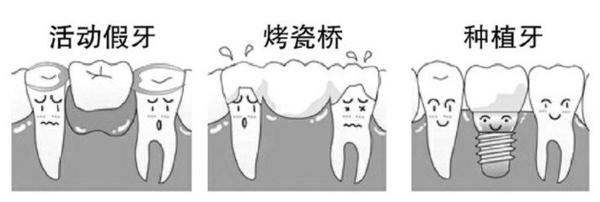
Porcelain crowns need the support of the adjacent teeth on both sides, and during the process the adjacent teeth may have to be ground down, which can be said to cause some damage to the adjacent teeth. Removable dentures also require grinding of the natural teeth, though the grinding is relatively minor. Dental implants place an artificial tooth root into the alveolar bone and do not wear down other teeth. Dental implants win this round narrowly.
PK Three: Comfort
Porcelain crowns are relatively comfortable to wear because of their small, delicate size. Removable dentures cause obvious discomfort when worn, because the prosthesis is relatively large. Dental implants do not pull on other teeth in one direction, and the finished tooth body is made small, fitting closely and being relatively comfortable. Well, removable dentures are slightly inferior here.
PK Four: Practicality
Porcelain crowns, which need the support of neighboring teeth to stand firm, have relatively poor load-bearing capacity when biting, and the more missing teeth there are in the mouth, the worse the load-bearing capacity becomes. Removable dentures also lack the support of tooth roots and rely only on the oral mucosa and partial support from adjacent teeth, so they are also not very feasible when chewing hard food. Dental implants, because a tooth root is implanted, are made similar to natural teeth, and their biting load-bearing capacity is correspondingly better. Dental implants win another round.
PK Five: Treatment time
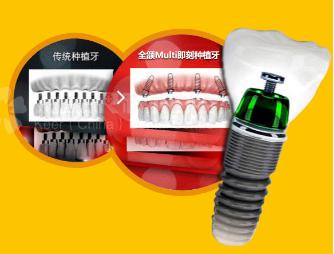
Porcelain crowns and removable dentures basically take 1-2 weeks, while dental implants take 3-6 months, speaking generally of dental implants. Although there is now full-arch Multi immediate implant technology, because it places relatively high demands on the doctor, only a small number of doctors in our country can perform it. Dental implants lose this round narrowly.
PK Six: Treatment cost
The price ranking among the three is that removable dentures are the most economical and lowest in price, porcelain crowns sit in the middle, neither high nor low, and the most expensive is dental implants.
PK Seven: Later stage
Nothing can last forever without breaking; although their previous mission is to repair missing teeth, they too have times when they are damaged. Among them, porcelain crowns can be repaired as a single tooth, but if the situation is serious, the entire porcelain crown body may have to be removed and redone. Removable dentures, because of their removable nature, are relatively convenient to repair.
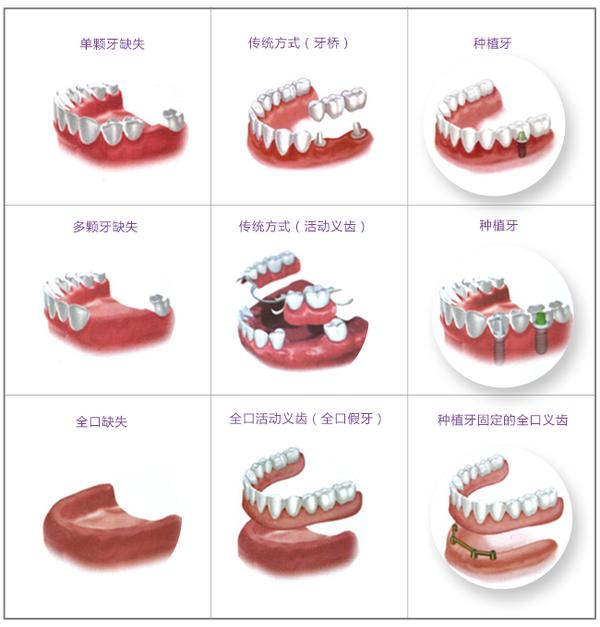
After reading the above comparison, you may have a rough understanding. To put it objectively, nothing is absolute; all three methods have advantages and disadvantages. If you have such troubles, you can go to a dental hospital and let a doctor diagnose you first, then choose the method that suits you best.
Author of this article: Fujian Oral Health Channel [WeChat public account]
This article is original by the author of the Toutiao account, and may not be reproduced without permission.