Detailed explanation of grape cultivation techniques: six common mistakes to avoid
Grapes are perennial vines with relatively soft canes; over a long phylogenetic development, in order to adapt to environmental conditions, they have developed characteristics such as vigorous growth and strong apical dominance.
I. The root system of grapes
Grapes have a powerful root system and extremely strong absorption capacity. The roots of grapes are fleshy roots that can store large amounts of nutrients. Before leaf fall in autumn and winter, large amounts of starch, protein, tannins, calcium oxalate and other substances begin to accumulate in the parenchyma cells of the cortex, the phloem and the pith, in preparation for overwintering.
The annual growth cycle of grapes varies with climate, soil and cultivar. Overall, the optimum temperature for growth is around 20°C, and generally there is a root growth peak once each year in spring and summer (April-May) and in autumn (September-October), with the most root growth occurring in spring and summer.
II. The canes and buds of grapes
According to their position and nature, the canes of grapes can be divided into the trunk, main canes, fruiting mother canes, fruiting canes, vegetative canes and new shoots.
The new shoots of grapes grow very rapidly and can sprout multiple times in a year. The annual growth of a new shoot is generally 3-5 m, sometimes reaching more than 10 m, and new shoots grow fastest around flowering. After a new shoot has fully matured, it already has mixed buds, and after leaf fall it becomes a fruiting mother cane. In spring, new shoots sprouting from the fruiting mother cane that bear inflorescences become fruiting canes, while new shoots without inflorescences become vegetative canes.
The buds on grape canes are all axillary buds and there are no terminal buds. On a new shoot, generally two types of buds form at each node: one that sprouts and produces a new shoot in the current year is called a summer bud; the other is covered by scales and generally does not sprout in the current year, and is called a winter bud. The winter bud appears externally as one bud, but in fact internally contains one main bud and several (3-8) secondary buds (reserve buds) of varying sizes, though only 2-3 secondary buds develop to a larger size. In spring, when the average daily temperature reaches about 10°C, the winter buds begin to sprout. Winter buds generally do not sprout in the current year, but if stimulated by pinching and removal of secondary buds, they can also produce secondary buds in the same year, and some cultivars such as Muscat Hamburg and Kyoho can even form fruit clusters and bear 2-3 crops.
III. The leaves of grapes
Grape leaves are alternate and usually fall into 3 types: 3-lobed, 5-lobed and entire. Young leaves have more hairs, while old leaves have hairs only on the underside. Generally speaking, leaves that are thick, dark in color and heavily hairy have stronger disease resistance. The main function of grape leaves is to provide nutrients for the growth and development of other tissues and organs through photosynthesis.
IV. The inflorescences and flowers of grapes
The inflorescences of grapes generally arise on nodes 3-8 of new shoots. Most new shoots bear 2 inflorescences, some bear 1 or 3, and some can bear as many as 4-5. The inflorescence is a raceme or panicle and, like tendrils, is formed from a modified stem. When nutrition is sufficient, it can form an inflorescence; otherwise, it forms a tendril or an intermediate type.
A fully developed inflorescence has a number of flowers that varies with cultivar, generally 200-1000. Grapes have the characteristic of cleistogamy; pollination is generally already completed before the corolla opens, and after pollination the pollen germinates on the stigma. Under suitable conditions, fertilization can generally be completed in 1-2 days. Under normal conditions, flowering begins when the average daily temperature reaches 20°C; there is very little flowering below 15°C; when the temperature rises to 18-21°C the amount of flowering increases rapidly; and when the temperature reaches 35-38°C flowering is again inhibited.
The length of the flowering period of grapes varies with cultivar and climate, ranging from as short as 4-5 days to as long as 2 weeks, usually 6-10 days. Full bloom is reached 2-3 days after the first flowers open, and physiological flower drop begins 5-6 days after full bloom.
V. The fruit clusters and berries of grapes
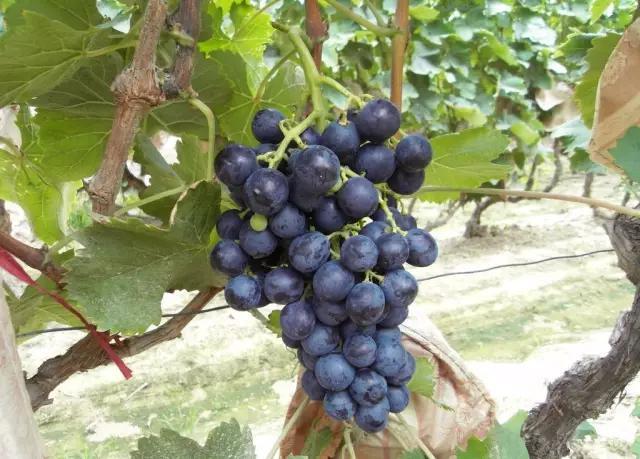
After pollination, the inflorescence forms a fruit cluster. The shape, size and length of the fruit cluster are often closely related to the shape and size of the inflorescence primordium and vary to a certain degree with cultivar.
The shape of the berries can be spherical, oval, heart-shaped, oblate and elliptical, etc.
After fruit set, the berries expand rapidly, and their growth and development generally go through the following 3 stages:
The first stage: the fruit grows rapidly, the flesh is firm, the acid content increases rapidly, and the respiration rate is very fast. For most grape cultivars this stage often lasts 5-7 weeks.
The second stage: fruit growth stagnates and the growth rate slows markedly, the acidity of the berries reaches its highest level and sugar accumulation begins, and the color of the berries begins to change. This stage generally lasts 2-4 weeks.
The third stage: the final swelling stage of the berries. At this time the berries begin to soften, sugar accumulation gradually increases, acidity decreases, and the cultivar's inherent color and aroma appear. This stage lasts 5-8 weeks, and the berries can be harvested once they reach physiological maturity.
6 major mistakes beginners in grape growing easily make!
Mistake one:A predatory cultivation model of high density and high yield,which causes excessive nutrient consumption in the grape vine, poor flower bud differentiation and decline in vine vigor. At present, in Binchuan grape production, the primary task is to reduce planting density, plant at a reasonable density, adjust the trellis system, and control per-unit yield, so that the grapes have a reasonable population structure and load (yield), thereby achieving the goal of improving quality and efficiency.
Mistake two:Neglecting the control of diseases and pests such as downy mildew and powdery mildew after grape harvest,so that leaves easily fall early, which is unfavorable for the accumulation of nutrients in autumn and winter. Therefore, during the rainy season and after fruit harvest, standardized control of grape diseases and pests should be strengthened to prevent early leaf fall and autumn-winter shoot sprouting, and to promote the accumulation of nutrients in the grapes.
Mistake three:Applying too much chemical fertilizer and little or no organic fertilizer, which aggravates secondary salinization and acidification, causes soil compaction and poor root growth and development,and is unfavorable for quality grape production year after year. For Binchuan grapes to follow a path of sustainable development, the application of organic fertilizers such as barnyard manure must be increased year by year, chemical fertilizer use gradually reduced, and green manure or other short-statured plants interplanted between grape rows, so as to reduce soil salt damage and acidification, increase soil organic matter content, promote the transformation and decomposition of soil nutrients, improve soil physical properties, enhance grape root vigor, and cultivate healthy vines.
Mistake four:Blindly rushing for an early start, disregarding the growth and development rhythm of grapes and the seasonal timing,and breaking dormancy too early to promote sprouting, so that if low-temperature chilling injury occurs, grape growth and development are hindered. According to the climate characteristics of Binchuan, it is recommended to prune grapes from the end of December to the end of January, and to promote sprouting at the appropriate time in early to mid-January, so as to promote synchronous growth of the aboveground and underground parts of the grapes.
Mistake five:Superstition about the effects of plant growth regulators, which causes an imbalance of endogenous hormones in the grapesand premature decline of the vine. Therefore, plant growth regulators should be used scientifically and reasonably, and dormancy breaking and fruit enlargement should be carried out at the right time and in the right amount, to prevent premature decline of vine vigor.
Mistake six:Not paying attention to soil improvement and building up soil fertility before grape planting.Before grape planting, in conjunction with deep plowing of the soil, sufficient base fertilizers such as organic fertilizers and micronutrient fertilizers should be applied to create the soil growth environment required by grape roots.
The Creative Agriculture Leader team is dedicated to the fields of agriculture, rural areas and farmers (supported by the strong agricultural technology team of the Beijing Academy of Agriculture and Forestry Sciences), providing better considerate service in the field of protected agriculture (park planning, greenhouse construction, agricultural intelligence, informatized IoT). For more information, please add the WeChat platform: linghang1128