Bitter melon growing methods are simple and easy to learn, and even beginners can get the hang of it with ease
The first time I ate bitter melon was when I was in college. My classmates went out to eat together, and a female class monitor ordered a plate of stir-fried bitter melon, and it seemed not cheap either. Everyone said she had good taste, so she proudly told us how good bitter melon was to eat, and everyone chimed in, eating happily, and I ate along with them and had to look happy too.

Stir-fried bitter melon
For many years afterward I never ate bitter melon again. I know that the way I tried so hard to fit in was not beautiful. I do not deny that some people must like the unique taste of bitter melon, and I also know that some people only pretend to like it. But I really like growing bitter melon. In an out-of-the-way spot in our park, in my small courtyard, I plant a few bitter melon plants every year, simply because I think it is beautiful.
In a country as large as ours, bitter melon is one of the few vegetables grown in both the north and the south, though more of it is grown in the south. Bitter melon grows by climbing and trailing, lush and green, its vines slender but not frail, its skin smooth with a very pleasant feel, and especially when the bitter melon ripens it turns entirely golden yellow and has sweet seeds. All of this is so beautiful.
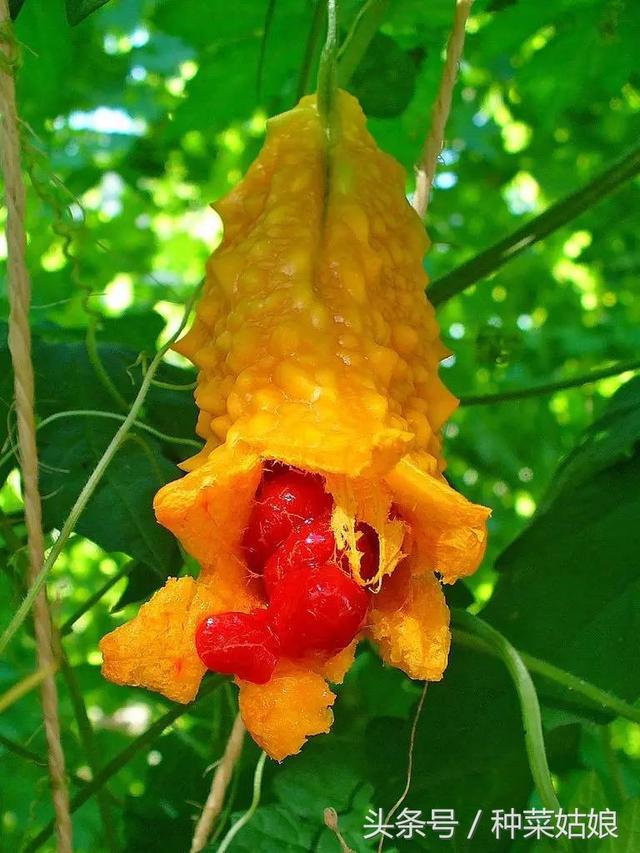
Ripe bitter melon
[How to grow bitter melon]
1. Suitable environmental conditions: Bitter melon likes mild conditions, tolerates heat but not cold. The suitable temperature for seed germination is 30-35°C, and the suitable temperature for growth is 20-25°C; bitter melon likes light and does not tolerate shade, and during the flowering and fruiting period, the stronger the light, the more favorable it is for fruit set; bitter melon has a well-developed root system, tolerates drought but not waterlogging.
2. Growing methods: Bitter melon is generally sown in spring. In the south it is sown and raised as seedlings in February-March, with a whole growth period of 80-100 days, while in the north it is sown and raised as seedlings in mid-to-late April, with a whole growth period of 150-210 days.
Bitter melon is difficult to grow mainly because its seed coat is very thick and the seedlings emerge poorly. Before sowing, the seeds must be soaked. To keep it simple, soak the seeds in clean water for 3-5 hours, dry the moisture on the surface of the seeds, and then sow them in holes. If you want to disinfect the seeds, you can also soak them in a 500-fold dilution of 50% carbendazim for 60 minutes (to prevent fungal diseases), then rinse them clean with water before sprouting or direct sowing.
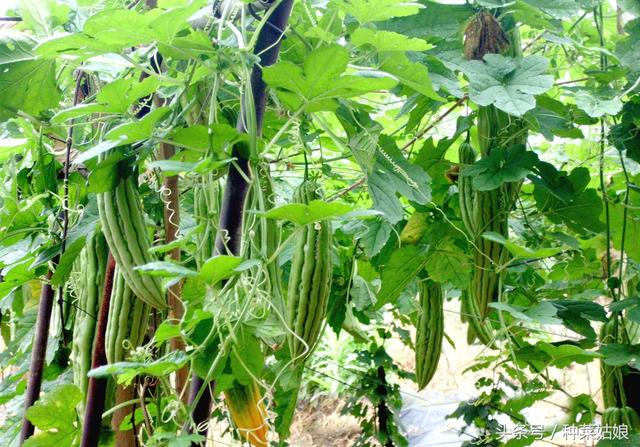
Bitter melon bears quite a lot of fruit
After bitter melon seedlings emerge, be careful to set up trellises in time. For home growing, plant spacing and row spacing do not matter, but in production, generally 400-500 plants are set out per mu.
When the vines are about 50 cm long, guide the vines onto the trellis, that is, wind the vines around it. Bitter melon has a particularly strong branching ability, so this keeps it from growing everywhere. Generally, remove the side vines at the base of the main vine and keep the side vines in the middle and upper parts to bear fruit. After fruit set, start applying additional fertilizer continuously.
While writing this article, I was listening to Zhao Lei's "Chengdu." Folk music always immerses people like this and makes them remember too many things. There are always some things that are tangled and knotted, just like how I do not eat bitter melon yet keep growing it. The hardest thing to fathom is the human heart, including my own and others'.