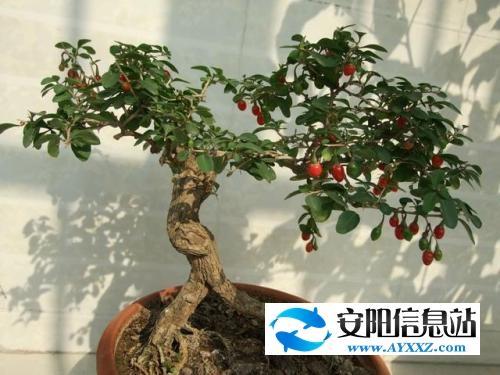
How to grow and care for potted goji berries? A complete guide to the methods
Care conditions for potted goji berries
Goji is a strongly sun-loving plant, so it should be placed in a spot with plenty of light. A well-ventilated environment can reduce the occurrence of pests and diseases. If light is insufficient and ventilation is poor, the branches will grow leggy, the internodes will be long, and the fruit-setting rate will be low. It also easily allows pests such as aphids to multiply rapidly and leads to powdery mildew and other problems. Humidity does not need to be too high; after the plant is established, there is no need to mist it frequently. In places where the temperature drops below minus five degrees, it must be brought indoors to overwinter, and placed outside again after Awakening of Insects in spring.
Watering and fertilizing. Generally, watering cultivated plants follows the principle of watering when dry and letting them dry between waterings, not a regular once-a-day schedule or anything like that. In other words, soil that dries quickly should be watered more often, and soil that dries slowly should be watered less, but each time you must water thoroughly. It is best to use pond water; if that is not available, let tap water sit for a few days before using it. Fertilizing should follow the principle of light fertilizer applied frequently. Newly planted cuttings must not be fertilized. After established plants have been given a base fertilizer, soybean cake water can be used every other week. Soybean cake water is very economical and practical: just soak one jin of soybean cake or soybeans in three jin of water for more than a month, then dilute with water at 1:2 before use. The drawback is that it smells bad!
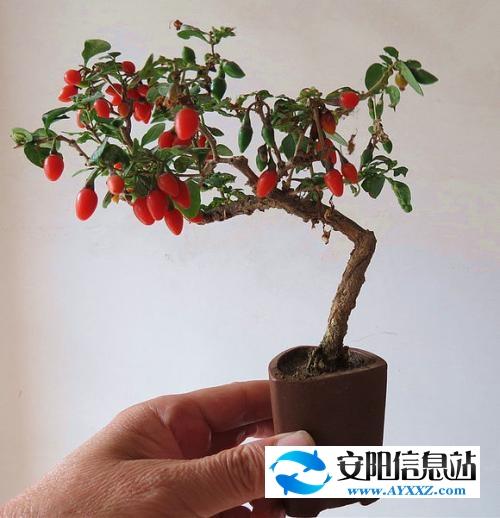
Fruiting characteristics. Goji has the trait of fruiting twice a year. The main fruiting is in autumn, and the berries are attractive and uniform, ripening around National Day. The summer crop is smaller, the leaves are not very green either, and considering nutrient loss and other factors, it is recommended to give it up. Autumn flower buds appear about one month after the summer dormancy, roughly after End of Heat, with new shoots and flower buds appearing at the same time. At this time, do not let the plant get too dry or too wet, do not mist it, and especially do not fertilize it, otherwise the buds will drop. Under natural open-air conditions, the fruit drop rate is very high, and no special treatment is needed
How to grow goji berries in pots
① Seed propagation. The suitable sowing period for goji is late April to early May. Before sowing, first soak the dry seeds in 20-degree warm water for 8 hours, then rub the seeds out by hand and prepare to sow. The sowing rate is 1500-2000 grams per 667 square meters. Open a 4-cm-wide furrow on the bed surface, 1 cm deep, mix the seeds evenly with 10 times their volume of fine sand and scatter them into the furrow, cover with 0.5 cm of fine moist soil, press down lightly, then cover with wet straw to prevent water loss and preserve moisture. The plant and row spacing is 10 cm x 40 cm. The storage life of the seeds generally should not exceed 4 years.
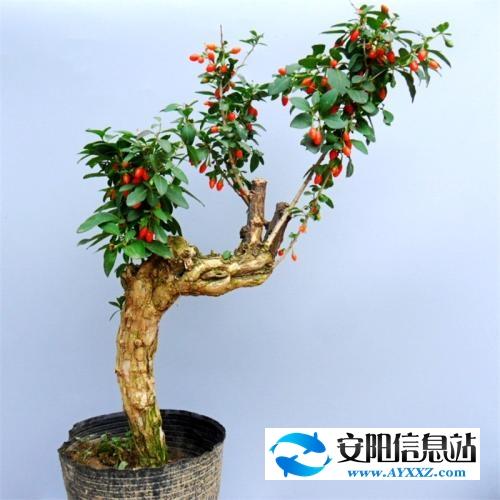
② Cutting propagation. There are hardwood cuttings and softwood cuttings. In the south, cuttings are taken in August-September, while in the north they can be taken in early April.
Hardwood cuttings: select thick, strong branches and cut them into sections 5-20 cm long with 2-3 buds to use as cuttings. These cuttings are best taken from the base or middle of the original branch; the tender, weak part at the tip of the branch should not be used. Use 150 mL/L naphthaleneacetic acid to soak the base of the cuttings, 5 cm deep. After soaking for 24 hours at room temperature, rinse with clean water and they are ready for cutting. When cutting, insert the cuttings vertically into a hotbed (with the hotbed temperature kept at 28-32°C and river sand as the substrate), with a plant and row spacing of 5 cm x 5 cm, keeping the axillary buds facing upward; rooting can begin in about 25 days. In late May to early June, move them to the nursery for management, with a planting spacing of 15 cm x 20 cm, water after inserting, and cover with rice straw to maintain soil moisture. After cutting, adventitious roots and new buds begin to appear in 10-15 days, and generally in 20-25 days 6-7 new roots and 4-6 new shoots can form.
Softwood cuttings: carried out in June-July. Before cutting, set up a plastic shed (or use an existing plastic tunnel or greenhouse), and shade the outside or inside of the plastic shed with shade netting so that the light transmission rate is about 30% of natural light. Inside the shed, use fine river sand to make a cutting bed 150-200 cm wide and 25-30 cm high. Collect semi-lignified new shoots, cut them into 10-12 cm long cuttings, remove the leaves from the basal 5-6 cm, and keep all the upper leaves. Quickly dip the lower end of the cuttings 5-6 cm deep in 1000 mg/L naphthaleneacetic acid, then insert them. The plant and row spacing for cutting is 5 cm x 10 cm, the cuttings are perpendicular to the bed surface, and the insertion depth is 5-6 cm. After cutting, spray water with a small-holed watering can every day from 8:00 to 16:00 to keep the cutting leaves moist; maintain the relative temperature inside the shed above 80% and the temperature at 30-34°C. The cuttings begin to root 20-30 days after cutting, and are transplanted to the field after 40 days. The rooting rate of softwood cuttings is about 70%, and the transplant survival rate can reach 90%.
3. Field management:
① Thin and finalize seedlings in time. In mid-to-late June, when the seedlings reach 4-6 cm tall, carry out the first thinning, leaving a plant spacing of 5-6 cm; in early July, finalize the seedlings, leaving a plant spacing of 12-15 cm.
② Apply additional fertilizer at the right time. In mid-June, apply quick-acting nitrogen and potassium fertilizer; in mid-August, apply quick-acting phosphorus and potassium fertilizer.
③ Keep the soil moist, and carry out timely cultivating, weeding, and earthing up.
4. Pest and disease control:
During the goji growing period, attention should be paid to controlling powdery mildew and root rot; you can spray 0.3-0.5 degree lime sulfur mixture or 2% copper sulfate solution once a week for 2-3 consecutive sprays. For aphids, goji gall mites, goji leaf beetles, and others, you can use 40% dimethoate 1000x solution, 50% pirimicarb 2000x solution, or 90% trichlorfon 800-1000x solution for spray control.