How Does Accumulated Temperature Affect Crop Cultivation? A Guide to Agricultural Basics
We often refer to the concept of accumulated temperature in agriculture, so what exactly is accumulated temperature? Simply put, the sum of the daily average temperatures during thecrop growth period when a certain indicator temperature persists is called accumulated temperature. Among the various accumulated temperatures (0°C, 3°C, 5°C, 10°C, 15°C), the most widely used are the accumulated temperature and active accumulated temperature during the stable period when the daily average temperature is ≥10°C.China uses accumulated temperature and the number of days of accumulated temperature duration, with reference to natural landscapes and crop distribution, to divide the country into 6 temperature zones and the Qinghai-Tibet Plateau region.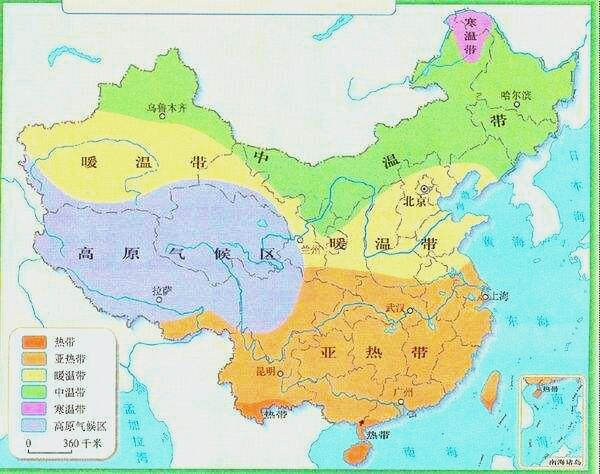 1、The equatorial zone is located in the South China Sea island region south of 10°N latitude, south of the southern limit of the average polar front in winter. The accumulated temperature is roughly above 10000°C, the number of days with ≥10°C is 365 days, the average January temperature exceeds 26°C, and the annual precipitation exceeds 1000 mm. It has more heat and moisture than the tropics, but the annual temperature variation is very small, rainfall is fairly evenly distributed across the four seasons, and various tropical plants can grow on the islands. In many cases, we do not divide this accumulated temperature zone separately but instead group it into five accumulated temperature zones, because there is very little agricultural activity in the true sense of the word in this region of China.
2. Tropical zone, including the entire Leizhou Peninsula, all of Hainan Island, all of Taiwan, China, and a few places in southern Yunnan. The accumulated temperature is ≥8000°C, the duration of ≥10°C is 350-365 days, the average January temperature is above 15°C, and there is no frost all year round. The lowland vegetation is mainly tropical monsoon forest. Tropical cash crops such as rubber, coconut, areca nut, and coffee can all grow. Rice can produce three crops a year, sweet potato can be sown in winter, and winter wheat is not suitable for cultivation.
3. Subtropical zone, including most areas south of the Qinling Mountains and the Huai River and east of the Qinghai-Tibet Plateau. The accumulated temperature is 4500-8000°C, the duration of ≥10°C is 218-365 days, the average January temperature is 0-15°C, and the frost-free period is 8-12 months. Natural vegetation includes subtropical monsoon forest, monsoon evergreen broad-leaved forest, and deciduous forest mixed with evergreen broad-leaved trees. This is China's main production area for citrus, tea, palm, tung oil tree, and moso bamboo. In the south there are also many cash crops such as banana, pineapple, lychee, longan, and olive. Rice can produce two crops a year, while wheat is cultivated in all areas.
Advertisements
4. Warm temperate zone, roughly including the vast area south of the Great Wall and north of the Qinling Mountains and the Huai River, as well as the Tarim Basin in Xinjiang. The accumulated temperature is 3400-4500°C, the duration of ≥10°C is 171-218 days, the average January temperature is -12 to -6°C to 0°C, and the growing period is 5.5-7.5 months. Natural vegetation is deciduous broad-leaved forest in the east and arid desert in the west. Crops can produce two crops a year or three crops in two years, and in some places one crop a year. Wheat is mainly sown in winter, and fruits such as apple, pear, persimmon, and grape are all of very good quality.
5. Middle temperate zone, including the area south of the cold temperate zone, north of the Great Wall, and the Junggar Basin in Xinjiang. The accumulated temperature is 1600-3400°C, the duration of ≥10°C is 100-171 days, the average January temperature is -30°C to -12°C to -6°C, and the growing period is 3.5-5.5 months. Natural vegetation is a mix of coniferous forest and deciduous broad-leaved forest in the east and arid desert in the west. The average July temperature is less than 20°C. Rice and castor bean can grow in most places, and wheat and soybean become major crops in different areas within the zone, but the winter cold season is long, so winter cropping is not suitable.
6. Cold temperate zone, in the northernmost part of Heilongjiang and the northeastern corner of the Inner Mongolia Autonomous Region. The accumulated temperature is below 1600°C, the duration of ≥10°C is less than 100 days, the average January temperature is below -30°C, summer temperatures are not high, the average July temperature is 16-18°C, and the frost-free period is about 3 months. Natural vegetation is coniferous forest. Rice, sorghum, and other crops cannot grow, and temperate fruits have completely disappeared. Only wheat, potato, buckwheat, and foxtail millet can barely be cultivated.
Qinghai-Tibet Plateau climate region. Because of its high altitude, the zonal pattern is disrupted, and it cannot be divided into temperature zones according to the above standards. Although winter is not as susceptible to invasions of cold air from the north as the eastern plains at the same latitude, summer temperatures are rather low, and accumulated temperature in most areas is less than 2000°C. In some places the whole year is a frost period, while in others the frost-free period lasts as long as 7 months. Therefore, the situation across the entire Qinghai-Tibet Plateau region is also very complex, so it is listed as a separate region.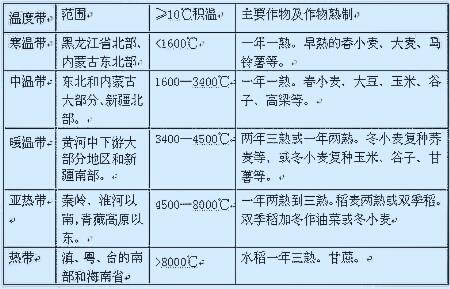 As a main soybean production area,Heilongjiang Province divides the province into six accumulated temperature zones: the first accumulated temperature zone is above 2700°C; the second accumulated temperature zone is 2500-2700°C; the third accumulated temperature zone is 2300-2500°C; the fourth accumulated temperature zone is 2100-2300°C; the fifth accumulated temperature zone is 1900-2100°C; the sixth accumulated temperature zone: less than 1900°C. And so on. The sixth accumulated temperature zone in the northernmost part is below 1900°C, as shown in the figure:
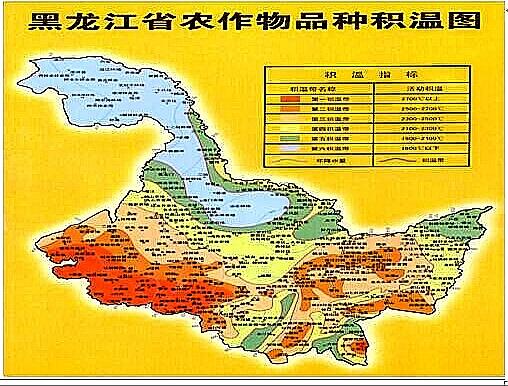 The division of accumulated temperature and temperature zones is only guiding segmentation carried out over large regions. In the process of agricultural production, it is still necessary to adopt more suitable and effective measures according to local specific conditions in a targeted way, so as to better improve efficiency.