Detailed Explanation of Cultivation Techniques and Growth Characteristics of Pearl Guava
Growth Characteristics and Cultivation Techniques of Pearl Guava
1 Growth Characteristics of Pearl Guava
1.1 Growth Habits
Pearl guava has strong vitality, sprouts relatively early, has well-developed branches and leaves, an inconspicuous trunk, and many branches.
1.2 Flowering and Fruiting Habits
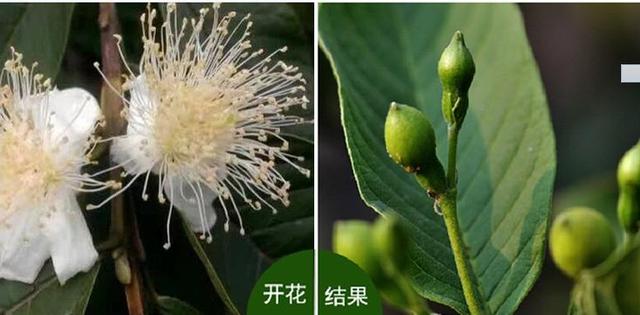
The flower buds of pearl guava are of the mixed type and can bloom in all four seasons, with new flower buds located at the 3rd to 5th nodes in the leaf axils. Pearl guava blooms intensively from March to April and from July to September each year; the flowering period from July to September is shorter, and the yield is lower than that from March to April.
1.3 Fruit Traits
The fruit of pearl guava is mostly pear-shaped or round, and a single fruit can weigh about 500g. When the fruit is ripe, the flesh is milky white and the skin is yellow-green. There are very few seeds in the fruit, the flesh is tender, sweet and delicious, and the vitamin content is very rich.
1.4 Early Fruiting and High Yield
Pearl guava is a fast-growing economic forest species. It can bloom and bear fruit seven to eight months after planting, with each plant yielding 6 to 10kg in the same year and 11 to 15kg per plant the following year. The yield of pearl guava increases year after year, continuing until the full production period.
1.5 Stress Resistance
Pearl guava has particularly strong environmental adaptability. Sandy loam and loam are suitable planting soils, requiring fertile soil, sufficient water sources, and convenient transportation.
1.6 Storage Tolerance
Pearl guava is suitable for cold storage. At a relative humidity of 85% to 90% and a temperature of 8 to 10°C, it can be stored for about 15d, and under such conditions the fruit remains intact. When stored at room temperature, however, the fruit is prone to spoilage and severe air-drying, which affects fruit quality.
2 Cultivation Techniques
2.1 Orchard Site Selection
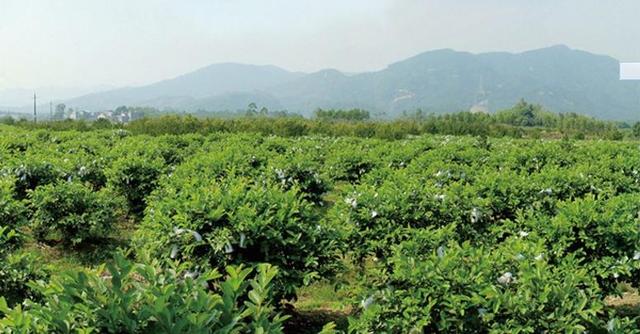
Pearl guava is light-loving and belongs to the tropical fruit category. Its distribution range is very wide, as long as the monthly average temperature is maintained above 15°C. Pearl guava is very sensitive to low temperatures and is prone to frost damage, so corresponding measures should be taken to protect it from low-temperature injury. The orchard should be selected in areas with air circulation and no frost or fog microclimates; such orchards are very favorable for the growth of pearl guava.
2.2 Planting
For planting seedlings of pearl guava, grafted seedlings of 1a or more than 1a are preferable. The transplanting time is best chosen in spring or autumn each year. The graft union should be well healed, the buds plump, the branches thick with short internodes, with three or four branches and a relatively complete root system; such grafted seedlings are beneficial to the growth of pearl guava. Pearl guava is a fast-growing tree species that bears fruit early, and the planting density is preferably 2m x 2m. Before planting, base fertilizer should be applied. Dig planting holes of 70cm x 70cm x 70cm, apply 0.5kg of calcium magnesium phosphate fertilizer and 5.0kg of decomposed organic fertilizer in each planting hole, fill in an appropriate amount of soil, and form a mound. After planting, water the plants sufficiently and cover the mound with dry rice straw to conserve soil and water.
2.3 Fertilizer and Water Management
Water and nutrients have a great influence on the growth and fruiting of pearl guava. Appropriate watering and fertilization should be carried out throughout the year, especially during the budding and fruit growth stages, where sufficient water and nutrient supply must be ensured to promote rapid plant growth and rapid fruit ripening. In the young forest stage, more fertilizer should be applied and more watering done, ensuring that fertilization and watering are carried out two to three times per month; in the full production stage, fertilization and watering should be carried out four to five times per year to promote full absorption of fertilizer. At the same time, trace element fertilizers can be appropriately added to improve fruit quality.
2.4 Training and Pruning Management
2.4.1 Young stage. Training and pruning are very important for the growth and fruiting of pearl guava, and the main purpose of training and pruning is to cultivate the crown shape of pearl guava. After planting is completed, when the seedlings grow to 50 to 70cm, select four or five well-growing branches with suitable angles as the main branches to be retained; when the new shoots grow to 30 to 40cm, cut the branches short to promote the growth of branches. Every 30d, cut back the new shoots once to promote branch growth, repeating the above operations for a duration of about 1a, until the number of branches of pearl guava reaches about 30.
2.4.2 Early fruiting stage. Pearl guava can bear fruit after about 3a of growth. At this time the orchard space is sufficient, providing ample room for plant growth. During this period, pruning and training measures should not be adopted; the plants should be allowed to grow freely to increase fruit production before the full production period and raise economic income. The flowers of pearl guava generally grow at the 3rd to 5th node positions of new shoots, so during this period, excessively fast-growing branches should be controlled and pinching measures should be taken in a timely manner.
2.4.3 Full fruiting stage. In the 4th year after planting, pearl guava reaches the full fruiting stage. At this time, an appropriate amount of training and pruning should be carried out on the plants, removing excess branches, retaining the main branches, dwarfing the plants, and promoting fruit bearing. When the plants are subjected to canopy closure treatment, appropriate pruning and pinching should be carried out to ensure the growth of the main branches, and diseased branches with poor growth and development should be removed to ensure the rational distribution of fertilizer and water. After canopy closure, pruning should mainly be heavy pruning; after heavy pruning, a large number of shoots sprout. At this time, training and pruning should follow the principle of "prune weak trees less, prune vigorous trees heavily, retain moderate ones, thin out strong and weak ones," so that the total number of terminal shoots of the whole plant is controlled at 210 to 260, while the canopy height is controlled not to exceed 2.5m.
2.4.4 Renewal stage. After the full production period, the fruit bearing of the plants gradually decreases, the fruiting positions gradually rise, and plant growth weakens. Old trees need timely pruning so that the plants renew naturally and maintain growth vigor. Generally in spring, the main trunk is cut off at about 100cm above the ground, and the secondary main branches are retracted so that new buds on them sprout into new branches, retaining growth and fruit-bearing capacity.
2.5 Flower and Fruit Management
2.5.1 Flower thinning and fruit thinning. To ensure large fruit and high quality, flowers need to be thinned according to the nutritional status of the tree vigor. For the production of summer and autumn fruit, because the temperature is relatively high and there is more rain at flowering, the fruit-setting rate is low, so flower thinning is generally not advocated; after the small fruits are stable, fruit thinning should be carried out according to the fruit-bearing situation. For the production of winter and spring fruit, the temperature at flowering is suitable and the fruit-setting rate is high, so appropriate flower thinning should be carried out. On new shoots, retain single flowers, thin out the small flower of double flowers, and thin out the left and right flowers of three-flower clusters. Fruit thinning mainly removes diseased and insect-damaged fruit, deformed fruit, and excessively dense fruit, while fruit retention depends on tree vigor, branch thickness, and leaf development. For strong trees with thick branches and thick, dark green leaves, retain more; otherwise, retain fewer or none.
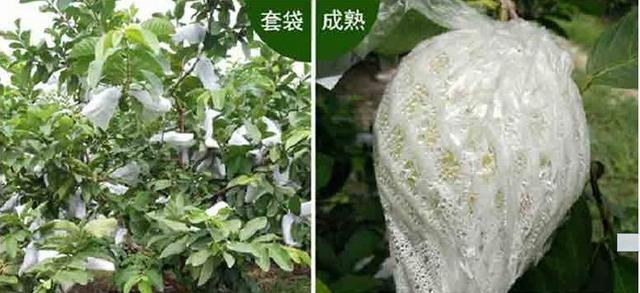
2.5.2 Fruit bagging. Fruit bagging treatment is of great significance. It not only protects the fruit from contamination by pesticides and chemical fertilizers and ensures a smooth fruit surface, but also reduces diseases and insect pests of pearl guava, improving not only the market appearance of pearl guava but also the fruit quality of pearl guava. Experimental results over many years show that unbagged fruit is more susceptible to diseases and insect pests, and pesticide residues are also significantly higher than in bagged fruit. Fruit that has undergone bagging treatment has a smooth surface, no wormholes, good taste, and no pesticide residues, and the fruit quality is significantly better than that of fruit that has not undergone bagging treatment.
2.6 Pest and Disease Control
Pearl guava is susceptible to diseases and insect pests throughout its growth period. The main diseases are sooty mold and anthracnose, and the main insect pests are aphids, mealybugs, and fruit-boring insects. Throughout the entire growth and development period of pearl guava, attention should be paid to monitoring and forecasting diseases and insect pests, so that they are discovered in time and controlled in time. Based on many years of research on pearl guava diseases and insect pests, it has been found that pearl guava diseases can be controlled with 75% chlorothalonil 800-fold solution or 70% thiophanate-methyl wettable powder. To reduce the reproduction coefficient of fruit borers, sex pheromone attractants should be used to trap and kill male insects. To control aphids and mealybugs, 20% fenvalerate emulsifiable concentrate 1000-fold solution should be used.