A Summary of Essential Knowledge for Succulent Growing Beginners
Succulents have a healing effect. When everyday stress is overloaded, spend 10 minutes tidying them up and a happy mood arrives right away. For succulent care, patience is most important. If you are not familiar with them, you will need to spend more time studying, especially since succulent plants need special care methods in each season, and varieties also differ, making it harder than imagined. But the key three factors are sunlight, air and water. Adjust according to conditions and care for them regularly. When it is too hot in summer, check on the plants at least every two days.
Agricultural Information Network
Beginner Knowledge for Growing Succulents
What will cause succulents to die?
There are many ways to kill them. Please refer to the following succulent death guide:
1. Water every day. (Most of them grow in harsh environments, so there is no need to pamper them excessively.)
2. Water in the middle of the day. (The water will heat up immediately and then the pot will become like a steam room, rotting the roots.)
3. No hole in the bottom of the pot. (Because the roots need air circulation, which can speed up water flow.)
4. Summer. (Especially summer in the south. It is very stuffy, hot and humid, and roots rot easily.)
5. Pests. (The most terrifying is the mealybug. Pesticides often cannot kill it because the powder on its body carries the pesticide away. Try using a needle to pierce them one by one. If ventilation is good, pests are not easily attracted.)
6. Pathogens. (It often happens that diseased jelly-like leaves fall onto the surface soil and begin to rot, then start infecting the whole plant until it dies.)
Agricultural Information Network
How often do succulents need watering?
For succulent plants, misting is a relatively ideal way to water. The best time to water is when there is plenty of sunlight, and you can adjust the watering frequency yourself. In dry places, you need to water more. Generally, you should water according to changes in the succulent's leaves and soil. I usually water when the soil is dry and the leaves are slightly soft, and I generally water thoroughly, which can last 1-2 weeks.
Of course, there are also tricks to watering succulents:
Trick 1 - The weighing method. First determine your own soil mix, and try to use the same formula each time you pot. At the same time, prepare an empty pot, fill it with thoroughly dry soil, then weigh it. After recording the weight, water thoroughly, weigh it again, and record the two figures. Next, weigh it once a day. Besides testing the water retention of your own soil mix, the ultimate goal is to see how many days it takes to return to the weight of the dry soil when potted. Subtract 1-2 days from that number of days, and that is the watering cycle you need. The above refers to Haworthia. For mesembs, you do not need to subtract days. Of course, this method ignores the roots' water absorption and transpiration. Generally, a pot with growing plants will dry faster, so if the data above can be compared with the weight of a pot with a plant during the same period, the watering cycle obtained will be more accurate.
Trick 2 - The medium color-change method. Increase the proportion of akadama in the soil mix, because akadama granules absorb water and transmit moisture quite well, and they change color as soon as there is a bit of water, making dry and wet very intuitive. Increasing the proportion of akadama in the mix can strengthen moisture transmission within the pot soil. The upper soil dries quickly, and moisture below will keep being transmitted upward until the moisture content in the lower medium decreases to a critical point, and this critical point is often the beginning of the watering signal. It is recommended to increase the akadama proportion in the mix to above 40%, and use pure akadama of 2-3 granule size for top dressing on the pot surface. When the akadama on the surface turns pale yellow and whitish, Haworthia can wait at most 1 more day, and mesembs should be watered after 2 days. If you want to use this method to determine the watering cycle, you still need to adjust it according to your own soil mix.
Do you need to change the soil or add supplementary fertilizer?
Succulent plants bought at ordinary flower markets mostly come with potting soil. Be sure to remember to change the medium, because potting soil holds too much water, and centipedes are often found in it. In addition, foreign soil often has uncertain factors such as insect eggs and ant nests. It is recommended that after buying them, remember to remove them from the pot, brush the soil clean, put them in a cool place to air-dry for a few days, let the wounds heal, and then plant them in a new pot. If you have rice-washing water at home, you can also use it to water succulents. It is simple, natural and clean. You can also choose chemical fertilizers.
What should you do if a succulent gets sick or a leaf withers?
Do not worry too much about a single withered leaf. Plants also need to replace old leaves to retain nutrients. Try to let them stay completely dry and fall off on their own. In the half-dry state, new plants will grow again at the joint with the stem, and the plant tends to start growing messily. If a jelly-like leaf becomes semi-transparent but has not yet dried up, pull it off immediately and check whether the stem or roots have turned black. If you see black, deal with it immediately with clean scissors, remove the plant from the pot directly, and place it in a cool, ventilated place to observe. If it is caused by mealybugs, kill the insects one by one immediately, and pay attention to whether any are missed in dense leaf areas. Then remove the plant from the pot, brush off all the soil with a toothbrush, and soak it in alcohol water to sterilize and disinfect.
Tips for Beginners
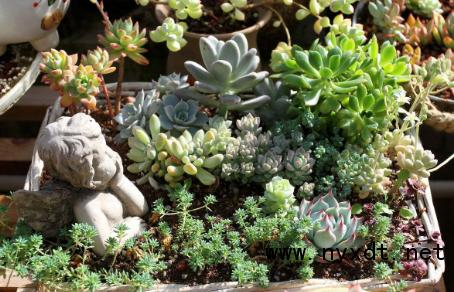
Besides the plants themselves, whether the pots are beautiful or not affects the visual effect of succulent growth. When planting several pots, try to raise the height of the plants in the center and back to create a sense of layering, place some small plants in front as accents, and place shorter plants around the other sides that can still serve as feature plants, giving the composition a focal point. After combining them, the lines, proportions, directions and variety matching are very subtle. Try more, and your photos will look better.
On this Agricultural Information Network, I recommend a few beginner varieties. Special reminder: when buying succulents, beginners had best buy slightly larger ones (3-5 cm is moderate). Do not be greedy for cheap prices. I may belong to the clumsy-hands group. I bought them three times. The first two times I was greedy for cheap prices and bought relatively small ones, and as a result only about 10% survived.
Agricultural Information Network
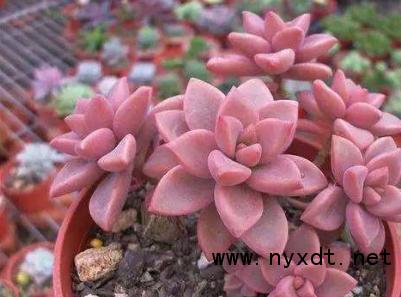
1. Graptopetalum paraguayense, with slightly pointed leaves and a rather cool white tone, commonly known as jewel flower. It is quite easy to grow, and old stems are not expensive either. Beginners can buy an old stem online to try their hand.
2. Pachyphytum 'Amethystinum', like Graptopetalum paraguayense, is easy to grow, and old stems are also cheap.
3. Graptoveria 'Titubans', a beautiful common variety, relatively easy to grow, and old stems are also cheap.
4. Sempervivum 'Chick Charms', a small clustering plant that loves to fill its pot. The leaves closing up during dormancy are very cute. It dies after flowering, so if flower buds grow, cut them off.
5. Echeveria 'Topsy Turvy', like Sempervivum 'Chick Charms', is one of my relatively favorite common varieties. Some people also say it is a relatively delicate variety among common ones, but the price is not expensive either. If you like it, you can get one.
6. Echeveria 'Black Prince'. Personally, I think Echeveria 'Black Prince' is not a particularly beautiful variety, but it is a black variety among common ones. With sun exposure it turns black easily, and it can be combined in a pot with succulents of other colors. It is cheap and easy to grow, and its flowers are red and quite beautiful.
7. Sedum rubrotinctum 'Aurora'. The price of Sedum rubrotinctum 'Aurora' is not too expensive either, and when colored up it is more beautiful than Sedum rubrotinctum, so I recommend buying this one. Leaves that fall into the soil root easily.
8. Sedum pachyphyllum, a relatively easy variety to grow. A very similar-leaved variety is Sedum 'Yatsugatake'.
9. Echeveria pulvinata, with a fuzzy surface and a bit of red on the edges. It is relatively cute, and the price is not expensive either.
10. Sedum adolphi, quite cute when young, with a yellowish-green color. Personally, I think young Sedum adolphi is more adorable than old stems.
11. Echeveria 'Perle von Nurnberg'. When grown well, the color is relatively purple; when not colored up, the color is ordinary and not very good-looking. It is a common variety and should not be difficult to grow.
12. Echeveria glauca. I have not grown it, but many people do, and since it is a common variety, it should not be difficult to grow.
13. Haworthia cooperi, a crystal-clear and very cute variety. It is said that this variety does not need sunlight so strongly.
14. Senecio rowleyanus, a trailing-type succulent, growing round and plump and very cute.
Agricultural Information Network
I recommend a few that are a bit more expensive than beginner level and a bit more difficult than growing common varieties. Once you have experience, you can get a few to grow.
1. Cotyledon tomentosa, with leaves like bear paws, very cute. After becoming widespread, the current price is not too expensive, and variegated varieties are not too expensive either.
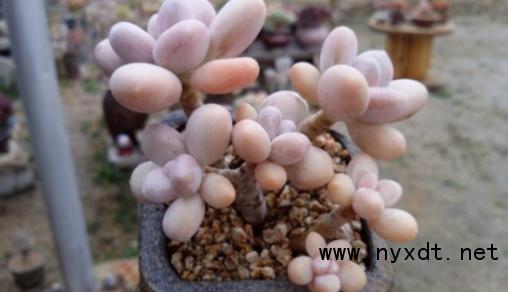
2. Pachyphytum 'Oviferum'. This variety is also quite popular. When the leaves color up they are pink and round, and cute. However, note that Pachyphytum 'Oviferum' and Pachyphytum 'Amethystinum' look very similar. Pachyphytum 'Amethystinum' has pointed tips, but Pachyphytum 'Oviferum' does not, and when Pachyphytum 'Amethystinum' does not color up, its color tends toward white-green. Because Pachyphytum 'Amethystinum' is much cheaper than Pachyphytum 'Oviferum', many sellers use Pachyphytum 'Amethystinum' as Pachyphytum 'Oviferum' to deceive buyers. Also, Pachyphytum 'Amethystinum' turns pink when colored up, so many people mistake one for the other. But Pachyphytum 'Amethystinum' is also very cute. Most of the Amethystinum series are quite cute, such as Pachyphytum 'Amethystinum' and Pachyphytum 'Oviferum'. They are relatively cheap, and if you like them you can grow them too. Actually, I think Pachyphytum 'Amethystinum' is quite easy to grow, plump and especially cute.
3. Echeveria 'Derluergii'. A few years ago this variety was not expensive. It was probably because too many people liked it that the price was driven up, and it is more expensive than before. The color is relatively cute.
Source: Agricultural Information Network