Symptoms and Treatment of Slug Damage on Purple Shamrock (Oxalis triangularis)
1. Morphological characteristics
The wild slug belongs to the order Stylommatophora, family Limacidae, also known as the gray garden slug. The adult is spindle-shaped, 20-25mm long and 4-6mm wide; the body surface is smooth, without an outer shell, dark gray, yellowish-white or grayish-red; it has two pairs of antennae, dark black, with the eyes at the tips of the posterior antennae; the front part of the back bears a mantle, with rolled-up edges and obvious concentric circular growth lines, and the mucus is colorless; the eggs are white and transparent, gelatinous and oval, gathered in clusters within the egg capsule; the newly hatched juvenile is light brown and resembles the adult in body form.
2. Occurrence pattern
The wild slug occurs in 1-2 generations per year, overwintering as adults and juveniles in the moist soil around plant roots, with more severe damage in spring and autumn. Air temperatures of 11.5-18.5°C and soil moisture content of 20-30% favor its reproduction. During the day, the wild slug hides in the roots of purple shamrock and in soil crevices, and at night it crawls out onto the ground to activity, harming the growth of purple shamrock. It has a strong tolerance for starvation and can refrain from eating and moving under food shortage or adverse conditions. The wild slug prefers dark, humid environments; damage is most severe especially in the corners of greenhouses in spring and in environments with high plant density and poor ventilation. Its feeding activity is most intense from evening until just before dawn the next day. When the wild slug encounters adverse environments such as dryness or irritating odors, it can quickly retract its foot into the shell and secrete mucus, forming a liquid film outside the shell opening to protect itself through the adverse environment. However, it has a strong attraction to sugar. The wild slug fears light, and under strong sunlight it will die within 2-3h.
3. Damage characteristics
The wild slug has omnivorous feeding habits and prefers to eat the leaves and petioles of purple shamrock, forming irregular notches, holes or dead seedlings. The damaged leaves are scraped and contaminated by the excrement left behind, losing their ornamental value. The body of the wild slug carries a variety of pathogens, and the wounds caused by its bites become channels for pathogen invasion, which can lead to fungal infection and cause the leaves to rot.
4. Control measures
The wild slug has very strong concealment, and its body surface secretes a large amount of mucus, so the pesticide solution cannot easily reach the insect body directly, and general insecticides are difficult to be effective; it is a relatively difficult-to-control harmful organism on potted purple shamrock.
① Agricultural control:
Dig drainage ditches well in greenhouses, pay attention to drainage, lower the groundwater level, and remove weeds in time. Cultivate and weed on sunny days to expose the eggs on the soil surface to die on their own. Spread lime powder or plant ash around the edges of outdoor sites where purple shamrock is placed, to reduce humidity and create an environment unfavorable for wild slug activity; after the wild slug crawls over it, its body will die from dehydration.
② Chemical control:
During the peak occurrence period of the wild slug, spray 100-fold ammonium bicarbonate solution, 100-fold 40% slug enemy concentrated aqueous solution and other agents. Because slugs are inactive during the day, the pesticide solution cannot easily be sprayed onto the wild slug's body, and the general control effect is unsatisfactory. Therefore, before chemical control, water the greenhouse floor and the inside of flower pots to increase environmental humidity, so as to favor slug activity, and apply the pesticide in the evening. In order to achieve sustained and effective control, carry out 2-3 consecutive treatments. Taking advantage of the wild slug's habit of being attracted to fragrance, use snail enemy to prepare a bait powder containing 4% active ingredient with oil cake powder or corn flour, and scatter it in the evening on the ground between flower pot gaps or at the edges of flower pots to trap and kill them. Chemical control experiments show that the control effect can also reach more than 85%.
The pest and disease control of purple shamrock is a complex task with strong comprehensiveness. It should be based on agricultural activities, with prevention as the priority, eliminating the sources of pests and diseases, and combining physical methods, chemical agents and biological natural enemies for integrated management. Follow the principle of "treat early, treat small, treat thoroughly", and eliminate pests and diseases at the initial stage of occurrence, rather than waiting until purple shamrock is severely damaged before treating it.
Symptoms and Treatment of Root Rot on Purple Shamrock (Oxalis triangularis)
1. Disease symptoms
Root rot harms the root system and bulbs of purple shamrock. Affected plants show a wilting state under sunlight during the day, and recover somewhat from night to early morning. The initial symptoms are that the leaves of purple shamrock show a state similar to nutrient deficiency and loss of purple color; the roots appear shrunken; there are few fibrous roots, which are light yellowish-brown; the main root shows no obvious symptoms. As the disease worsens, the plant's growth becomes increasingly poor, the leaves begin to turn yellow and wither, the fibrous roots rot completely, and the main root turns dark brown and gradually rots as well; after squeezing, the root cortex is very easy to peel off; dark brown mold layers and glue-like liquid can sometimes be seen at the base of the bulb. Finally, the plant's water shortage worsens, all the leaves of purple shamrock wilt, and the plant dies. This disease is not easy to detect in the early stage.
2. Disease occurrence pattern
The pathogen overwinters in the soil and on diseased plant residues. The pathogen invades the body of purple shamrock through root wounds, then produces conidia in the diseased parts, and spreads and expands with the help of rainwater or irrigation water, causing secondary infection; a high-temperature and high-humidity environment favors its occurrence. In addition to environmental conditions, disease occurrence is closely related to cultivation management; in continuous cropping land without soil disinfection, localized low-lying water accumulation, use of undecomposed fertilizer, frequent occurrence of underground pests, or root injury caused by agricultural operations, the disease is often relatively severe. Generally, it occurs more severely in high-temperature seasons, and it is also very prone to occur when soil moisture content is relatively high.
3. Control measures
① Agricultural control:
Clean the cultivation site in time, fertilize and water scientifically, prevent flooding irrigation, and keep soil moisture moderate. Before cultivating purple shamrock, alternately spray the substrate several times with several fungicides to disinfect it well. Pentachloronitrobenzene or formalin can be used for disinfection. Promptly pull out and destroy diseased plants when found. The root rot pathogen is an anaerobic bacterium; after purple shamrock is planted, loosening the soil once every 3-5d to enhance soil aeration is an effective control measure.
② Chemical control:
In the early stage of disease occurrence, spray or drench the roots with 500-fold 50% thiophanate-methyl solution, 500-fold 50% carbendazim solution, etc. After disease occurrence, 700-fold 50% tuijunte solution, 1000-fold 50% thiophanate-methyl solution, 600-800-fold 65% dexon solution, 600-fold 75% chlorothalonil solution and other agents can be used to drench the roots or spray.
Is purple-leaf Yamamoto oxalis a flowering plant? Pictures and brief introduction of purple-leaf Yamamoto oxalis
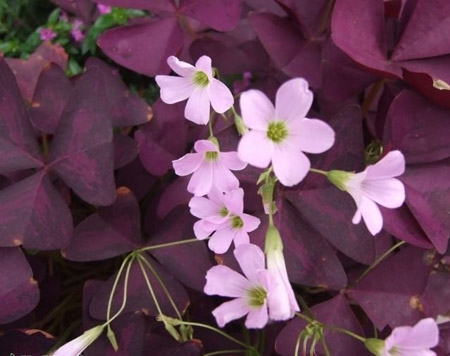
Chinese name: purple-leaf Yamamoto oxalis
Alternative name: purple shamrock
Latin scientific name: Oxalis griffithii Edgew. et Hook.f.
Family and genus: Oxalidaceae, Oxalis
Origin and distribution: China
Purple-leaf Yamamoto oxalis has a peculiar leaf shape, deep purple leaf color, and small white-pink flowers; the color contrast is strong and very eye-catching. It is mainly propagated by division and sowing. Division can be carried out throughout the year, and division in April-May in spring is best. It likes a warm and humid environment. It grows vigorously in fertile and moist soil and is relatively cold-tolerant. It is suitable for potted cultivation, and is very suitable as a groundcover plant for shady and humid sites in gardens.