Symptoms and Treatment Methods for Purpleleaf Woodsorrel Damaged by Bradybaena similaris
1. Morphological characteristics
Bradybaena similaris belongs to the order Stylommatophora, family Bradybaenidae, also known as the water buffalo snail. The adult shell is flat-spherical, solid and thick, with a yellow-brown or red-brown surface, and a horseshoe-shaped aperture. The egg is spherical, milky white, and glossy. The young snail is smaller in size but similar in form to the adult. Its mouth is located on the ventral side of the head, and the mouth has a radula, on which grow many neatly arranged small teeth used for chewing and grinding food.
2. Occurrence pattern
Bradybaena similaris occurs in 1-3 generations per year, overwintering as adults and young snails in moist, dark places in greenhouses. The shell aperture is sealed with a white membrane. In the north, overwintering Bradybaena similaris generally begins to become active and feed gradually in early March of the following spring, and gradually enters overwintering in late September. The peak egg-laying periods for Bradybaena similaris are May-June and August-September, mostly in moist, loose soil cracks, at the base of grass, or under dead leaves or stones. Eggs cannot hatch if the soil is dry or the eggs are exposed on the surface, and eggs on the surface are prone to bursting under sunlight. Bradybaena similaris prefers warm, dark, and moist environments, hiding by day and emerging at night, feeding in the evening or early morning, and on overcast and rainy days it rests on plants or in dark places all day.
3. Damage characteristics
Bradybaena similaris feeds on the leaves and petioles of purpleleaf woodsorrel. Adults and young snails use their radula to scrape and feed on the leaves and petioles of purpleleaf woodsorrel, causing holes or notches; in severe cases they eat all the leaves and bite through the rhizomes of the plants, causing missing plants and broken rows, or even requiring destruction and replanting. The wounds caused by feeding can sometimes also induce soft rot, leading to rotting and necrosis of leaves, bulbs, or roots. The white, shiny gelatinous trails and dark green droppings left where Bradybaena similaris has crawled affect the photosynthesis of purpleleaf woodsorrel.
4. Control measures
① Agricultural control:
Clean the field, cultivate and loosen the soil after rain, and remove field weeds, stones, plant residues, and other debris to destroy the habitat and egg-laying sites of Bradybaena similaris. Deep plow the soil in autumn to cause mechanical injury and death to some overwintering adults and young snails, and expose them on the surface to be pecked by natural enemies or frozen to death, while eggs burst under the sun. Controlling soil moisture plays a key role in the control of Bradybaena similaris. In the first half of the year there is more rain, especially in areas with a high groundwater table, so ditches should be opened in time to drain standing water and reduce soil moisture. Although manual collection is time-consuming, it is very effective. Persist in collecting them on the soil surface and on leaves before sunrise each day or when they are active on overcast days. Bradybaena similaris collected must be killed and must not be discarded and ignored, to prevent the eggs in their bodies from hatching after the mother dies.
② Chemical control:
When Bradybaena similaris burrows into the soil in the early morning (on overcast days it can be in the morning), spray with copper sulfate at 1:800 dilution or 1% salt water for control. Spray with miewoling at 800-1000 times dilution or ammonia water at 70-400 times dilution for control. It is recommended to alternate the above chemicals to ensure snail killing and leaf protection, and to delay the development of resistance in Bradybaena similaris. Using metaldehyde, triphenyltin, mida, and other chemicals to prepare poisoned soil and broadcasting it in the evening also has a certain effect. Broadcasting tea seed cake powder or applying 8% miewoling granules on the soil surface around the roots can also achieve the effect of controlling Bradybaena similaris. Spraying trichlorfon, deltamethrin, or lime powder around flower pots can effectively kill or drive away Bradybaena similaris.
Control Methods for the Flower Pest Bradybaena similaris
Also known as tingyou luo and water buffalo. It is distributed in Hebei, Shandong, Inner Mongolia, Gansu, Shaanxi, Hunan, Hubei, Jiangsu, Zhejiang, Beijing, Tianjin, Jiangxi, Sichuan, Taiwan, China, and other places. It damages many kinds of flowers, such as chrysanthemum, orchid, cockscomb, salvia, hibiscus, canna, hydrangea, dahlia, wintersweet, kumquat, citrus, finger citron, Chinese rose, crape myrtle, rose, climbing rose, honeysuckle, redbud, peony, tree peony, crabapple, and so on.
Damage characteristics
Newly hatched young snails feed only on the leaf mesophyll, leaving the epidermis; when slightly larger, they use their radula to scrape and feed on leaves and stems, causing holes or notches, and in severe cases bite off seedlings, causing missing plants. The snail's foot gland can secrete mucus, and wherever they crawl, band-like, silvery-gray shiny traces are left on leaves, stems, and trunks.
Morphological characteristics
Body length about 2 cm, about 2.5 cm when crawling. The head and the back of the anterior body are pale gray-yellow, and the posterior body is gray-white. The body surface has relatively dense, slightly raised gray-white patches. The head is well developed, with 2 pairs of tentacles on the head; the anterior pair is about 1 mm long, the same color as the body or pale gray-black, and the posterior pair is about 4 mm long, gray-black. The eyes are borne at the tips of the posterior tentacles and are black. The tentacles can be extended and retracted, and the eyes can also be retracted into the body. The mouth is located on the ventral side of the head and has tactile lips. The foot is on the ventral side of the body, broad, and suitable for crawling. Outside the body is a spiral hard shell, flat-spherical, with a shell height of 12 mm and width of 16 mm, and 5~6 whorls. The shell is relatively hard, yellow-brown or red-brown. The spire is low, the body whorl is relatively broad, and there is 1 brown band in the middle of the periphery. The aperture is horseshoe-shaped or oval, and the umbilicus is round. Normally the body is hidden inside the shell; when active and foraging and crawling, it emerges from the shell opening and carries the shell on its back.
Control methods
(1) Eradicate weeds in and near protected areas.
(2) In the evening, in places where snails are often active, broadcast quicklime powder or tea seed cake powder, etc., to poison adults and young snails.
(3) Manually collect adults and young snails, or make trap piles with weeds, leaves, vegetable leaves, etc., to lure snails to hide in them, and then capture and kill them.
(4) Dilute ammonia water with water 70~100 times and spray at night, which can poison snails and also serve as fertilizer.
(5) Chemical poisoning. You can choose 90% trichlorfon original powder at 1000 times dilution, 20% jusha emulsifiable concentrate at 1200 times dilution; broadcast 6% mida (metaldehyde) granules at a rate of 7~10 kg/sq km mixed with 150 kg sand; use 20% snail enemy (metaldehyde) 1: ground soybean cake or corn flour 20 to prepare poisoned bait, and broadcast it in the affected area in the evening for trapping and killing; spray 20% snail enemy liquid, etc., once every 15 days, for 2 consecutive sprays.
Jingxi Ottelia
Jingxi Ottelia
Jingxi Ottelia is a submerged herbaceous plant. The rhizome is short, about 2 cm long and about 5 mm in diameter. The fruit is triangular, with warty dots, longer than the spathe. Seeds are numerous, long-elliptic, with very sparse hairs. Flowering period is June-October. 2n=22.
This variety is similar to the original variety Ottelia acuminata (Gagnep.) Dandy var. accuminata, with the main differences being that its male spathe contains an exceptionally large number of male flowers, up to 140-190; the degenerated stamens in the male flowers are 2-lobed at the apex; the degenerated pistil has 6 grooves; and the female spathe contains 8-9 female flowers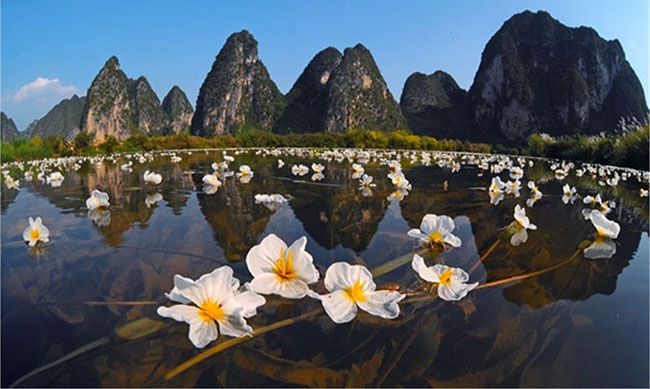
Morphological characteristics of Jingxi Ottelia
Leaf characteristics
Leaves basal, uniform; leaf blade long-elliptic or ribbon-shaped elliptic, apex acuminate or obtuse, base gradually narrowed or shallowly cordate, entire, slightly wavy and wrinkled, 24-50 cm long, 8-14 cm wide; veins 9, raised on the abaxial surface, smooth; petiole 30-60 cm long, 5-8 mm wide, flatly triangular, with a sheath at the base, white, about 2.5 cm wide.
Inflorescence characteristics
Flowers unisexual, dioecious; spathe flat-elliptic, smooth, 3-6 cm long, 1.2-2.6 cm wide, raised and keeled in the middle, with 3 ribs on it, lateral edges obvious, apex 2-toothed; spathe peduncle flat-cylindrical, 10-90 cm long, about 5 mm wide, curved or spirally twisted; male spathe contains 60-190 or even more male flowers, pedicels triangular to round, 8-9 cm long, about 1.8 cm in diameter, flowering outside the spathe; sepals 3, broadly lanceolate, 1.8-2 cm long, 0.5-0.7 cm wide, recurved outward, green; petals 3, obovate, apex slightly concave, with longitudinal streaks, white, yellow at the base, about 2.5 cm long, 3.5-4 cm wide; stamens 12, in 2 whorls, inner whorl longer than outer whorl, filaments flat, pale yellow, densely pubescent; degenerated stamens 3, linear, flat, green, 8-12 mm long, apex 2-lobed, lobes 1-3 mm long; degenerated pistil spherical, pale yellow, with 6 grooves; female spathe contains 8-9 female flowers, and after flowering the inflorescence peduncle becomes spirally twisted; sepals and petals similar to those of male flowers, slightly smaller; degenerated stamens 3, about 5 mm long; ovary triangular, pale purple, 5.5-8 cm long, 0.3-0.7 cm wide, 1-loculed, parietal placenta
Growing environment of Jingxi Ottelia
Jingxi Ottelia is produced in Guangxi (Jingxi). It grows in flowing river bays or streams
Main value of Jingxi Ottelia
Jingxi Ottelia has many uses, mainly in water purification, ornamental value, scientific research, and production. Jingxi Ottelia has very strict requirements for its growing waters; it can survive only in clear, transparent, and clean waters, and is praised as the “touchstone” for water purification. It can form large-area, stable submerged plant communities, indicating that the water quality here is relatively good. Of course, it can also be said that Jingxi Ottelia plays an important role in purifying water quality. Its male flowers are numerous and its flowering period is long, making it more ornamental, and it can be developed into a local tourism feature of Jingxi, which will certainly attract more tourists to sightsee in Jingxi. For scientific researchers
Jingxi Ottelia has high research value. It evolved from bisexual flowers to unisexual flowers, with reduced numbers of stamens and styles, and its population morphology is variable and easily changed. These characteristics have great scientific value for studying the coevolution of environmental factors and organisms and their species changes. According to tests by the Yunnan Institute of Nutrition and Food, Ottelia is rich in various trace elements, vitamins, and carbohydrates, and is a low-calorie, fat-free wild green food. Its tender leaves and scapes are both edible, and local residents in Yunnan like this cooking ingredient very much. However, local residents and the government are completely unaware that Jingxi Ottelia has such high value. Jingxi Ottelia is suffering various kinds of destruction——sand extraction, excessive harvesting to feed fish, snail raking, etc., causing Jingxi Ottelia in some areas to be scattered and not grow over large areas. These human impacts determine the fate of Jingxi Ottelia. It has now been listed among China's vulnerable species, and its protection is of great significance.