Things to check when buying foliage plants, so they do not easily die at home
What practical tips are there for buying potted foliage plants at a flower shop or flower market? In home gardening, indoor environments are generally dominated by foliage plants, most of which are air-purifying green plants, so how can you avoid buying one and having it wilt just a few days after bringing it home?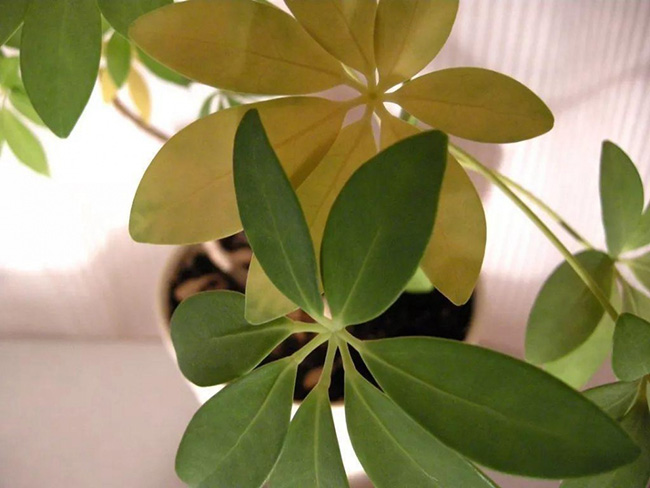
1. Choose flowers according to the season
Most foliage plants are native to tropical regions, so they all like warm, humid environments. From spring to autumn is their most vigorous growing season. In places with lower temperatures, avoid buying tropical plants in winter; even with heating at home, they are very hard to grow well.
(Schefflera arboricola with yellow leaves from too much water)
In winter, also do not buy bare-root lucky bamboo for water rooting. The difficulty of getting it to root is much higher than in other seasons.
2. Variegated cultivars
If you are choosing variegated foliage plants, then you must choose plants with distinctly marked leaves, so that after you buy them and care for them at home, the variegation is less likely to fade, and they will also be more ornamental when grown.
3. Choosing large-leaved green plants
Usually, when buying large-leaved foliage plants, you should pay more attention to whether the leaf surfaces and undersides have markings, whether there are small spots or yellow patches. The leaves at the bottom should be relatively thick and fleshy, and make sure the leaves are not damaged. It is even better if small new buds or small leaves are growing from the upper part of the stems and roots.
4. Choosing ferns
For ferns, you must choose plants that are lush, with no obvious dead branches or withered leaves on the stems and leaves, relatively simple lower stems, clear leaf veins, and glossy leaves. Of course, also check whether there are tender buds at the top.
5. Check whether the plant has pests or diseases
The key point when choosing foliage plants is to check whether there are pests or diseases, such as whether there are disease spots on the leaf surface. It is best to carefully check and clean the leaf undersides and leaf axils as well, so that you can understand their condition as much as possible.
6. Choosing large potted plants
For foliage plants, you must choose ones with dense leaves and a round, full plant shape. While the leaves are dense, you should also make sure the leaves grow closely together. The leaves do not necessarily have to be large.
Also pay attention to the gloss of the leaf surface. Choosing a plant with bright, deep green leaf color means it is the most robust. After buying it and bringing it home, you can keep its nutrients sufficient.
The ten best foliage plants for indoor growing, water culture or soil culture, your choice!
Home gardening is becoming more and more common. Many flower growers keep plants just to make the home feel more alive~ Just one more touch of green makes the home a bit fresher. As for growing them well and exquisitely, that takes too much time……
The editor recommends the ten plants best suited for growing at home. Most of them can be grown in water, too. Isn't that thoughtful?
1. Golden pothos
Golden pothos is a must-recommend from the editor, and it is also something everyone knows well. Basically, an office can lack any green plant, but there will definitely be a pot of golden pothos!
Golden pothos likes shade. Giving it light once a week is enough, and it will not die even with completely indoor indirect light.
When the water runs out, just add more. No need to specially change the water. This is what they call tough love growing!
2. Spider plant
Spider plant is grown for its leaves and roots, and it also blooms!
Water culture looks quite pretty, and soil culture easily fills the pot!
However, spider plant needs light. Without light, spider plant loses its green color and turns yellow and white, becoming frail and delicate……
3. Pennywort
Pennywort is similar to spider plant and also needs light. Without light, its stems grow thin and tall from etiolation and easily fall over.
If you choose the right container for pennywort, it can be very beautiful!
4. Lucky bamboo
Lucky bamboo has a good name and a good meaning!
It is also very easy to grow. Just put it in a glass bottle and change the water frequently.
Green plants all need light, and lucky bamboo is no exception~
There is a folk trick for growing lucky bamboo: drop two rusty iron nails into the glass bottle, and it can make lucky bamboo green and beautiful. You can try it~
5. Ivy
Ivy is a very common climbing plant. Under overpasses, there are whole patches of it!
If your home has a wall, then you can go home and try growing a wall of ivy~
Put two sprigs of ivy in water, and it also has a special charm~
6. Maidenhair fern
Maidenhair fern has very high ornamental value among foliage plants. Its thin, black, wire-like stems paired with small fan-like, emerald green leaves make it so beautiful when placed on an office desk!
Maidenhair fern likes water and often grows beside streams; it likes bright indirect light and avoids direct sunlight, so growing it indoors is just right~
That is all for plants that can be grown both in water and in soil. Next, let us introduce several green plants grown in soil~
7. Money tree
Money tree is a very common plant on computer desks, but money tree has one problem that everyone must pay attention to:
A money tree that has been indoors for a long time should not be casually moved outside to bask in the sun. Money tree is especially sensitive to light!
Some people, on a whim, give their money tree some sun, and then the leaves turn yellow, become transparent, and die……
8. ZZ plant
The leaves of the ZZ plant look like a long string of coins, symbolizing bringing in wealth and treasure, glory and prosperity!
The ZZ plant is also easy to grow. Water it thoroughly and place it on a table, and you do not need to manage anything; it will sprout new shoots on its own~
Its meaning is also excellent. If you need to give a gift, you might consider giving a ZZ plant. It is easy to grow, beautiful, and has a good meaning!
9. Dumb cane
When dumb cane blooms, it really looks like Guanyin. If you have the chance, you must try growing one to bloom~
The editor has a very large dumb cane at home. At the beginning of the year it froze to death, so all the leaves were cut off. Now it has not only grown back, but also bloomed!
The "dripping" in dumb cane refers to its sap dripping from the leaf tips, and this sap is slightly toxic!
Flower growers with small children at home should probably not grow it~
10. Asparagus fern
Asparagus fern gives people a refined, literary air, and placing it in the living room makes the space look very elegant!
But asparagus fern is just a little harder to grow than the plants introduced above……
Asparagus fern leaves easily turn yellow. Light and water are both indispensable!
The reason asparagus fern is placed last is to let everyone grow them one by one, slowly. Does it feel like leveling up and fighting monsters~~
Every plant grower will grow these 5 foliage plants
Foliage plants can be seen everywhere in life, such as golden pothos, snake plant, ivy, money tree, and so on, but there are also some less common foliage plants. They have very unusual plant shapes and are also relatively ornamental. Of these 5 below, how many can you recognize?
Every plant grower will grow these 5 foliage plants1. Crystal anthurium
Actually, crystal anthurium and anthurium are the same type of plant. Looking at their flowers and leaves, their forms are about the same. It belongs to the foliage-type plants, and very few people grow it. This is not because it is not beautiful, but because it is relatively difficult to care for, so you will not see it in flower shops. It can still be found in large flower markets.
It likes warm, humid environments and needs relatively high environmental humidity, which is generally hard to achieve in ordinary homes. It has thick, velvety leaves, and the leaves have striking variegated veins. It can also bloom, with flowers like candles, though its flowers are far inferior to those of anthurium.
Every plant grower will grow these 5 foliage plants
2. Foliage begonia
We have seen very many kinds of flowering begonias, such as Rieger begonia, wax begonia, and so on, but how many foliage begonias have you seen, especially the following type with spiral leaves?
The leaves of this foliage begonia are very large, and the patterns on the leaves are also very rich. Besides these spiral-patterned flowers, there are actually many other types of patterns, as shown below.
The leaf patterns of foliage begonia are wonderful, and paired with the markings, they are relatively ornamental. Of course, they can also bloom small flowers, but against the large leaves, the flowers have little distinctive feature.
They like warm, humid environments, like indirect light, and need loose, fertile soil, avoiding waterlogged soil.
Every plant grower will grow these 5 foliage plants
3. Tank bromeliad
Ornamental bromeliads are very rich in varieties, and this tank bromeliad is one of them. Its plant shape is very compact, its leaf colors are also relatively rich, and care requires a warm, humid environment.
It is a foliage plant. At the center of the leaves there is a large water cup, which is where it stores nutrients. They can collect natural fallen leaves, animal droppings, and so on, and can convert them into fertilizer for their growth.
When caring for it, you can directly water its leaf center, so it is called tank bromeliad.
Every plant grower will grow these 5 foliage plants
4. Caladium
It is the most brilliant of the foliage plants and is very popular in the horticultural world. Its leaves are broad, and its leaf colors are beautiful, charming, and rich. Moreover, its leaves have striking patterns, and the leaf markings of each cultivar are different. It is suitable for growing together with other plants.
They like warm, humid environments. Care requires frequent watering to keep the soil moist. The minimum temperature during care should be kept above 5 degrees. When the air is dry, spray water appropriately to increase humidity.
It is afraid of cold and excessive dryness. Only by maintaining beautiful leaf color can it keep growing healthily. In summer care, it can get some light in the morning, but in the afternoon it should be shaded appropriately to avoid scorching sun.
Every plant grower will grow these 5 foliage plants
5. Coleus
Coleus is also called painted nettle. Its varieties are very rich, and care is relatively simple. In temperate regions it is generally grown as an annual plant, while in more southern regions it is a perennial plant. Care requires a warm, humid environment. In winter, as long as the roots and stems do not wither, it can grow again the next year.
Its leaf colors are striking and beautiful, and its leaf colors are very rich. The leaf shapes also differ quite a bit. It can also produce beautiful and delicate flowers.