What are the cultivation methods and precautions for the corn plant (Dracaena fragrans)
Morphological characteristics of the corn plant
The corn plant is an evergreen tree that can reach a height of over 6 m. The leaves are clustered at the top of the stem, 40-90 cm long and 6-10 cm wide, broadly linear, with slightly blunt tips, curving into an arch shape; the leaf margins are wavy and undulating, bright green, with parallel veins, glossy, and nearly stalkless. The panicle bears small, clustered, yellow-green flowers that release fragrance toward evening. The fruit is orange-yellow.
Growing environment of the corn plant
The corn plant likes a hot and humid climate. It is highly adaptable to light and can grow in slight shade or in sunlight, but in spring, autumn and winter it should receive plenty of sunlight, while in summer it should be shaded or placed indoors in a well-ventilated spot. The corn plant is vigorous, needing only sunlight, air and very little water, and can live well on its own stored energy. The corn plant is drought-tolerant but not waterlogging-tolerant. It can be watered generously during the growing season. The corn plant is sensitive to cold and freezing, so in winter it should be placed indoors in a sunny spot, with the temperature maintained at 5°C-10°C.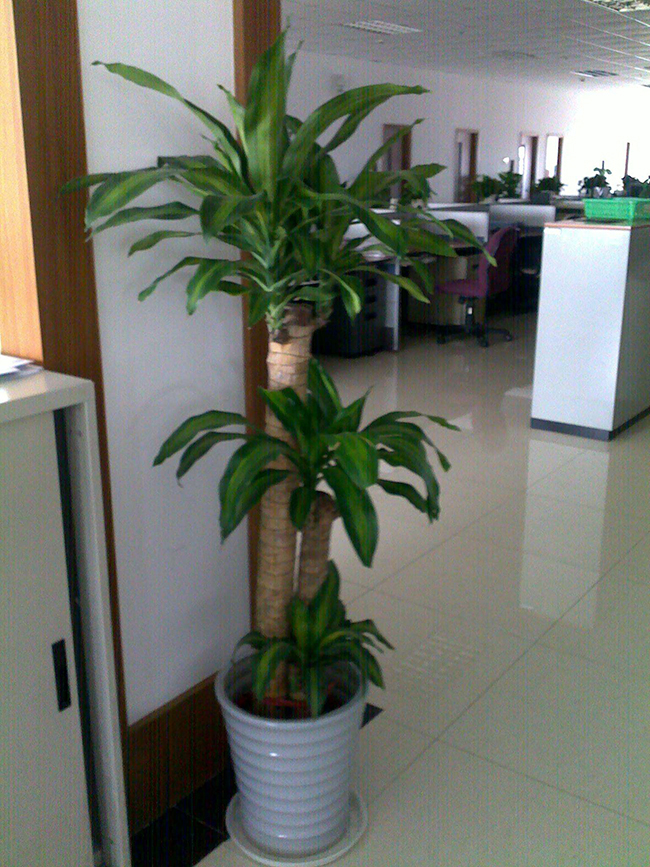
Main value of the corn plant
The corn plant is a rather popular large indoor potted foliage plant, especially when placed in a relatively spacious living room, study or lounge, where it creates an elegant, simple style with a tropical flavor. It is a world-famous new-generation indoor foliage plant with a graceful, neat plant shape.
Propagation methods of the corn plant
Soil cutting method:
For soil cutting, cut the top stems and branches trimmed from an old plant into 8-10 cm small sections and insert them into clean river sand; roots will form as long as a certain humidity is maintained.
Water cutting method:
Insert the cuttings 2-3 cm into water and change the water frequently to keep it clean; roots will form in 1 month.
Soil selection for the corn plant
The soil should be fertile and well-drained, suitable for indoor cultivation. For potting, a mix of leaf mold, potting soil and coarse sand is best. Potted corn plants on the market mostly use fine sandy soil, which helps the plant root, but long-term use will be unfavorable to plant growth due to lack of fertilizer, so it must be replaced with the above-prepared mixed soil. Repotting must be done every spring: new plants once a year, old plants once every 2 years.
Daily care precautions
1. Placement of the corn plant
The corn plant needs bright light all year round, with at least 3 hours of direct sunlight every day.
2. Fertilizing the corn plant
Organic fertilizer can be buried at the base or along the edge, and after half a month apply a liquid organic-inorganic mixed fertilizer (urea or potassium dihydrogen phosphate solution). During the growing period, foliar topdressing can also be done appropriately, spraying the leaves with a nutrient solution diluted 100 times, once every half month. In winter, the amount of fertilizer can be halved or stopped. Nitrogen fertilizer should not be applied too much, otherwise the golden-yellow markings on the leaves will be less obvious and the ornamental effect will be affected.
3. Watering the corn plant
The corn plant has a low water requirement; watering is generally done about once every 10 days, and the potting soil should be kept half dry and half moist. Do not water too much, to prevent the trunk from rotting. In addition, when cultivated in the north, because the climate is dry, the leaves and the surrounding ground should be sprayed with water frequently to increase the surrounding air humidity, which benefits the growth of the corn plant.
4. Temperature and light for the corn plant
The suitable growing temperature for the corn plant is 20-30°C. In winter it can survive at 10°C or above; when the temperature is too low, growth stops and yellow-brown spots appear at the leaf tips and margins. The corn plant prefers some shade and grows well in bright, indirect light. In summer, avoid direct light and place it in a cool spot. In autumn and winter, placing it indoors in a sunny spot is sufficient. When light is too little, the leaves of the corn plant turn gray-green with unclear stripes, and the basal leaves yellow; especially for variegated varieties kept under low light for a long time, the colors become lighter or disappear, thus losing their ornamental value.
5. Pest and disease control for the corn plant
The corn plant has few pests and diseases, but in recent years the incidence rate has been rather high, mainly caused by moth pests hidden in the branches and trunks brought from its place of origin. When eroded by pests and diseases, the plant shows symptoms such as loose, shedding bark and falling leaves. You can first spray insecticide on the plant's branches and trunks, then cover them with plastic paper to suffocate the eggs or larvae. You can also peel back part of the bark, remove the pests with tweezers, and then spray the medicine to prevent spread. A tobacco infusion can also be sprayed. In addition, attention should be paid to keeping the leaves clean and providing appropriate ventilation to improve the micro-environment.
For damage from leaf spot disease and anthracnose, spray with a 1000-fold dilution of 70% thiophanate-methyl wettable powder. For pest damage from scale insects and aphids, spray with a 1000-fold dilution of 40% omethoate emulsifiable concentrate.
How to grow the corn plant_ cultivation methods and precautions for the corn plant_ corn plant pictures
The corn plant carries the meaning of happiness, and people like to give it to friends to express good wishes. The corn plant is also a very good indoor potted plant, mostly seen in offices. So how do you grow the corn plant? Let's look at the cultivation methods and precautions for the corn plant.
1. How to grow the corn plant
The corn plant has a graceful, neat plant shape and is slightly shade-tolerant. It likes high temperatures; below 13°C the plant goes dormant and stops growing. It likes loose, well-drained soil; for potting, use fertile soil rich in humus and well-drained, which can be made by mixing leaf mold and river sand. The corn plant is drought-tolerant but not waterlogging-tolerant. It can be watered generously during the growing season. In winter it should be placed indoors in a sunny spot, with the temperature maintained at 5°C-10°C.
2. Cultivation methods for the corn plant
1. Soil:The corn plant is suitable for loose, well-drained, fertile river-sand loam rich in humus, and avoids alkaline soil. For potting soil, use leaf mold or peat soil, adding about 1/4 river sand or perlite and a small amount of decomposed organic fertilizer. Loose soil that drains well and is rich in organic matter is beneficial to its growth.
2. Sunlight:The corn plant has a wide range of adaptability to light, but it is not tolerant of strong light; especially the strong sunlight from May to October can cause the leaves to yellow or the leaf tips to scorch, so shading should be provided and bright indirect light is sufficient. Although it is shade-tolerant, too much shade will also make the leaf color dull; especially for variegated varieties, the markings on the leaf surface easily disappear, reducing ornamental value.
3. Temperature:The suitable growing temperature for the corn plant is 20°C to 28°C, the dormancy temperature is 13°C, and the wintering temperature is 5°C. If the temperature is too low, yellow-brown spots will appear at the leaf tips and margins, and in severe cases the tender branches or the whole plant may be damaged by freezing. Therefore, in the north it must be moved into a greenhouse for winter care. If placed indoors, it should be placed in a spot with light, and the room temperature should preferably be kept at 6°C to 8°C or above.
4. Watering:For corn plants grown in the north, during the growing period in spring, summer and autumn, water once every 2 to 3 days on sunny days, and spray the leaves once to twice a day. After late autumn, watering should be controlled, keeping the potting soil slightly moist. In winter, watering should be controlled, keeping the potting soil half dry and half moist; too much water will cause root rot and scorched leaves.
5. Fertilizing:During growth, the corn plant consumes some of its own nutrients; if fertilizer is not applied in time, it will lack staying power and gradually degenerate. During the growing period, first bury organic fertilizer at the base or along the edge, then apply liquid fertilizer once every 15 to 20 days, or compound fertilizer once to twice, to ensure luxuriant growth of branches and leaves. Fertilizer should be applied thinly, never as a concentrated fertilizer; the fertilizing period is from May to October each year. Stop fertilizing in winter and move the plant indoors to overwinter. For variegated varieties, attention should be paid to reducing the proportion of nitrogen fertilizer when fertilizing, to avoid excessive leaf growth and to prevent the markings from becoming dull or even disappearing.
6. Pests:Common pests and diseases of the corn plant include damage from leaf spot disease and anthracnose, which can be sprayed with a 1000-fold dilution of 70% thiophanate-methyl wettable powder. Pest damage from scale insects and aphids can be sprayed with a 1000-fold dilution of 40% omethoate emulsifiable concentrate.
Precautions for growing the corn plant
1. The corn plant grows vigorously and can form a large plant. However, if the plant is too tall, or the lower leaves fall off, the ornamental effect is affected, so pruning is needed. When pruning, if you cut off the top of the plant or about 15 cm above the ground, buds will sprout below the cut and grow into new branches.
2. The wintering temperature for the corn plant should be kept above 10°C; the silver-striped corn plant has slightly stronger cold resistance, but the temperature should not be lower than 8°C. After late August, fertilizing should be stopped to enhance wintering ability.
3. The corn plant likes a high-humidity (70%-80%) environment. When new leaves emerge, if the air is too dry, the leaf margins and tips easily wither and curl, so spraying of the leaves and surrounding environment should be strengthened during the growing period. During growth, pay attention to providing sufficient water and keeping the potting soil moist, but avoid waterlogging.
4. When the plant grows too tall and the lower part becomes bare, the overly long part can be cut off. After trunk cutting, new branches will sprout below the cut on the remaining part, thus forming a more ideal plant shape.
Aboutthe cultivation methods and precautions for the corn plantthat's all for the introduction. The corn plant is more suitable for growing in a spacious area, so if your home or office space is small, consider it carefully.
Cultivation methods for the corn plant. Cultivation methods and precautions for the corn plant
The corn plant is a plant that likes hot weather and a humid climate. If the temperature and humidity conditions are suitable, the corn plant can grow all year round. The corn plant has strong adaptability to light and can grow in sunlight and in sheltered places. The corn plant has strong vitality; sunlight, air and water are enough for it to grow healthily. Below, the editor will introduce the cultivation methods and some precautions for the corn plant.
The first thing to note in the cultivation methods for the corn plant is temperature and light; the temperature should be controlled at 20°C to 28°C. When the temperature is below 13°C, the corn plant enters a dormant state; and when the temperature is below 5°C, yellow-brown spots appear at the leaf tips and margins of the corn plant, and in severe cases it can even die. When the corn plant is placed indoors, it should be placed in a spot exposed to sunlight.
Second, the cultivation methods for the corn plant also require attention to the control of water and humidity. The corn plant does not need much water, but it has somewhat higher humidity requirements. Therefore, we only need to keep the potting soil moist and frequently spray the leaves with water to increase the surrounding air humidity. It is worth noting that water must not accumulate in the potting soil, as waterlogging will cause the roots of the corn plant to rot.
The third point in the cultivation methods for the corn plant is to pay attention to soil and fertilizer; the corn plant is suitable for growing in loose, fertile river-sand loam. In addition, the corn plant should be repotted and the soil changed once a year to keep the soil nutrients sufficient. Fertilizing is generally done by first applying organic fertilizer at the base or along the edge during the growing period, then applying liquid fertilizer once every 15 to 20 days, to ensure luxuriant growth of branches and leaves.
The cultivation methods for the corn plant also require attention to pest prevention, because sometimes the corn plant shows symptoms such as scorched leaves, which are caused by drought, too-low temperature, improper watering or fertilizing, and so on. At this time we should improve the cultivation management methods, pay more attention to controlling temperature and humidity, and also promptly remove pests and apply some diluted insecticide.
Summary:The corn plant has a very graceful plant shape; placed in the living room, it immediately makes the living room look high-end, elegant and classy. The corn plant has a rather strong fragrance; if you are not very comfortable with strong fragrances, just place it in a spacious, well-ventilated place. The corn plant is a very stylish and elegant plant with a charming tropical flavor, and is a rather famous indoor foliage plant in the world. Have you learned the above cultivation methods for the corn plant?
▽ Latest news articles ▽
◇ ▏Cultivation methods for gardenia ▏European royal cross-stitch ▏What to do when asparagus fern leaves turn yellow ▏Modern abstract painting ▏◇
◇ ▏What plants absorb formaldehyde ▏Wall art paint liquid wallpaper ▏Indoor plant pictures and names ▏Iris flower language ▏◇
◇ ▏Cultivation methods for narcissus ▏Cross-stitch "Abundance year after year" ▏What is the flower language of cornflower ▏Chongqing carpet cleaning ▏◇
◇ ▏The best cross-stitch brands ▏What fabric is chiffon ▏Which brand of down quilt is good ▏Lithops ▏◇
◇ ▏Is liquid wallpaper good ▏Cross-stitch brand rankings ▏Bedroom hand-painted wall pictures ▏Statice ▏◇