How to grow Calathea makoyana? Detailed guide to care methods and precautions
Introduction to Calathea makoyana
Calathea makoyana: family Marantaceae, genus Calathea, a perennial evergreen herb. The plant is upright and can reach 60 cm in height. The petioles are purplish-red, the leaves are thinly leathery, ovate-elliptic, and the leaf surface bears feather-like markings alternating dark green with white or pale yellow, just like the pattern on a peacock's tail feathers, which is how it got its name. The leaves also have a special trait: they spread open during the day and fold up at night.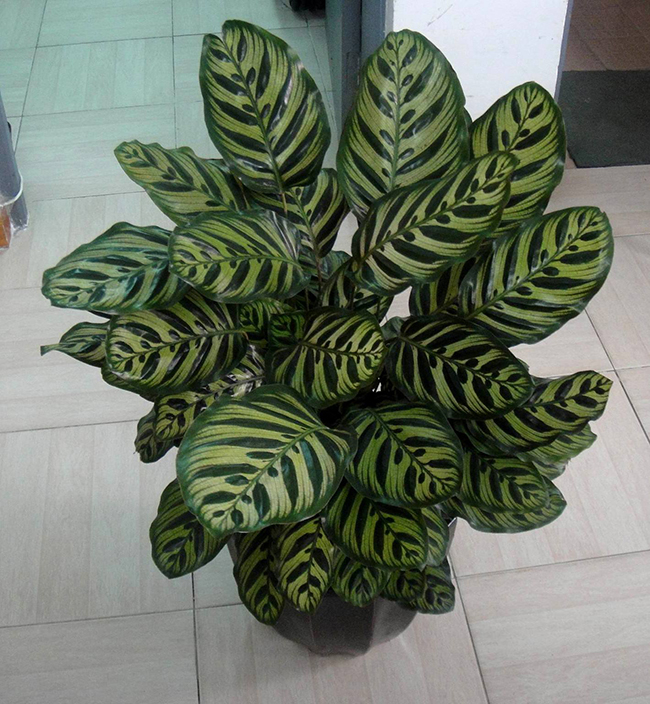
Growth habits of Calathea makoyana
It likes partial shade and cannot tolerate direct sunlight, and it adapts to growing in a warm, humid environment. When cultivating it, give it a certain degree of shade, and keep the temperature at around 12-29°C; in winter the temperature should be maintained at 16-18°C. It grows vigorously in spring and summer and needs relatively high air humidity, so misting can be done; it is not very demanding about soil, but the soil should be kept moderately moist. During the growing season, fertilize about once every 2 weeks, while in winter the soil can be slightly dry and cool, and the frequency of fertilizing should be reduced;
Propagation methods of Calathea makoyana
Division is generally used, carried out in early summer each year when the daytime temperature is around 20°C (if the temperature is too low, division easily damages the roots, affecting survival or causing weak growth). After digging out a densely growing old plant, divide it along the underground rhizome, leaving 2-3 buds per section. After cutting, pot them up immediately, place them in a cool place for a week, then gradually move them to a spot with ample light. In the early stage after dividing and planting, water should be controlled, and only after new roots have formed should they be watered thoroughly.
Division propagation
This can be done in spring between March and April in conjunction with repotting and changing the soil. The number of divisions at one time should not be too many, otherwise it will affect the growth of the plant; it should be determined by the size and vigor of the mother plant.
Cutting propagation
In summer, select young shoots with 2 to 3 leaves at the base as cuttings, or use the stolons of some species for cuttings. A mix of half peat soil and half river sand, or vermiculite and perlite, can be used as the medium. Keep it moist, and roots will form in about 5 weeks, after which they can be divided and potted up.
How to grow Calathea makoyana
Soil selection
For potted Calathea makoyana, use a loose, fertile, well-drained, humus-rich, slightly acidic loam. Generally, it can be mixed from 3 parts leaf mold, 1 part peat or sawdust, and 1 part sand, with a small amount of soybean cake added as a base fertilizer. Avoid heavy garden soil. When potting, first place a 3 cm thick layer of coarse sand at the bottom of the pot as a drainage layer to facilitate drainage.
Water requirements
During the growing period, give sufficient water. Especially in summer and autumn, in addition to keeping the potting soil moist at all times, you must also frequently spray water on the leaves to lower the temperature and maintain humidity; it requires relatively high air humidity, ideally 70% to 80%; avoid dry air and dry potting soil, but do not let water accumulate. After late autumn, water should be controlled to help it resist the cold and survive winter. In winter, keep the environment dry; if it is too wet, the basal leaves will turn yellow and scorch, affecting its ornamental value.
Light requirements
During the growing season from May to September, place it in a shaded or partially shaded spot, maintaining a light transmittance of 40%-60%, and avoid direct burning sun. Too strong light or dry air easily causes the leaf margins and leaf tips to scorch and the leaf markings to become dull and lusterless; however, the light should not be too weak either. If it is kept for a long time in a dark room with low temperature and insufficient light, its growth will also weaken, which is unfavorable for leaf color formation, and it will lose the unique metallic luster of the leaf surface. In winter, it can receive direct sunlight through glass.
Fertilizing requirements
When Calathea makoyana lacks fertilizer, the plant is noticeably shorter, the leaf color is dull, and the golden luster is not vivid. During the growing season, apply a dilute liquid fertilizer once every 20 days, with a nitrogen-phosphorus-potassium ratio of 2:1:1, which can make the leaf color glossy and vivid. Be sure not to use too high a proportion of nitrogen fertilizer. For example, spraying a 0.2% liquid fertilizer directly on the leaf surface every 10 days is very beneficial for budding and growth. Stop fertilizing in winter and summer.
Pest and disease control
Calathea makoyana has relatively few pests and diseases, but under conditions of dry air and poor ventilation, it is prone to scale insects, whiteflies, and the like. These can be killed by spraying with a 1000-fold dilution of 25% phosmet emulsion or a 1500-fold dilution of 40% omethoate.
Precautions for growing Calathea makoyana
Calathea makoyana has relatively shallow roots, so it is best to choose a wide, shallow pot; this way it does not affect root growth, and when the leaves spread open during the day it will not look top-heavy. The potting soil should preferably be loose, breathable, well-drained, nutrient-rich, and slightly acidic.
Calathea makoyana is generally repotted in spring when it is divided, once every 1-2 years. When repotting, add new growing medium, cut off residual roots and withered leaves, and replant to encourage growth.
Calathea makoyana has relatively few pests and diseases, but if ventilation is poor and the air is dry, scale insect damage can also occur, which should be prevented and controlled by spraying with imidacloprid-series pesticides.
Main value of Calathea makoyana
Calathea has underground rhizomes or tubers, and the leaves are single and relatively large. In addition to an open leaf sheath at the base, the leaf also has a noticeably swollen joint where the leaf blade connects to the petiole, called the "pulvinus," which contains water-storing cells and functions to adjust the direction of the leaf, that is, at night when water is sufficient the leaf stands upright, and during the day when water is insufficient the leaf spreads open. This is a characteristic of plants in the family Marantaceae. In addition, some Calathea also have "sleep movement," that is, the leaves spread open during the day and fold up at night, which is very peculiar.
How to grow Calathea makoyana? Growing methods and precautions for Calathea makoyana
Calathea makoyana is a perennial evergreen herb. Its feather-like marked leaves are like a peacock's unfurled feathers, very beautiful, and it also has a special trait: it spreads open during the day and folds up at night. So, how do you grow Calathea makoyana? Below we introduce the growing methods and precautions for Calathea makoyana.
Best propagation time for Calathea makoyana: Calathea makoyana is mostly propagated by division, generally carried out in spring from April to May in conjunction with repotting and changing the soil. Dividing too early when the temperature is too low slows wound healing, easily causes rot, and reduces the survival rate.
Key points for propagating Calathea makoyana: Calathea makoyana is mostly propagated by division, carried out in spring from April to May in conjunction with repotting and changing the soil. Dividing too early when the temperature is too low slows wound healing, easily causes rot, and reduces the survival rate. When dividing, knock the mother plant out of the pot, remove the old soil, and use a sharp knife to cut every 3-4 buds into 1 plant. Apply charcoal powder to the cut surfaces to prevent rot. After cutting, pot them up immediately, water thoroughly, and place them in partial shade to recover. After 5-7 days they can be returned to normal care. When dividing, it is best to plant 3-5 plants per pot. If only one plant is planted per pot, more than 5 leaves must be retained and more roots must be kept, otherwise it will affect the survival of the plant and its growth and development after survival.
Best growing soil for Calathea makoyana: For potted Calathea makoyana, use a loose, fertile, well-drained, humus-rich, slightly acidic loam. Generally, it can be mixed from 3 parts leaf mold, 1 part peat or sawdust, and 1 part sand, with a small amount of soybean cake added as a base fertilizer. Avoid heavy garden soil. When potting, first place a 3 cm thick layer of coarse sand at the bottom of the pot as a drainage layer to facilitate drainage.
Humidity requirements for growing Calathea makoyana: The suitable air humidity for Calathea makoyana is 70%-75%, and when new leaves are emerging the humidity requirement is even higher. Therefore, during the growing season it should be watered sufficiently to keep the soil moist, but water should not accumulate. In summer, spray water on the leaf surface 2-3 times a day, and also sprinkle water on the surrounding ground to increase humidity and lower temperature, which benefits its growth. In winter, watering should be controlled; the potting soil only needs to be slightly moist. In northern winters, indoor air is dry, so in addition to spraying and washing the leaf surface with clean water at a temperature close to room temperature around midday, it is best to cover it with a plastic film cover at night to keep it warm and moist. To keep the leaves fresh, neat, and radiant, gently wipe the leaves with clean water about every half month.
Best growing temperature for Calathea makoyana: Calathea makoyana is not cold-tolerant. When overwintering, the room temperature should not be lower than 15°C. The suitable growing temperature for Calathea makoyana is 18-25°C. In summer the temperature must not be higher than 35°C, otherwise the plant will stop growing and the leaf color will turn yellow. In winter it must not be lower than 5°C to prevent cold damage.
Best growing light for Calathea makoyana: Calathea makoyana likes a high-temperature, humid environment and has strong shade tolerance. The light intensity should preferably be 30%-40%.
Note on watering Calathea makoyana: In summer, spray water on the leaf surface 2-3 times a day, and also sprinkle water on the surrounding ground to increase humidity and lower temperature, which benefits its growth. In winter, watering should be controlled; the potting soil only needs to be slightly moist. In northern winters, indoor air is dry, so in addition to spraying and washing the leaf surface with clean water at a temperature close to room temperature around midday, it is best to cover it with a plastic film cover at night to keep it warm and moist. If conditions permit, a humidifier can be used to raise indoor humidity. To keep the leaves fresh, neat, and radiant, the leaves should also be gently wiped with clean water about every half month.
Applying fertilizer to Calathea makoyana: During the peak growing season, apply a dilute liquid fertilizer about once every half month. When fertilizing, be careful not to apply too much nitrogen fertilizer, otherwise undesirable growth phenomena such as fading of leaf markings, thickening of leaves, and softening of petioles will occur. Generally, the application ratio of the three fertilizers nitrogen, phosphorus, and potassium should be 1:1:1; this ratio can make the leaf color glossy and beautiful.
Changing the potting soil for Calathea makoyana: Calathea makoyana is generally repotted in spring when it is divided, once every 1-2 years. When repotting, add new growing medium, cut off residual roots and withered leaves, and replant to encourage growth.
Pest and disease control for Calathea makoyana: Calathea makoyana has relatively few pests and diseases, but if ventilation is poor and the air is dry, scale insect damage can also occur, which should be prevented and controlled by spraying with imidacloprid-series pesticides.
Growing methods and precautions for Calathea makoyana
I. Cultivation
1. Knock the mother plant out of the pot and remove the old soil.
2. Use a sharp knife to cut the plant apart, so that each daughter plant has 3-4 buds and 5-7 leaves.
3. After cutting, apply charcoal powder to the cut surfaces to prevent the cuts from rotting.
4. Then pot up the daughter plants and water them thoroughly. First place them in a partially shaded place for care so that they gradually resume growth. Only after about 5-7 days can they be moved to a place with relatively good light for normal care.
Beginner's tip: Before potting, first place coarse sand about 3 cm thick at the bottom of the pot as a drainage layer to ensure smooth drainage.
II. Watering
1. During the growing season, provide the plant with sufficient water. Especially when the climate is dry in summer, in addition to watering daily to keep the potting soil moist, also spray clean water on the leaf surface 2-3 times a day to lower the temperature, maintain a certain humidity, and promote the plant's growth and development.
2. After entering winter, be careful to control watering and keep the potting soil in a non-dry state to help it through the winter. Wait until the plant sends out new leaves the following spring before returning to normal watering.
III. Light
Calathea makoyana can tolerate shade relatively well and fears intense direct sunlight. It can be kept for a long time in a room with ample scattered light.
IV. Temperature
The suitable growing temperature for Calathea makoyana is 18°C-25°C.
V. Fertilizing
Ordinarily, a 0.2% liquid fertilizer can be sprayed directly on the leaf surface once every 10 days. During the growing season, apply a low-concentration liquid fertilizer once a month. When fertilizing, mainly apply phosphorus fertilizer and potassium fertilizer, and it is not suitable to apply too much nitrogen fertilizer.
VI. Pest and disease control
1. The disease that commonly occurs on Calathea makoyana is leaf spot. Once it is found, immediately remove all diseased and disabled leaves and weeds to prevent the disease from spreading further, and use a 500-600-fold dilution of 50% mancozeb wettable powder.
2. When Calathea makoyana is harmed by scale insects, whiteflies, and the like, spraying with a 1000-fold dilution of 25% phosmet emulsifiable concentrate or a 1500-fold dilution of 40% omethoate emulsifiable concentrate can effectively deal with them.
VII. Pruning
Every year when changing the pot, dry roots and withered leaves should be cut off to promote faster growth of the plant and maintain a beautiful shape.