How to Grow and Care for Bird's Nest Fern: Methods and Precautions
Bird's Nest Fern Growth Habits
The bird's nest fern often grows as an epiphyte on tree trunks or on rocks beneath the forest canopy in rainforests or monsoon forests. It prefers high temperatures and humidity, and cannot tolerate strong light.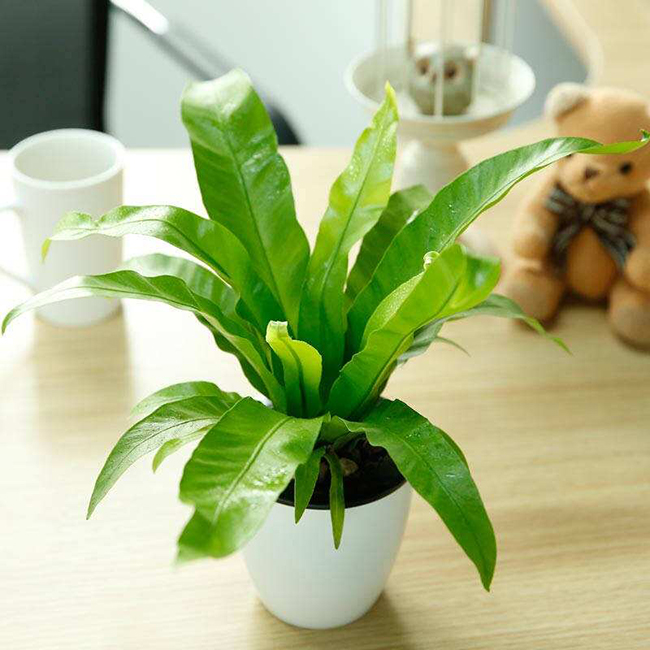
Bird's Nest Fern Growing Methods
1. Temperature:
Its optimal growing temperature is 16°C to 27°C, of which March to October is 22°C to 27°C, and October to March of the following year is 16°C to 22°C. In summer, when the temperature exceeds 30°C, measures such as building a shade frame and spraying water around the bird's nest fern's environment to lower the temperature and increase humidity should be taken, so that it can continue to maintain vigorous growth. Whether for household potted plants or commercial cultivation, it is best to maintain a greenhouse temperature above 15°C in winter so that it can continue to grow. When conditions do not allow, at least maintain a greenhouse temperature no lower than 5°C. If the temperature is too low, it easily causes the leaf margins to turn brown, and may even cause plant death due to cold damage.
2. Light:
The bird's nest fern's native environment is in moist jungles, where it mostly grows as an epiphyte. It only needs a small amount of scattered light to grow normally, so potted plants can be kept year-round in a bright indoor spot for care. If placed outdoors for short periods in spring and autumn under tree shade or in a greenhouse, it is even more beneficial for its growth and can increase the glossiness of the leaf surface. Potted bird's nest ferns must never be exposed to scorching sun, otherwise the plant will show abnormal phenomena such as deteriorated and yellowing leaf color, sunburned leaf surfaces, and scorched leaf margins, reducing its ornamental value. In summer, it should be placed under a shade shed with more than 70% shading, which is relatively beneficial for its growth. In winter, inside the greenhouse, appropriate light should be given, and artificial supplemental light should be provided in overly dark places.
3. Water:
Potted bird's nest ferns require not only moist potting soil but also relatively high relative air humidity. During the growing season, watering should be sufficient. Especially in summer, in addition to frequently watering the growing medium thoroughly, the leaf surfaces must also be rinsed 2 to 3 times a day, while also sprinkling water on the surrounding ground to increase humidity, maintaining relatively high air humidity in the local environment. This can both increase the glossiness of the leaves and is very beneficial for the germination of spore leaves. If the potting soil lacks water or the air is relatively dry, it easily causes the leaf margins to dry out and curl. When winter temperatures are relatively low, it is better to keep the potting soil moist, and you can spray more water and water less, so as to avoid root rot caused by excessive water in the potting soil under low-temperature conditions. Because its leaves are leathery, they can prevent water evaporation, so it can also tolerate short periods
of dry conditions. It is precisely because of this that it is relatively suitable for indoor cultivation and display.
4. Soil:
The potting medium can be mainly leaf mold or peat soil, vermiculite, etc., mixed with a small amount of river sand. It can also be made by mixing fern roots, crushed bark, moss, or crushed brick particles with a small amount of humus soil and blending evenly. Where conditions permit, it is best to use a porous flower pot or porous plastic basket as the container, with 1/3 crushed brick particles placed at the bottom of the pot, and fern roots, bark chunks, moss, leaf mold, etc. added above, and then the bird's nest fern's roots planted into it. In this way, growth will be even more vigorous. For potted bird's nest ferns, the pot can be changed once every 2 years. Take it out of the flower pot, shake off the old soil, cut off some residual roots and withered yellow leaves, and plant the separated offsets separately. After replacing the growing medium for the old plant, plant it properly in a slightly larger pot. In addition, in spring each year, a small amount of crushed lime can be added to the pot, which is beneficial to the growth and development of its side shoots.
5. Fertilizer:
The bird's nest fern's special form and structure are beneficial for absorbing water and nutrients. Its rhizome is short and densely covered with scales, and produces large clusters of sponge-like fibrous roots that can absorb relatively more water. The leaves radiate from the top of the rhizome, forming a bird's nest shape or a hollow funnel shape. In its native environment, it can collect fallen leaves, bird droppings, and rainwater in its nest. These substances are converted into humus and can serve as an important part of its own nutrient source. For potted bird's nest ferns, during the vigorous growing season, it is advisable to apply a diluted fertilizer balanced in nitrogen, phosphorus, and potassium once every half month, which can promote the continuous growth of large numbers of new leaves. If the plant lacks fertilizer, the leaf margins will also turn brown. When the summer temperature is above 32°C, or the winter greenhouse temperature is below 15°C, all forms of topdressing should be stopped.
Bird's Nest Fern Precautions
1. For potting soil, use peat soil or leaf mold, and keep the temperature at 22-27°C.
2. In summer, when the temperature is high, the new leaves of the bird's nest fern need more spraying during growth to maintain appropriate air humidity and promote spore germination.
3. Maintain appropriate sunlight and avoid direct sunlight.
4. When winter temperatures are relatively low, keep the potting soil moist.
Bird's Nest Fern Pest and Disease Control
1. Disease - anthracnose:
In environments with high temperature and high humidity and poor ventilation, the leaves are susceptible to anthracnose, whose lesions are brown, with obvious concentric rings in the later stage.
Control method: In the early stage of the disease, you can uniformly spray with 75% chlorothalonil wettable powder 600x solution, or 70% thiophanate-methyl wettable powder 1000x solution, or 10% difenoconazole water-dispersible granules 2500x solution, once every 10 days, for 3 to 4 consecutive times. In addition, attention should also be paid to preventing sunscald, cold damage, and so on.
2. Pest - nematodes:
Nematode damage to bird's nest ferns can cause brown net-like spots to appear on the leaves.
Control method: Carbofuran or fenamiphos granules can be spread on the surface of the potting soil, and the insecticidal effect is relatively good.
How to Care for Bird's Nest Fern: Growing Methods and Precautions
The bird's nest fern's naturally spreading emerald-green leaves are like an enthusiastic and unrestrained young person waving to you. Besides being beautiful, it also has medicinal value. So what exactly are the growing methods and precautions for this treasure of a bird's nest fern? I believe everyone wants to know, so the following content should not be missed.
Bird's Nest Fern Growing Methods and Precautions
Bird's nest fern, also known as mountain asparagus flower, is a plant of the Aspleniaceae family, genus Asplenium, and is native to eastern Australia, Southeast Asia, Indonesia, and other places. Its plant height is about 0.8-1 m, with an upright stem that is thick and short. The entire scale is broadly lanceolate, the main vein is raised on both sides, and the other leaves spread out naturally. Like other ferns, it bears spores and has no flowering period. It likes to grow in high-temperature and humid environments, but cannot withstand strong light.
The suitable growing temperature for it is between 16°C and 27°C, and it requires growth in moist potting soil. It also has relatively high requirements for relative air humidity. Because summer temperatures are all high, it needs frequent watering to ensure the plant has sufficient water so that the leaves do not dry out and curl. When choosing a potting medium, leaf mold, vermiculite, or peat soil, etc., can be used as the main component, mixed with a small amount of river sand, and used as the growing soil. In its early growth stage, it needs to be fertilized once every 20 days. Once it matures, there is no need for additional fertilization.
Bird's Nest Fern Culinary/Medicinal Value
What many people do not know is that, besides its ornamental value, the bird's nest fern also has many uses.
It is a little expert at purifying air. The bird's nest fern is also a must-have green plant for a new home, because it can purify the air and remove the heavy smell of formaldehyde. It is also one of the recommended gifts for housewarming.
It is a good helper for treating injuries and recovering from illness. Because it is rich in potassium, iron, calcium, vitamin A, dietary fiber, and other substances, it can strengthen muscles and bones and invigorate blood circulation to remove stasis. In addition, it can also be used in the treatment of fractures, headaches, and other diseases.
It is a good dish with a bitter taste and pleasant flavor. The tender buds of the bird's nest fern can be eaten. After being rinsed clean, simply blanch them briefly in boiling water and they are ready to eat, or they can also be used as a side dish and eaten together with other ingredients.
After reading this introduction to the treasure of a bird's nest fern, do you feel eager to grow one? Although growing a bird's nest fern is not difficult, you still should not be careless. You should know that growing a plant well requires time and patience, and I hope plant lovers can draw some inspiration from this.
Bird's Nest Fern: Growing Methods and Precautions for Bird's Nest Fern
The bird's nest fern is a plant 80 cm to 100 cm tall, with an upright, thick and short, woody rhizome about 2 cm thick, and dark brown in color. It is native to Southeast Asia, eastern Australia, Indonesia, India, eastern Africa, and other places, and is widely distributed in tropical regions of China. The bird's nest fern often grows as an epiphyte on tree trunks or on rocks beneath the forest canopy in rainforests or monsoon forests. It relatively prefers high temperatures and humidity, and cannot tolerate strong light. Today, let us look at the content about the growing methods of the bird's nest fern and precautions for yellowing leaves.
Bird's Nest Fern Introduction
The bird's nest fern is a species under the genus Asplenium in the family Aspleniaceae, and is a perennial shade-loving herbaceous foliage plant. It is also known by another name, mountain asparagus flower. The bird's nest fern likes to grow on tree trunks and rocks beneath the forest canopy in rainforests or monsoon forests. It relatively prefers high-temperature and moist-soft environments, but cannot tolerate strong light. The bird's nest fern generally has a plant height of about 80 cm, with an upright, thick and short, woody rhizome about 2 cm thick, dark brown, with the apex densely covered with scales. The scales are broadly lanceolate, about 1 cm long, with an acuminate apex, entire margins, membranous, dark brown, and slightly glossy. It has the effects of strengthening muscles and bones and invigorating blood circulation to remove stasis, and is also suitable for conditions such as bruises, fractures, blood stasis, headaches, bloody strangury, impotence, and gonorrhea.
Bird's Nest Fern Growing Methods
[Sowing]: For potted bird's nest fern soil, it is best to choose peat soil or leaf mold, and pot it in spring. Mix fine sand and humus soil evenly, disinfect at high temperature, put it into a sowing pot and level it, evenly scatter mature spores on the potting soil, then immerse the entire pot in shallow water and use osmosis to fully moisten the potting soil, cover with glass to retain moisture, and place it in a warm, moist, and shady place. The bird's nest fern can germinate in 7-10 days, and after about 1 month, green prothalli will grow. After 3 months, when several true leaves have grown, it can be potted for cultivation.
[Division]: In late April each year, the bird's nest fern can be divided. Generally, when dividing, choose robustly growing plants, cut the rhizome together with leaves and root clusters into several pieces, or pull off the small offsets growing beside it, cut off 1/2 of the leaves, pot them separately, and cover with a small amount of leaf mold to create a small environment that is moist, ventilated, and well-drained. The environmental temperature should be controlled at around 25°C, and the survival rate is relatively high this way. When watering it, note that the potting soil must not be too wet, so as to avoid root rot. Division is the most effective propagation method for flower lovers.
[Temperature and Light]: The bird's nest fern is a plant that likes high temperature and moist-soft conditions and cannot tolerate light, so its growing temperature is best at 25°C-27°C. In summer, it should be shaded, or placed in a shaded spot, avoiding direct strong sunlight. This is beneficial for growth and makes the leaves glossy. When grown indoors, it should be placed in a bright place and not kept in a dark place for a long time. In winter, it should be moved into a greenhouse, with the temperature kept above 16°C so that it continues to grow, but the lowest temperature must not be lower than 5°C.
[Watering]: In summer, the weather is hot and humid. At this time, for the newly grown leaves of the bird's nest fern, we should spray water on them repeatedly. Spray the leaf surfaces fully and maintain relatively high air humidity, which is beneficial for the bird's nest fern's germination. As the leaves enlarge, they often cover the growing soil in the pot. When watering, be sure to water thoroughly through the pot, so as to avoid the plant's leaves drying out and curling due to lack of water.
Precautions for Yellowing Leaves of Bird's Nest Fern
1. The bird's nest fern is suitable for growing in peat soil or leaf mold, and the growing temperature is 25-27°C;
2. Under summer conditions, the bird's nest fern should have its newly grown leaves sprayed with water multiple times. Maintaining air humidity is beneficial for leaf germination;
3. Growing the bird's nest fern does not require too much sunlight; an appropriate amount is enough. In summer, it should be shaded.
4. During the growing season, the bird's nest fern should be watered sufficiently. When the winter room temperature is low, keep the potting soil moist. Its lowest winter growing temperature must not be lower than 5°C.
Summary: The above is the growing methods for the bird's nest fern and precautions for yellowing leaves introduced by the editor. After reading the editor's introduction, I believe everyone has a better understanding of it. In fact, the bird's nest fern is an epiphytic fern that grows widely in tropical regions. When growing it, you can cultivate it according to its living habits.