How to Grow Gerbera Daisies? Detailed Guide to Cultivation Methods and Precautions
Introduction to the Gerbera Daisy
It is a perennial herbaceous plant of the Asteraceae family, also known as the sunflower, gorilla chrysanthemum, and sun flower. Propagation is by sowing or division. The plant height is 30-45cm, with a short rhizome wrapped by residual leaf stalks, most leaves are basal with pinnate lobing. It has relatively thick fibrous roots, terminal inflorescences, and large flowers. The flower colors include red, white, yellow, orange, purple, etc. The colors are rich, and management is labor-saving. In warm regions it can be supplied year-round. It is an important material in modern cut flowers, used for flower arrangements and making flower baskets, and can also be grown as a potted ornamental.
Distribution Range of the Gerbera Daisy
The Gerbera daisy is native to South Africa, mainly produced in southern South Africa, and there are also large numbers growing wild on the island of Madagascar. A small number are distributed in Asia. With the advancement of China's greenhouse technology and the introduction of new foreign greenhouse technology, the cultivation volume in China has also increased significantly, and it is cultivated in South China, East China, Central China and other regions. However, due to its fast reproduction rate, it has been listed as an invasive alien species in Guangdong, China.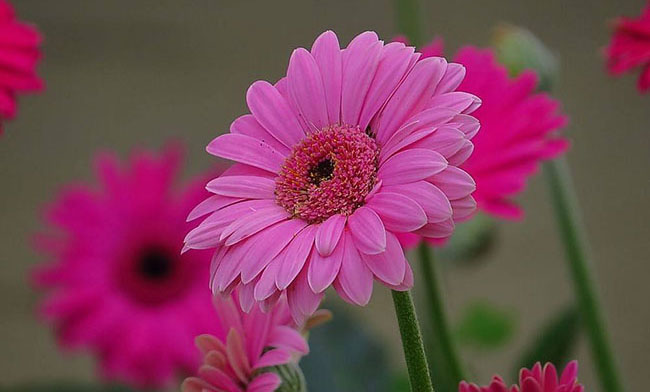
Propagation Methods of the Gerbera Daisy:
1. Sowing
Usually each flower can produce twenty to thirty seeds, which can be sown in spring or autumn.
2. Division
Take out the small seedlings growing beside the mother plant. It is best to plant them in holes in groups of two, as this helps increase the number of flowers. As for places with the necessary conditions, if test-tube seedling cultivation can be carried out, it will be even more beneficial for accelerating the propagation and promotion of fine varieties.
Cultivation Methods of the Gerbera Daisy:
1. Soil:
The Gerbera daisy is very sensitive to water, so a medium with good air permeability and drainage performance should be used, preferably a substrate mixed with peat and perlite. A pH value of 5.5 to 6.0 and an EC value of 0.7 to 1.0 are beneficial for the absorption of trace elements.
2. Watering:
Potted Gerbera daisies are very sensitive to moisture, so the correct watering time must be ensured. Water in the morning or evening, and keep the plant relatively dry when night falls. When the plant begins to grow roots, it must be watered from below, and a bottom seepage method can be used; during high temperatures, it can be watered from above the plant, but care should be taken to prevent fungal mildew starting from the center of the plant.
3. Sunlight:
The most suitable day length for the Gerbera daisy during growth is 11 hours to 13 hours, so artificial supplemental lighting can be carried out during low light. Generally, the requirement for artificial supplemental lighting is 3500 to 4000 lux per square meter.
4. Temperature:
The most suitable growth temperature for the Gerbera daisy is between 15°C and 25°C, with the maximum not higher than 30°C and the minimum not lower than 13°C. High temperatures will affect normal flower bud differentiation, and low temperatures will cause plant death.
5. Fertilization:
The Gerbera daisy is a fertilizer-loving perennial root flower with a large demand for fertilizer. The ratio of nitrogen, phosphorus, and potassium in fertilization is 15:18:25. Special attention should be paid to supplementing potassium fertilizer. Apply 2.5 kg of potassium nitrate, 1.2 kg of ammonium nitrate or ammonium phosphate per mu, once every 5-6 days, and once every 10 days. If high temperatures or relatively low temperatures cause the plant to enter a semi-dormant state, stop fertilizing.
6. Pests:
The diseases of the Gerbera daisy include leaf spot, powdery mildew, and viral diseases. For leaf spot, spray with 70% thiophanate-methyl wettable powder at 800-1000 times dilution or 50% carbendazim wettable powder at 500 times dilution. For powdery mildew, use 70% thiophanate-methyl at 1500 times dilution or 75% triadimefon wettable powder at 1000-1200 times dilution for control, once every 7-10 days, spraying two to three times consecutively.
7. Pruning:
The lower leaves of the basal leaf cluster of the Gerbera daisy tend to turn yellow and age, and should be removed promptly. This is beneficial both for the sprouting of new leaves and new flower buds and for ventilation, enhancing the plant's growth vigor. In addition, if the branches and leaves of the plant are too luxuriant and shade each other without ventilation, some leaves can be appropriately removed.
Cultivation and Management of the Gerbera Daisy
1. Management during the seedling stage:
After planting, shade with a 70% shade net for 7-10 days, and gradually increase light after the seedlings survive; regulate the day and night temperatures by opening and closing the side film and top film, keeping the daytime temperature at 22-25°C and the nighttime temperature at 20-22°C for 1 month; during this period, use spray watering, preferably in the morning. Make a small hole beside the plant to indicate soil moisture. The moisture should not be too dry or too wet. The watering frequency is once every 5 days, but it is not fixed and should be determined according to the soil structure, weather conditions, etc.; inspect each plant every day, promptly remove diseased plants, and replace them with healthy seedlings.
2. Management during the mature seedling stage:
About 1 month after planting, the Gerbera daisy enters a vigorous growth period, and appropriate shading is needed when the light is too strong; adjust the temperature to 14-16°C at night, and 18—25°C during the day as the minimum temperature; apply 0.1% compound fertilizer (N:P:K 15:15:15) once every 1 week, and spray 0.1% monopotassium phosphate foliar fertilizer once every 2 weeks; spray broad-spectrum fungicides, such as thiophanate-methyl at 800-1000 times dilution, 2-3 times to prevent disease.
3. Management during the flowering stage:
After about 3-4 months, it enters the flowering stage. Apply compound fertilizer with N:P:K=12:12:17 once every 1 week. Use foliar spraying of trace fertilizers, generally once every 25 days, each time using 0.1-0.2% Ca(NO3)2.4H2O, 0.1-0.2% chelated iron plus 0.1-0.2% borax plus 5-10ppm sodium molybdate for alternating foliar spraying; use drip irrigation for watering, and the watering principle is "do not water if not dry, water thoroughly when watering," and never water from the center of the leaf cluster. Keep the relative humidity in the greenhouse at 80%-85%; promptly weed, remove diseased leaves and dead leaves, pull out diseased plants and disinfect the soil in the planting holes with quicklime; during the summer flowering period, pay attention to shading and ventilation cooling, and during the winter flowering period, pay attention to insulation and heating, especially preventing too large a temperature difference between day and night to reduce the production of deformed flowers.
The Flower Language of the Gerbera Daisy
The flower language of the Gerbera daisy has the effect of encouraging and blessing the owner's life. The Gerbera daisy, also known as the African daisy, symbolizes mutual respect and love, perseverance, and fearlessness of hardship. Some regions like to use Gerbera daisies tied into bouquets to decorate the bridal chamber during wedding celebrations. Taking its homophonic meaning, it reflects the mutual respect and love of newlyweds. The Gerbera daisy has a radial flower shape and is often used as the main body of flower arrangements, mostly combined with sword ferns and asparagus ferns. At the same time, it also represents mystery, excitement, perseverance, elegance, seclusion, and nobility. Its flower language is passion and eternal happiness. Its flower language all shows that the Gerbera daisy is a plant that loves life. While living strongly on its own, it also encourages everyone to love life.
How to Grow Gerbera Daisies: Cultivation Methods and Precautions for Gerbera Daisies
Some friends have tried growing Gerbera daisies but are unclear about how to grow them. Today we will introduce the cultivation methods and precautions for Gerbera daisies.
Cultivation Methods of the Gerbera Daisy:
1. Propagation: The propagation of the Gerbera daisy is divided into seed propagation and division propagation. In seed propagation of the Gerbera daisy, usually each flower can produce twenty to thirty seeds, which can be sown in spring or autumn. In division propagation of the Gerbera daisy, take out the small seedlings growing beside the mother plant. It is best to plant them in holes in groups of two, as this helps increase the number of Gerbera daisy flowers. As for places with the necessary conditions, if test-tube seedling cultivation can be carried out, it will be even more beneficial for accelerating the propagation and promotion of fine Gerbera daisy varieties.
2. Light: The most suitable day length for the Gerbera daisy during growth is 11 hours to 13 hours, so artificial supplemental lighting can be carried out during low light. Generally, the requirement for artificial supplemental lighting is 3500 to 4000 lux per square meter. Supplemental lighting can only be carried out at least 4 weeks after the Gerbera daisy is potted.
3. Temperature: The most suitable growth temperature for the Gerbera daisy is between 15°C and 25°C, with the maximum not higher than 30°C and the minimum not lower than 13°C. The suitable winter temperature for the Gerbera daisy is 12-15°C, and growth stops below 10°C. The Gerbera daisy is a semi-cold-tolerant flower and can endure short-term low temperatures of 0°C. High temperatures will affect normal flower bud differentiation, and low temperatures will cause the death of the Gerbera daisy.
4. Soil: The Gerbera daisy is very sensitive to water, so a medium with good air permeability and drainage performance should be used, preferably a substrate mixed with peat and perlite. A pH value of 5.5 to 6.0 and an EC value of 0.7 to 1.0 are beneficial for the absorption of trace elements.
5. Watering: Potted Gerbera daisies are very sensitive to moisture, so the correct watering time must be ensured. Water in the morning or evening, and keep the plant relatively dry when night falls. When the plant begins to grow roots, it must be watered from below, and a bottom seepage method can be used; during high temperatures, it can be watered from above the plant, but care should be taken to prevent fungal mildew starting from the center of the plant.
6. Fertilization: The Gerbera daisy is a fertilizer-loving perennial root flower with a large demand for fertilizer. The ratio of nitrogen, phosphorus, and potassium in fertilization is 15:18:25. Special attention should be paid to supplementing potassium fertilizer. Apply 2.5 kg of potassium nitrate, 1.2 kg of ammonium nitrate or ammonium phosphate per mu, once every 5-6 days, and once every 10 days. If high temperatures or relatively low temperatures cause the plant to enter a semi-dormant state, stop fertilizing.
7. Pruning: The lower leaves of the basal leaf cluster of the Gerbera daisy tend to turn yellow and age, and should be removed promptly. This is beneficial both for the sprouting of new leaves and new flower buds and for ventilation, enhancing the growth vigor of the Gerbera daisy. In addition, if the branches and leaves of the Gerbera daisy are too luxuriant and shade each other without ventilation, some leaves can be appropriately removed. Excess flower buds or deformed flowers should also be removed promptly to ensure that the remaining flower branches have sufficient nutrients and improve the quality of the Gerbera daisy.
8. Pests: The pathogenic bacteria carried in disease prevention and control pose the greatest threat to growing Gerbera daisies, so attention should be paid to disinfection. The diseases of the Gerbera daisy include leaf spot, powdery mildew, and viral diseases. For leaf spot, spray with 70% thiophanate-methyl wettable powder at 800-**** times dilution or 50% carbendazim wettable powder at 500 times dilution. For powdery mildew, use 70% thiophanate-methyl at 1500 times dilution or 75% triadimefon wettable powder at 1000-1200 times dilution for control, once every 7-10 days, spraying two to three times consecutively.
Precautions for Growing Gerbera Daisies:
Now the editor will talk about the aspects that need attention in the daily cultivation process of potted Gerbera daisies.
1. The cultivation temperature of the Gerbera daisy should be controlled between 15°C and 25°C, with the maximum temperature limit not higher than 30°C and the minimum not lower than 13°C. Under general conditions, the daily average temperature is 18°C to 19°C, and ventilation should be provided when it exceeds 19°C.
2. Growing Gerbera daisies is very sensitive to moisture. The correct watering time is in the morning or evening, and the plant should be kept relatively dry when night falls. When the Gerbera daisy plant begins to grow roots, it must be watered from below, and a bottom seepage method can be used. During high temperatures, it can be watered from above the Gerbera daisy, but care should be taken to prevent fungal mildew starting from the center of the Gerbera daisy.
3. The Gerbera daisy is relatively fond of fertilizer, so the soil requirements for growing Gerbera daisies are also very high. On the one hand, a medium with good air permeability and drainage performance should be used, preferably a substrate mixed with peat and perlite. A pH value of 5.5 to 6.0 and an EC value of 0.7 to 1.0 are beneficial for the absorption of trace elements. When fertilizing the Gerbera daisy in summer, the ratio of nitrogen to potassium is 2:1, and in winter it is 1.5:1. The fertilizer pH value for the Gerbera daisy should be 5.5 to 6.0.
More InformationHow to Grow Gerbera Daisies/African Daisies: Cultivation Methods and Precautions for Potted African Daisies
The African daisy, also called the Gerbera daisy, has large flowers and bright colors. It is a very famous and elegant flower, often used as material for flower arrangements and dried flowers. In daily life, many flower lovers like to grow African daisies themselves, so how do you grow African daisies? Below is a carefully selected set of cultivation methods and precautions for African daisies by the editor. It is very comprehensive. Friends who want to grow them should definitely take a look.
1. How to Grow African Daisies: Understand Their Habits
Indoor cultivation is not like the wild, where we need to create everything ourselves, so to know how to grow African daisies, we must first understand their growth habits and then create an environment conducive to their growth. For this, the editor will bring you the cultivation methods and precautions for African daisies from aspects such as soil, light, temperature, watering, fertilization, and pruning. Let's continue reading.
2. Cultivation Methods and Precautions for Potted African Daisies
1. Soil, slightly acidic
How to grow potted African daisies? First, of course, is choosing soil. Whether planting yourself or changing potting soil, the choice of soil is very important. According to the growth habits of African daisies, everyone should choose loose, fertile, well-drained, slightly acidic soil.
Pot and soil selection: The pot does not need to be too large; 12-18cm is suitable for African daisies; the soil can be a mix of 2 parts peat and 1 part perlite, or commercially available culture soil with peat as the main component, such as Cuiyun, etc.
2. Light, full sun in winter
During the cultivation of African daisies, we need to give them sufficient light. Because African daisies love light and have relatively high light requirements, when not lacking water, the more they are exposed to the sun, the stronger they become, growing quickly and flowering more.
Precautions: Be sure to give African daisies sufficient light. When light is insufficient, artificial supplemental lighting is needed. In addition, in summer, when the sunlight is too strong, some strong sunlight should be shaded for the African daisy, while in winter, full sun should be ensured as much as possible.
3. Temperature, 20-25°C
In the cultivation methods of African daisies, temperature is also a point that everyone needs to pay attention to. It is understood that African daisies are not heat-tolerant or cold-tolerant. When growing indoors, it is best to control the temperature between 20-25°C.
Precautions: In winter, the temperature should not be lower than 10°C, otherwise the African daisy will stop growing. It is worth mentioning that the extreme tolerance temperature of the African daisy is 5-40°C, but it cannot last too long. Everyone must pay attention to this point.
4. Watering
How to grow African daisies? Watering is naturally indispensable. It is understood that African daisies prefer a humid environment. During the growing period, we must ensure sufficient water supply. In summer, when the temperature is high, water lightly and frequently; in winter, when the temperature is low, the watering interval can be longer.
Watering timing: You can often touch the leaves of the African daisy with your hands. If they are firm, they do not need water. Slightly soft but not wilted is the best time to water.
Precautions: When watering African daisies, do not choose noon; it is best to arrange it in the morning or evening. In addition, be careful not to water at the center of the leaves.
5. Fertilization
After watering, let's talk about fertilization, which is also very important in the cultivation methods of African daisies. It is understood that African daisies have a large demand for fertilizer. Fertilization should be light and frequent. Apply fertilizer once a week in spring, and less in summer and winter, once every half a month.
Precautions: When the temperature is too high or too low, everyone should stop fertilizing. In addition, fertilizing African daisies should be sufficient and balanced. Like other herbaceous plants, if you want them to grow strong, use fertilizer with balanced nitrogen, phosphorus, and potassium. As for how to fertilize African daisies, the specific details were introduced earlier, so we will not say more here.
6. Pruning
The above points must be done by everyone in the process of growing African daisies, and the next points require special attention, such as pruning and pests and diseases. First is pruning. During growth, the leaves of the African daisy may turn yellow or become too dense. At this time, everyone should prune appropriately, cutting off yellow leaves, dead leaves, and overly dense leaves.
7. Pests and Diseases
During the growth of African daisies, due to improper care and various other reasons, insect infestations and diseases will inevitably occur. Among them, diseases include powdery mildew, leaf spot, viral diseases, etc., and pests include whiteflies, cabbage caterpillars, and thrips, etc. As for what to do, there are detailed introductions in the pest and disease control of African daisies, which everyone can refer to for solutions.