How to Grow Dracaena reflexa? Detailed Guide to Care Methods and Precautions
Introduction to Dracaena reflexa
Dracaena reflexa is an evergreen shrub of the Asparagaceae family with a perennial root system, and its leaves are emerald green and glossy. It belongs to the tribe Dracaeneae and the genus Dracaena. The leaves have golden-yellow stripes down the middle, making them very beautiful, and it is one of the common foliage plants grown in homes. It also flowers, with white, relatively small flowers, and is dioecious, with fairly long inflorescences that can reach half a meter. Dracaena reflexa has good adaptability and can grow long-term indoors under semi-shade or scattered light. It is distributed in Madagascar. Dracaena reflexa is extremely popular. The foliage color of this plant is particularly elegant, making it an excellent indoor foliage plant. It originated in Madagascar and is now widely cultivated as a foliage plant. Its leaves are graceful and flowing, and it tolerates shade well, making it suitable for indoor display and also for hydroponic appreciation.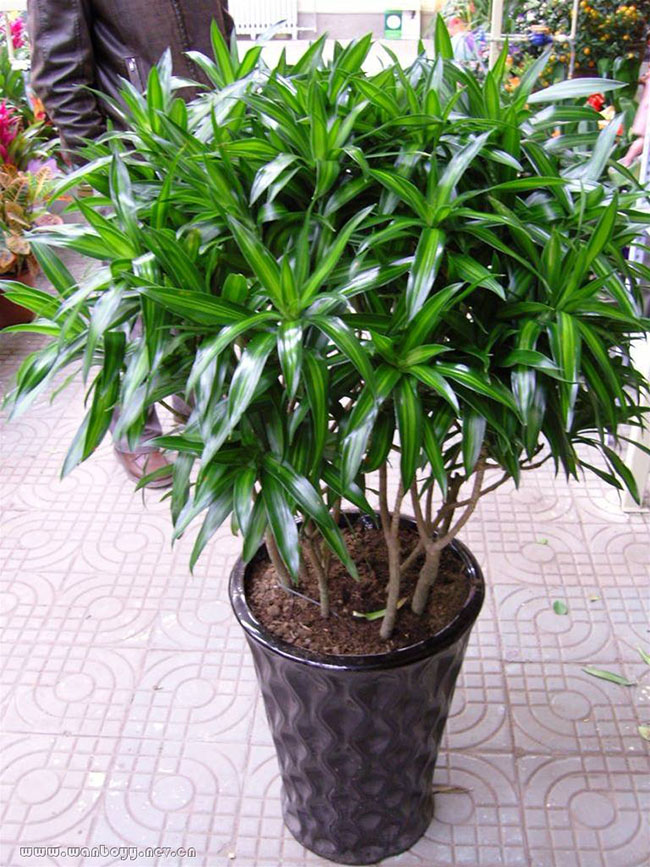
Morphological Characteristics of Dracaena reflexa
Perennial evergreen shrub or small tree. Leaves linear or lanceolate, entire, deep green and glossy, loosely clustered; inflorescences solitary or branched, often recurved, flowers white, dioecious. Inflorescences solitary or branched, florets white. Its variegated cultivar, Dracaena reflexa 'Variegata' (golden-edged Dracaena reflexa), is also seen in cultivation, with golden-yellow longitudinal stripes along the leaf margins; Dracaena reflexa 'Song of India' has green leaf margins with a golden-yellow center.
Growing Environment of Dracaena reflexa
It has a robust nature and prefers high temperatures and high humidity, with an optimal growing temperature of 20—28°C. It is drought-tolerant and also moisture-tolerant, growing vigorously at high temperatures, while dry cold in winter easily causes the leaf tips to dry out. It prefers semi-shade and dislikes strong direct sunlight, and overwintering requires temperatures above 12°C. It is not demanding regarding soil and fertilizer. It has strong shade tolerance; although it can grow under full sun or half-day sun, it grows best at 50%-70% shade. It is not demanding about water, being drought-tolerant and also moisture-tolerant, not cold-tolerant, and afraid of scorching sun exposure, but it grows best in moist, well-drained, organic-rich sandy loam. It likes a humid environment and grows vigorously when air humidity is high.
Home Cultivation of Dracaena reflexa
For home cultivation, a mix of leaf mold and river sand or furnace slag ash can be used as the growing medium. Repot once every 2 years, and a foliage plant potting mix can be chosen.
[Temperature]: 15-22 degrees
[Light]: Please do not place it too far from a window, except from 10 a.m. to 5 p.m. in summer.
[Soil]: Mix 1 part foliage plant nutrient soil, 1 part leaf mold and 1 part river sand.
[Fertilizing]: Once a month from April to September each year.
[Air humidity]: Please place the plant on a moist gravel layer. Spray water daily.
[Watering]: When the surface of the potting soil is dry to a depth of 2-3 cm, water thoroughly.
[Repotting]: Repot once every 2 years, in March.
[Special requirements]: Dracaena reflexa likes the company of other indoor plants, which can be seen as providing it with a beneficial moisture supplement.
[Propagation]: From March to September, take 10 cm stem sections and root them in water or in a sealed environment.
[Tip]: To make the plant grow vertically and symmetrically, please rotate the pot 1/4 turn regularly.
Field Cultivation of Dracaena reflexa
Growing medium
Dracaena reflexa has good adaptability and can grow in clay and sandy soil, but it grows best in loose, fertile, well-drained sandy soil rich in humus. For home cultivation, a mix of leaf mold and river sand or furnace slag ash can be used as the growing medium.
Humidity
The optimal growing temperature is between 20-30°C, and the overwintering temperature is best kept above 10°C, as it is not tolerant of low-temperature freeze damage. During growth it needs a certain amount of air humidity, otherwise the leaf color becomes dull and its glossiness decreases. During the growing season, frequently spray the plant with clean water, and if conditions permit, it is best to increase the moisture humidity in the environment.
Light
Dracaena reflexa likes light but also dislikes direct summer sunlight, so for home care it can be placed under a south-facing window or on a balcony, only avoiding direct light in summer; in other seasons it is best to give it some light, otherwise the golden-yellow stripes in the middle of the leaves will fade and disappear, seriously reducing its ornamental value.
Watering
Dracaena reflexa has a fairly wide tolerance for water, and mild drought or slight waterlogging will not cause much harm, but in management it is best to water thoroughly after the surface layer of the potting soil dries, which favors good growth. Alternating wet and dry watering can make the branches and leaves dense and the internodes compact, giving high ornamental value.
Fertilizing
Its demand for fertilizer is not strict; during the growing season it can be top-dressed with chemical fertilizer or organic fertilizer solution, but when applying chemical fertilizer, use small amounts and apply frequently, and water promptly after fertilizing. In addition, when repotting and changing soil each year, a certain amount of decomposed organic fertilizer can be added as a base fertilizer, which ensures good growth.
Pruning
Because it has a certain perennial-root nature and can grow new branches from the roots, the plant shape is generally good. Dracaena reflexa tolerates pruning relatively well, and it is best to appropriately increase fertilizer and water management before and after pruning, which ensures better new branches and leaves. Pruning is mainly for shaping, though of course the need for cuttings during propagation is also one of the main reasons for pruning.
Pest and Disease Control
Dracaena reflexa has relatively few pests and diseases. The main disease is leaf spot, and during home care it is often harmed by spider mites due to dry air or the presence of other flowering plants. Generally, it can be washed with a large amount of water several times, or directly sprayed with miticides specific to mites for control, such as dicofol, hexythiazox, propargite, etc.
Propagation Methods of Dracaena reflexa
Seed sowing or cuttings can be used; for mass propagation, seed sowing can be used, with spring to summer being the suitable sowing period, and the suitable temperature for germination and rooting being 20-25°C. For cuttings, spring and autumn are the suitable periods; cut branches into sections of just over 10 cm each, and if they have leaves, cut off most of them, then insert them into a moist sand bed or soil, maintain humidity, and provide 50%-60% sunlight; roots can form after about 30-40 days.
Seed sowing method
Mostly used for mass propagation; spring and summer are the best sowing seasons, and the suitable temperature for germination and rooting is 20-25°C. It grows best in loose, fertile, well-drained sandy soil rich in humus, and it can be mixed from 1 part plant nutrient soil, 1 part leaf mold and 1 part river sand.
Cutting method
In spring, cut the severed stems into 5 cm to 10 cm leafless stem nodes, or cut base tips that tend to dry out. For branches with stem tips that have partially grown for a long time in a shaded indoor spot, insert them into clean coarse river sand, water thoroughly, cover with a plastic bag, keep the medium moist, and place in a bright indoor spot; roots can form in about 25 days. Or insert the cut branches into water, and at 25°C roots can form in about half a month.
Landscape Uses of Dracaena reflexa
It is now widely cultivated as a foliage plant. Its leaves are graceful and flowing, and it tolerates shade well, making it very suitable for indoor display and also for hydroponic appreciation.
It is extremely popular. The foliage color of this plant is particularly elegant, making it an excellent indoor foliage plant.
Dracaena reflexa comes in large-leaf and small-leaf types. The small, narrow-leaf type tolerates sunlight and is suitable for outdoors. The large-leaf Dracaena reflexa is a semi-shade plant and cannot be exposed to strong sun. It is an excellent choice for indoor decoration.
How to Grow Dracaena reflexa, Its Care Methods and Precautions / Avoid Direct Strong Light
Gardeners are probably familiar with Dracaena reflexa, also called lucky bamboo; it is a widely cultivated foliage plant and is deeply loved by gardening enthusiasts. In daily life, because Dracaena reflexa has strong benefits, many people want to grow it, so how do you grow Dracaena reflexa? Below is a carefully compiled, very detailed guide to the care methods and precautions for Dracaena reflexa. Friends who want to grow it should definitely take a look~
1. How to Grow Dracaena reflexa: Understand Its Habits
Dracaena reflexa likes a high-temperature, high-humidity environment. It is drought-tolerant, not cold-tolerant, likes semi-shade, and dislikes strong light, so how do you grow Dracaena reflexa? When growing it indoors, you should place it in an environment with ample scattered light, water it regularly to keep the potting soil moist, and take good cold-protection measures in winter. As for the growing medium, Dracaena reflexa is not demanding about soil.
2. Care Methods and Precautions for Dracaena reflexa
1. Soil
How do you grow Dracaena reflexa indoors? The editor suggests choosing the potting soil again. It is understood that nowadays when people grow Dracaena reflexa, they like to buy it online, and there is ready-made potting soil, but that soil is very cheap; it is fine for normal care, but if you want to grow it well, it is best to replace the soil.
Soil choice: According to the growth habits of Dracaena reflexa, although it is not demanding about soil, it grows best in loose, fertile, well-drained sandy soil rich in humus. For this, the editor recommends using soil mixed from leaf mold and river sand or furnace slag ash.
2. Light
In the care methods for Dracaena reflexa, light is very important, but it likes a semi-shade environment, so for home care it can be placed under a south-facing window or on a balcony. Grown under ample scattered light, Dracaena reflexa will grow beautifully~
Precautions: Dracaena reflexa dislikes strong light, so in summer avoid direct strong light; however, except in summer, in other seasons it is best to give Dracaena reflexa some light, otherwise the golden-yellow stripes in the middle of its leaves will fade and disappear, seriously reducing its ornamental value.
3. Temperature
How do you grow Dracaena reflexa? Adjusting the temperature in good time is also very important. It is understood that the most suitable growing temperature for Dracaena reflexa is 20-30°C. If you want its leaves to stay green all year round, it is best to maintain this temperature when growing it indoors.
Precautions: Dracaena reflexa is not cold-tolerant; once the temperature drops below 10°C, the plant is easily frostbitten. So in winter, you should move Dracaena reflexa indoors and keep the overwintering temperature above 10°C.
4. Watering
Water is the source of life, so in the care methods for Dracaena reflexa, watering is a very important part. Because Dracaena reflexa likes a humid environment, and mild drought or slight waterlogging will not harm the plant much, in home care watering should be done alternately wet and dry, and shading can make the branches and leaves dense and the internodes compact, giving high ornamental value.
5. Fertilizing
Having covered watering, let's talk about fertilizing, which is also very important during the growth of Dracaena reflexa. However, Dracaena reflexa is not demanding about fertilizer. Besides adding a certain amount of decomposed organic fertilizer as a base fertilizer when repotting, you can top-dress with organic fertilizer solution during the growing season. But fertilizer should be applied in small amounts and frequently, and it is best to water promptly after each fertilizing.
6. Pruning
For the sake of appearance, besides routine care, timely pruning of Dracaena reflexa is very important. However, Dracaena reflexa has a certain perennial-root nature and can grow new branches from the roots, so the plant shape is generally good. Therefore, pruning Dracaena reflexa is mainly for shaping; simply cut off yellow leaves, old leaves, overly dense branches, etc.
7. Potting Soil Replacement
Although Dracaena reflexa does not like fertilizer, adding base fertilizer to the potting soil is still very important. But as the growing time increases, the nutrients in the potting soil are continuously lost, so gardeners should repot Dracaena reflexa once every 2 years in spring. When repotting and changing soil, add a certain amount of decomposed organic fertilizer as a base fertilizer, which ensures good growth.
Overall, Dracaena reflexa is quite easy to grow, but if you want to grow it beautifully, you need to put in more effort and care for it according to the requirements above, so that it can grow lush and flourishing. This is the end of the editor's introduction to the care methods and precautions for Dracaena reflexa. Gardening enthusiasts who are tempted might as well try growing one~
How to Grow Dracaena reflexa: Care Methods and Precautions
Dracaena reflexa is a perennial evergreen shrub or small tree. How do you grow Dracaena reflexa? Below, let's share the care methods and precautions for Dracaena reflexa.
Care Methods for Dracaena reflexa:
1. Propagation: The most suitable propagation method for home cultivation of Dracaena reflexa is stem cutting, best done in combination with pruning. Propagation of Dracaena reflexa can be done from April to September each year. The branch length is about 10 cm, keeping only a few leaves at the upper part. Insert into clean river sand or vermiculite, water thoroughly, and place in semi-shade; roots will form in 2 weeks, and it can be transplanted in 3-4 weeks.
2. Light: Dracaena reflexa likes light but also dislikes direct summer sunlight. When growing Dracaena reflexa, you can place it under a south-facing window or on a balcony, only avoiding direct light in summer; in other seasons it is best to give it some light, otherwise the golden-yellow stripes in the middle of the Dracaena reflexa leaves will fade and disappear, seriously reducing its ornamental value.
3. Temperature and humidity: Dracaena reflexa originated in Madagascar and likes a warm, humid growing environment. It can also grow under high-temperature conditions, with the most suitable growing temperature being between 20-30°C, and the overwintering temperature is best kept above 10°C, as it is not tolerant of low-temperature freeze damage. During growth it needs a certain amount of air humidity, otherwise the leaf color becomes dull and its glossiness decreases. During the growing season, frequently spray the plant with clean water, and if conditions permit, it is best to increase the moisture humidity in the environment.
4. Soil: Dracaena reflexa has good adaptability and can grow in clay and sandy soil, but it grows best in loose, fertile, well-drained sandy soil rich in humus. For home cultivation, a mix of leaf mold and river sand or furnace slag ash can be used as the growing medium.
5. Watering: Dracaena reflexa has a fairly wide tolerance for water, and mild drought or slight waterlogging will not cause much harm, but in cultivation it is best to water thoroughly after the surface layer of the potting soil dries, which favors good growth of Dracaena reflexa. Alternating wet and dry watering can make the branches and leaves of Dracaena reflexa dense and the internodes compact, giving high ornamental value.
6. Fertilizing: Its demand for fertilizer is not strict; during the growing season it can be top-dressed with chemical fertilizer or organic fertilizer solution, but when applying chemical fertilizer, use small amounts and apply frequently, and water promptly after fertilizing. In addition, when repotting and changing soil each year, a certain amount of decomposed organic fertilizer can be added as a base fertilizer, which ensures good growth.
7. Pruning: Dracaena reflexa has a certain perennial-root nature and can grow new branches from the roots, so the plant shape of Dracaena reflexa is generally good. Dracaena reflexa tolerates pruning relatively well, and it is best to appropriately increase fertilizer and water management before and after pruning, which ensures better new branches and leaves of Dracaena reflexa. Pruning is mainly for shaping, though of course the need for cuttings during propagation is also one of the main reasons for pruning Dracaena reflexa.
8. Pests and diseases: Dracaena reflexa has relatively few pests and diseases. During the process of growing Dracaena reflexa, it is often harmed by spider mites due to dry air or the presence of other flowering plants. Generally, it can be washed with a large amount of water several times, or directly sprayed with miticides specific to mites for control, such as dicofol, hexythiazox, propargite, etc.
Precautions for Growing Dracaena reflexa:
1. Watering Dracaena reflexa generally starts from the leaf edges at the bottom; before watering, dig into the soil to check, and water again when it is dry 2 cm down.
2. When growing Dracaena reflexa, do not water it every few days, as this will cause the Dracaena reflexa leaves to dry out and affect its ornamental value.
3. It is best to move Dracaena reflexa to a place near a window or door with good air circulation for cultivation, which favors ventilation and is more conducive to the growth of Dracaena reflexa.
4. Growing Dracaena reflexa requires cutting off the yellow and damaged leaves of Dracaena reflexa to increase its ornamental value.
5. Most Dracaena reflexa are grown in large, deep ceramic pots. This kind of pot looks nice, but it is not conducive to water evaporation, and if water accumulates further, it will cause the Dracaena reflexa leaves to dry out.