How to Grow a Weeping Fig (Ficus benjamina)? Detailed Guide to Care Methods and Precautions
Weeping Fig Morphological Characteristics
Overall Characteristics
A large tree, up to 20 m tall, DBH 30-50 cm, with a broad crown; bark gray, smooth; branchlets pendulous.
Leaf Characteristics
Leaves thinly leathery, ovate to ovate-elliptic, 4-8 cm long, 2-4 cm wide, apex shortly acuminate, base rounded or cuneate, margin entire; primary and secondary lateral veins difficult to distinguish, running parallel and extending almost to the leaf margin, netted into a marginal vein, smooth and hairless on both surfaces; petiole 1-2 cm long, with a groove on the upper side; stipules lanceolate, about 6 mm long. Syconia paired or solitary in leaf axils, base constricted into a stalk.
Flower Characteristics
Spherical or oblate, smooth, red to yellow when ripe, 8-15 cm in diameter, basal bracts inconspicuous; male flowers, gall flowers and female flowers borne together in the same syconium; male flowers very few, stalked, perianth segments 4, broadly ovate, stamen 1, filament short; gall flowers stalked, numerous, perianth segments 5-4, narrowly spatulate, ovary ovoid, smooth, style lateral; female flowers sessile, perianth segments shortly spatulate.
Fruit Characteristics
Achene ovoid-reniform, shorter than the style, style nearly lateral, stigma swollen. Flowering period August-November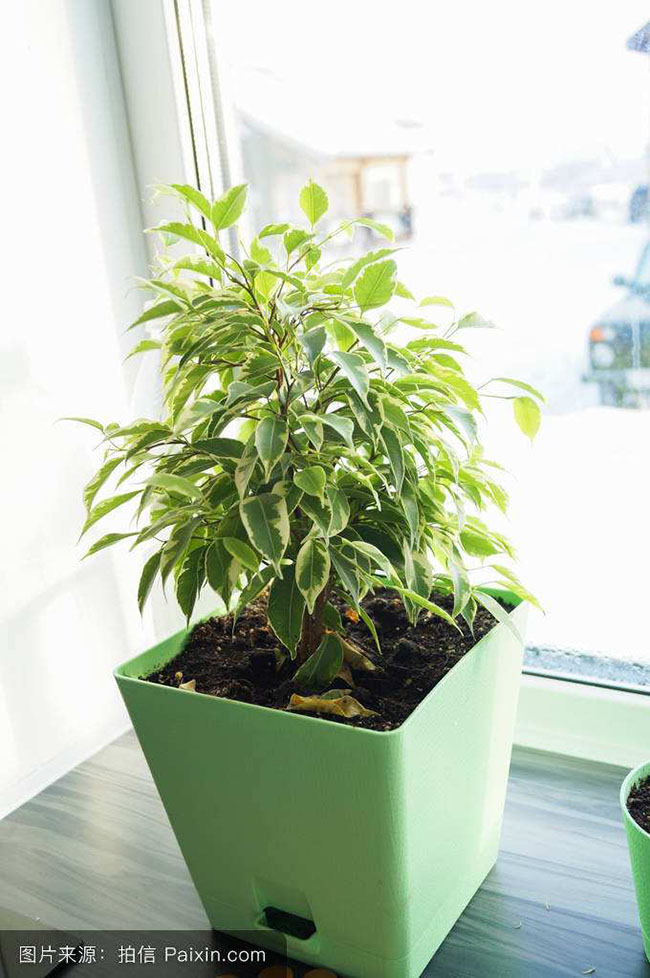
Weeping Fig Growing Environment
In Yunnan it grows in moist mixed forests at an altitude of 500-800 m.
Likes High Temperatures and High Humidity
It is an evergreen tree that is heat-tolerant, drought-tolerant, moisture-tolerant, wind-tolerant, shade-tolerant, pollution-resistant, tolerant of pruning and easy to transplant. Light-demanding, it likes a hot and humid climate. [2] The weeping fig likes a warm and humid environment and dislikes low temperatures and dry conditions.
Sunlight and Temperature Requirements
It is not very demanding about light; the suitable temperature for growth and development is 23-32°C, and it has fairly strong cold tolerance, withstanding brief low temperatures of 0°C. It likes light and a hot, humid climate, is highly adaptable, wind-resistant, tolerant of poor soil, resistant to air pollution, and not tolerant of drought.
Soil and Pruning Requirements
It is not demanding about soil, but the soil must be fertile and well-drained. It tolerates heavy pruning, can be trained into various shapes, and transplants easily and survives well
Weeping Fig Distribution
Distribution in China
The weeping fig is produced in Guangdong, Guangxi, Hainan, Yunnan and Guizhou, and Zhenyuan Flowers in Zhangzhou, Fujian has long supplied it.
World Distribution
It is distributed in Nepal, Sikkim, Bhutan, India, Myanmar, Thailand, Vietnam, Malaysia, the Philippines, Papua New Guinea, the Solomon Islands, northern Australia and elsewhere.
Weeping Fig Propagation Methods
Cuttage Method
Cuttage propagation roots easily and can be carried out from April to June. Select robust, mature branches and take the tips of young shoots, about 10 cm long; remove the lower leaves and keep 2-3 leaves at the top. Milky sap will exude from the cut; wash it off with warm water or singe it over a flame so that it coagulates, then insert the cutting into a sand bed, keeping the temperature at 24-26°C and maintaining high air humidity; roots will form in about one month. After rooting, pot it up and place it in a shaded spot; once it has grown to 20-30 cm, move it to a spot with ample light or grow it outdoors.
Air Layering Method
This can be done from April to August. Choose a semi-lignified terminal branch on the mother plant, keep 3-4 leaves at the upper part, make a ring girdle or tongue cut below it, then wrap it with moss and tie it with plastic film; roots will form in about 40 days. Once it has grown to about 30 cm, it can be cut off and planted in place or potted up
Precautions for Growing Weeping Fig
(1) Light and temperature. It should generally be placed in a bright spot, but direct strong light should be avoided,
especially for variegated cultivars, which most dislike exposure to sunlight. With insufficient sunlight, the internodes elongate, the leaves droop and soften, and growth is weak; in sunlight, the leaf tissue becomes thicker and more glossy. Although weeping figs have some cold tolerance, the wintering temperature should not be lower than 5°C, and the optimum growth temperature is 15—30°C.
(2) Water. During the vigorous growth period, water frequently to keep the soil moist, and frequently spray water on the leaf surfaces and the surrounding space to promote plant growth and improve leaf glossiness. In winter, overly wet potting soil easily causes root rot, so water only when the pot is dry.
(3) Soil and fertilization. A humus-rich mixed soil can be used for potting, for example compost mixed with an equal amount of peat soil, with some base fertilizer added as a bottom dressing. During the growing season, apply liquid fertilizer once every 2 weeks, mainly nitrogen fertilizer, suitably combined with some potassium fertilizer. Choice of potting soil and pot. The size of the flowerpot varies with the size of the plant. To form a good tree shape, 3 seedlings can be planted per pot. Generally, small potted plants should be repotted once a year in April, while large potted plants can be repotted once every 2—3 years to supplement the nutrients needed for growth
Medicinal Value of Weeping Fig
Functions and Effects
Aerial roots, bark, leaf buds and fruits: clear heat and detoxify, dispel wind, cool the blood, nourish yin and moisten the lungs, promote eruption, and promote lactation.
Indications
Used for rheumatic numbness and nosebleeds
How to Grow Weeping Fig: Growing Methods and Precautions for Weeping Fig
The weeping fig is often seen among indoor plants. Its leaves are thinly leathery, and its aerial roots, bark, leaf buds and fruits can be used to clear heat and detoxify, dispel wind, cool the blood and more. In addition, the weeping fig can purify the air and serve as a decoration. So how do you grow a weeping fig?
I. Growing Methods for Weeping Fig
1. Choosing/repotting: The size of the flowerpot is generally determined by the size of the weeping fig seedling. To obtain a good plant shape, 3 seedlings should be planted in one pot. To supplement nutrients, the weeping fig needs repotting once every 1-3 years; small potted plants can be repotted once a year in April, while large ones once every 2-3 years. When repotting in spring, add 1/4 decomposed compost (such as dried pig manure) as a layer at the bottom of the pot, then add fresh potting soil. It is best to prune a little at the same time as repotting to encourage branching.
2. Soil: The weeping fig is best grown in an acidic mixed soil containing humus. This can be a mixture of compost and peat soil in equal proportions with a little base fertilizer added, or a mixture of 1/2 garden soil, 1/2 leaf mold and a little coarse sand.
3. Temperature: The weeping fig likes a hot environment; the optimum growth temperature is 22-30°C. It is not cold-tolerant, and to prevent cold damage the temperature during the wintering period should not be below 5°C.
4. Light: The weeping fig likes light and is generally placed in a sunny spot, but it must not receive direct strong light, and variegated cultivars even less so. A weeping fig that receives enough sunlight has thick, glossy leaf tissue; a plant lacking light grows weakly, with elongated internodes and drooping, soft leaves.
5. Water: The weeping fig likes a high-humidity environment and dislikes dryness. During the peak growing period in midsummer, water frequently to keep it moist and spray water frequently on the leaves and into the air so that the weeping fig grows better and its leaves become more glossy. In winter, to prevent root rot, water only when the soil looks dry.
6. Fertilization: During the growing period, the weeping fig should be given liquid fertilizer once every 2 weeks, mainly nitrogen fertilizer, with a small amount of potassium fertilizer suitably added.
7. Pests and diseases: The weeping fig is prone to leaf spot and black mold, which can be controlled by spraying 50% carbendazim wettable powder at 600-1000 times dilution or 70% mancozeb wettable powder at 400-600 times dilution. As for insect pests, the weeping fig is susceptible to scale insects and red spider mites, which can be controlled by spraying 40% dicofol emulsion at 1000-1500 times dilution or 40% omethoate emulsion at 1000 times dilution.
II. Precautions for Growing Weeping Fig
The weeping fig tree likes a warm and humid growing environment; avoid planting it in low-temperature, dry conditions; it is not strict about light; the most suitable temperature for growth and development is 23°C-32°C, and this tree has relatively strong cold tolerance, withstanding brief low temperatures of 0°C. The weeping fig tree likes light and a hot, humid climate, and is highly adaptable. At the same time, it is not demanding about soil, and grows best in a fertile, well-drained environment.
When the weeping fig tree enters the vigorous growth period, it should be watered frequently to keep the soil moist, and water should be sprayed around the leaf surfaces, which can effectively promote the plant's growth and development and improve leaf glossiness. In winter, watering should avoid excessive moisture, which causes root rot.
Growing Methods and Precautions for Weeping FigThat is everything for everyone; we hope it is helpful and that you can better cultivate your own weeping fig.
How to Grow Weeping Fig: Growing Methods and Precautions for Weeping Fig
The weeping fig, also called the small-leaved fig, is an evergreen tree of the genus Ficus in the mulberry family, native to Yunnan, Hainan, Guangdong and other places. The weeping fig is a very effective air purifier that can absorb indoor formaldehyde, and it can also serve as an indoor decoration. So let us learn together about how to grow a weeping fig, and its growing methods and precautions!
How to Grow Weeping Fig: Growing Methods and Precautions for Weeping Fig:
1. Growth habits: The weeping fig tree likes a warm and humid growing environment; avoid planting it in low-temperature, dry conditions; it is not strict about light; the most suitable temperature for growth and development is 23°C-32°C, and this tree has relatively strong cold tolerance, withstanding brief low temperatures of 0°C. The weeping fig tree likes light and a hot, humid climate, and is highly adaptable. At the same time, it is not demanding about soil, and grows best in a fertile, well-drained environment.
2. Watering: When the weeping fig tree enters the vigorous growth period, it should be watered frequently to keep the soil moist, and water should be sprayed around the leaf surfaces, which can effectively promote the plant's growth and development and improve leaf glossiness. In winter, watering should avoid excessive moisture, which causes root rot.
3. Fertilization: During the growing season, the weeping fig tree should be fertilized about every 14 days with a liquid fertilizer, which should be mainly nitrogen fertilizer, combined with potassium fertilizer. At the same time, for potted plants, a humus-containing mixed soil should be used, with some base fertilizer added as a bottom dressing, which can promote plant growth and supplement the nutrients needed for growth.
The above is how to grow a weeping fig, and its growing methods and precautions. Growers should water and fertilize in good time according to the crop's growth, which can effectively promote plant growth.