How to Grow Guzmania (Vriesea): Detailed Guide to Cultivation Methods and Precautions
Guzmania Encyclopedia
Guzmania is a flowering plant in the Bromeliaceae family. Because its flower core is bright red, it is called "Hong Yun Dang Tou" (Good Fortune).
Guzmania Morphological Characteristics
The flowers open at the top or middle of the plant, with abundant flowers and leaves and brilliant red flower color, giving a very festive feeling. The leaves are broad and strap-shaped, appearing dark green. The spike-like inflorescence resembles a cone shape, with densely growing bracts, and the tips are yellow. It is precisely because this bromeliad has bright red flowers at the top that the idiom "Hong Yun Dang Tou" (good fortune) is borrowed to name it, representing good luck. Its flower meaning is perfection. In people's eyes, Guzmania is an auspicious and noble flower.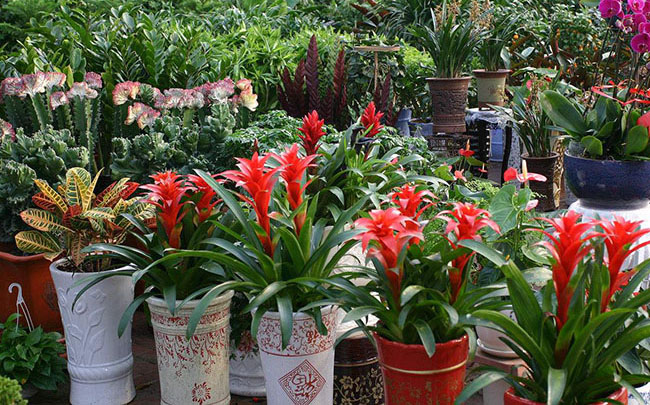
Guzmania Growth Habits
Guzmania prefers a warm and humid environment. The suitable growth temperature is 21-28°C during the day and 18-21°C at night, and the maximum temperature must not exceed 35°C. High temperatures are unfavorable for growth.
Guzmania Propagation Methods
Propagation key points: Guzmania is usually propagated by division, dividing offsets in spring when repotting and changing soil. Guzmania can also be propagated by cuttings, and tissue culture is also often used for mass propagation. During breeding, seeds are used for propagation.
1. Guzmania Cutting Propagation
Small shoots will continuously grow from the leaf axils at the base of Guzmania. When they grow 5 to 6 leaves, they can be cut off for cutting propagation, and roots will grow in about 1 month. After the small plants have grown, they can be cut from the mother plant with a sharp knife and planted separately. Generally, old plants will not bloom again and can later be used as mother plants to propagate new plants.
2. Guzmania Division Propagation
For Guzmania division propagation, in spring the tiller buds at the rhizome base of the adult mother plant can be separated and planted separately. For tissue culture, young leaves are often used as explants, and through callus induction, clustered buds are differentiated, then roots are induced to form seedlings. From inoculation to seedling transplantation takes about 4 months, and flowering occurs 2-3 years after planting. Cut off the suckers growing at the base of Guzmania, level the cut surface, and plant them in plain sandy soil, with a plastic bag over the pot mouth to keep warm and moist. Place in a lightly shaded and ventilated environment, and roots will quickly form at 25°C.
Guzmania Cultivation Methods
Best Propagation Time:
The best propagation time for Guzmania is in spring.
Best Growing Soil:
Guzmania is suitable for growing in loose, fertile soil containing humus. For home cultivation, you can choose 2 parts peat soil mixed with 1 part fine sand to prepare the growing medium, which is more conducive to the robust growth of Guzmania.
Growth Humidity Requirements:
In hot weather, Guzmania should keep the potting soil moist, and clean water can be sprayed on the leaf surface 1-2 times a day.
Best Growing Temperature:
The suitable growth temperature for Guzmania is 15°C-22°C.
Best Growing Light:
In order to make Guzmania's leaf color bright and bloom regularly, a certain amount of photosynthesis is needed. In winter, 4-5 hours of direct sunlight are needed daily. In rainy weather, artificial light should be used to increase lighting. In summer, the seedling pots should be placed in tree shade to avoid strong direct sunlight on Guzmania. For indoor cultivation, shade nets can be set up according to the growth of Guzmania.
Guzmania Potting Soil Selection
Guzmania soil requires rich humus, loose, fertile, good air permeability and drainage, slightly acidic (pH 5-5.5). For home use, leaf mold, river sand, a small amount of cake fertilizer, or decomposed chicken manure are most commonly used. Of course, to save trouble when changing soil, you can directly buy it from a flower shop.
Guzmania Watering Methods
Guzmania likes a humid environment. During the growing period, it is necessary to ensure relatively high air humidity and sufficient potting soil moisture. Keep the potting soil moist, and control the air humidity at 70%-80% as appropriate. The usual watering frequency is every 5-7 days. For some hard-leaved types that need less water, keep the pot surface relatively dry. For soft-leaved types that need more water, keep the potting soil moist frequently, and it is appropriate that the surface soil does not look dry. Always keep water in the leaf cup; lack of water in the leaf cup can easily cause the plant to wilt.
Proper Watering Control in Autumn
After the beginning of autumn, Guzmania's growth slows down, and watering and spraying should be properly controlled. After entering the dormant period, watering should be controlled, and it is enough to keep the potting soil slightly moist. Do not water if the potting soil is not dry; excessively wet potting soil can easily cause root rot. Keep the bottom of the leaf cup moist, but do not give too much water to avoid rot.
Guzmania Fertilization Methods
During the growing season, fertilize once every 10-20 days, using fermented cake fertilizer or chemical fertilizer. For chemical fertilizer, nitrogen, phosphorus and potassium are usually used, with the concentration controlled at 0.1%-2.3%. When fertilizing, try not to apply fertilizer at the center of the plant to avoid causing harm. Fertilization should be stopped during the flowering period, dormant period and summer.
Guzmania Light Requirements
Guzmania's growth requires sufficient light, with daily light time controlled at 12-16 hours. Under sufficient light, combined with high humidity and good ventilation conditions, growth will be faster and better. The plant will become short, plump and sturdy, with broad, short, firm leaves and brightly colored flowers.
Guzmania Precautions
Applying Fertilizer:
Guzmania enters the flowering period in winter and requires sufficient fertilizer. Usually, a dilute organic liquid fertilizer is applied once every 14 days. Soybean soaking liquid or fermented rice washing water can be used to promote the growth and development of Guzmania.
Watering Key Points:
Guzmania likes a humid growing environment, and it is enough to keep the potting soil moist. In order to improve the ornamental value of Guzmania, water its leaf surface once a day and remove dust, making Guzmania's leaf color bright, which is beneficial to photosynthesis and promotes robust plant growth.
Pruning Essentials:
After the inflorescence produced by Guzmania in winter and spring has gone through an ornamental period of up to half a year, it gradually fades. At this time, it can be cut off to reduce nutrient consumption, which is beneficial to the growth of side shoots.
Potting Soil Replacement:
When repotting Guzmania, scrape off about 1/3 or 1/2 of the old soil around the roots, and use scissors to properly prune old roots, dead roots, curled roots and poorly growing roots near the pot edge. Only remove a little of the surface of the soil ball; generally no treatment is done, but be careful not to break the soil ball when planting. After treatment, switch to a larger pot and plant according to the potting procedure.
Guzmania Pest and Disease Control:
In an environment with excessively high temperature and humidity and poor ventilation, Guzmania is prone to pest and disease damage, such as sooty mold, red spider mites, scale insects, etc. If disease is found, carbendazim can be sprayed promptly; for pests, omethoate can be sprayed. No matter which medicinal solution is sprayed, it must be done outdoors to prevent polluting the indoor environment. In addition, you can also buy sterilization and insecticide tablets from the flower market and bury them in the potting soil to eradicate pests and diseases. Red spots are symptoms of brown spot disease and require timely spraying of strong fungicides such as carbendazim, propiconazole, Amistar, or agricultural streptomycin for prevention and control. This is because the timing of spraying water is chosen too late. Do not spray water after evening, as it easily breeds pathogens, and no water should remain on the leaf surface at night.
Guzmania Variety Identification
① Aechmea fasciata
The leaf bases overlap each other to form a tube; the leaves are broad and strap-shaped, covered with silvery-gray scales. The leaf surface has tiger-stripe-like silvery-white horizontal stripes. The spike-like inflorescence is upright, densely packed into a broad conical sphere, the bracts are light pink, and the small flowers are light blue.
② Neoregelia carolinae
The leaves are yellow-green, with broad cream-yellow or pink stripes along the edges; the leaf margins have sharp serrations, and the leaf back is slightly covered with white powder. The common peduncle is round and thick, firm, with a terminal spike-like inflorescence, gathered into an ovate shape. The berries are orange-red. It is a variegated variety of edible pineapple, with a fruit-viewing period lasting as long as half a year.
③ Cryptanthus bivittatus
The leaf margins are wavy, with fine serrations; the leaves are rose-red, with two pale yellow-white longitudinal stripes, and the leaf back has white powder. The flowers are small and white.
④ Guzmania lingulata
Perennial epiphytic herbaceous plant. The stem is short, with many sprouts at the base. The leaf bases overlap each other to form a tube, forming a loose rosette; the leaves are leathery, glossy, and entire. The inflorescence is spike-like, the bracts are bright red, and the small flowers are cream-yellow. The flowering period is in spring.
⑤ Billbergia zebrina
The leaf edges have yellow or white band-like stripes, and the leaf margins have fine serrations. When flowering, the leaf rosette near the center turns bright red, and the inflorescence is short and does not extend beyond the leaf rosette; the flowers are small and blue-purple.
⑥ Tillandsia cyanea
(Pink quill, pink-flowered Tillandsia) The plant is low, the leaves are narrow and long, gray-green, with purple-brown stripes at the base. The spike-like inflorescence
is oval, the flower stem is short; the bracts are pink, and the small flowers are blue-purple, shaped like butterflies. It blooms in spring, and the ornamental period lasts as long as 3 months.
⑦ Vriesea splendens
(Red sword) The leaves have purple-black horizontal markings on both sides, with entire margins. The spike-like inflorescence is upright, sword-shaped, the bracts are bright red or yellow, and the small flowers are yellow. The flowering period lasts as long as 5 months.
⑧ Vriesea carinata
The leaves are emerald green, and the flat bracts at the top of the peduncle are neatly stacked in sequence to form a crest-like shape. The base of the bracts is red, and the top is tender yellow or yellow-green. The flowering period lasts as long as 5-6 months.
How to Grow Guzmania (Hong Yun Dang Tou): Cultivation Methods and Precautions
Growing Guzmania can not only beautify the home environment, but also produce good meanings and thoughts. In addition, Guzmania also has a certain effect of resolving negative energy, so growing a pot of Guzmania at home is very appropriate. Here, the editor provides some cultivation methods for Guzmania.
How to Grow Guzmania (Hong Yun Dang Tou)
Guzmania likes a high-temperature, humid, semi-shaded environment and can be placed in a warm, bright room all year round. In winter, it can receive full sun; in spring and autumn, there should be light in the morning and evening; in summer, avoid direct sunlight. With bright light, the leaf color is vivid.
The suitable growth temperature for Guzmania is between 15-20°C, and the overwintering temperature must not be lower than 10°C. However, above 20°C is not conducive to the plant's dormancy and will affect growth and flowering the following year.
Guzmania Cultivation Methods and Precautions
1. Potting Soil Selection
Guzmania soil requires rich humus, loose, fertile, good air permeability and drainage, slightly acidic (pH 5-5.5). For home use, leaf mold, river sand, a small amount of cake fertilizer, or decomposed chicken manure are most commonly used. Of course, to save trouble when changing soil, you can directly buy it from a flower shop.
2. Repotting Method
Guzmania does not have a very long lifespan. Usually plants 3-4 years old will bloom, gradually wither after flowering, and after withering the plant is renewed. Therefore, it should be repotted once every 1-2 years to ensure sufficient nutrient supply in the soil.
3. Watering Method
Guzmania likes a humid environment. During the growing period, it is necessary to ensure relatively high air humidity and sufficient potting soil moisture. Keep the potting soil moist, and control the air humidity at 70%-80% as appropriate.
The usual watering frequency is every 5-7 days. For some hard-leaved types that need less water, keep the pot surface relatively dry. For soft-leaved types that need more water, keep the potting soil moist frequently, and it is appropriate that the surface soil does not look dry. Always keep water in the leaf cup; lack of water in the leaf cup can easily cause the plant to wilt.
After the beginning of autumn, Guzmania's growth slows down, and watering and spraying should be properly controlled. After entering the dormant period, watering should be controlled, and it is enough to keep the potting soil slightly moist. Do not water if the potting soil is not dry; excessively wet potting soil can easily cause root rot. Keep the bottom of the leaf cup moist, but do not give too much water to avoid rot.
4. Fertilization Method
During the growing season, fertilize once every 10-20 days, using fermented cake fertilizer or chemical fertilizer. For chemical fertilizer, nitrogen, phosphorus and potassium are usually used, with the concentration controlled at 0.1%-2.3%. When fertilizing, try not to apply fertilizer at the center of the plant to avoid causing harm. Fertilization should be stopped during the flowering period, dormant period and summer.
5. Light Requirements
Guzmania's growth requires sufficient light, with daily light time controlled at 12-16 hours. Under sufficient light, combined with high humidity and good ventilation conditions, growth will be faster and better. The plant will become short, plump and sturdy, with broad, short, firm leaves and brightly colored flowers.
6. Precautions
Growth humidity is very important for Guzmania. The suitable relative humidity is 50%-75%. Above 80%, ventilation should be strengthened, otherwise diseases or leggy growth are likely to occur. Below 40%, leaf tips are likely to wither, and regular spraying is needed to maintain moisture.
Guzmania care should also depend on the variety. For light-loving varieties such as the variegated Guzmania, more light should be given, and they should be placed on windowsills or balconies for care.
The water quality for watering is also very important for Guzmania. It likes to grow in acidic soil and requires water quality that is also weakly acidic. It does not like salts, especially calcium salts and sodium salts.
The Role of Guzmania
1. Guzmania Creates a Natural Oxygen Bar for You
Guzmania is a flowering plant in the Bromeliaceae family. Among pineapple varieties, it is an ornamental pineapple. As an ornamental pineapple, Guzmania can release oxygen at night. Most plants have their stomata open during daytime photosynthesis, and at night the plant enters a sleep state with stomata closed. Bromeliads are just the opposite; the technical term is crassulacean acid metabolism. Under this effect, Guzmania can absorb a large amount of carbon dioxide and release oxygen at night. Therefore, placing a pot of Guzmania at home means having a household oxygen bar.
2. Guzmania Is a Symbol of Happiness
Guzmania is a very beautiful indoor potted flower that can be enjoyed for both its flowers and leaves. It has a rosette-shaped plant form and bright spike-like inflorescences, making it a favorite in the flower market. Especially its bright red color suits people who like vitality. Guzmania can be considered a fine product among flowers. Growing it in coordination with home furnishings adds a beautiful scenery. Imagine how pleasing it is to see such a pot of bright flowers every day.
How to Make Guzmania Bloom
Normally, Guzmania needs 2-3 years of care to bloom, and it basically blooms in autumn, then enters the winter dormant period after flowering. But many times people hope to master its flowering time and control good luck, which gives rise to the following flower-forcing techniques:
First, stop fertilizing. When Guzmania is growing relatively robustly, stop fertilizing for half a month, and basically do not fertilize for 1 month.
Second, use "ethephon solution" or "acetylene aqueous solution" to irrigate its leaf cup. The prepared concentration is generally 1:1000 (control the concentration well, otherwise it will backfire). Just irrigate 1 to 3 times.
Finally, when forcing flowers, control the temperature at 15-18°C, not too high. After one month, gradually increase fertilizer and water, and it will bloom soon.
Only after Guzmania blooms is it truly "Hong Yun Dang Tou" (good fortune), so maintaining the flowering state of Guzmania is very important. There are methods and requirements for forcing flowers in the text. Friends who are willing to try can give it a go; it will not have any bad effect on Guzmania.
Guzmania Cultivation Methods and Precautions
Growing plants in family life is very common. Guzmania is a type of plant. The flower meaning of Guzmania: perfection. What are the cultivation methods of Guzmania? What are the precautions for growing Guzmania? Below, the editor will take everyone to learn some knowledge about this aspect together. I hope it will be helpful to everyone. Let's take a look.
Guzmania Cultivation Methods
Guzmania Cultivation MethodsGuzmania cultivation methods mainly include the following aspects:
First, Growing Temperature
The most suitable growing temperature for Guzmania is 21-28°C during the day and 18-21°C at night, and its maximum temperature must not exceed 35°C. Of course, in winter when the temperature is lower, the temperature can also be appropriately lower, but it must not be lower than 10°C, otherwise the plant will be frostbitten and the leaves will turn yellow. Therefore, attention must be paid to temperature control.
Second, Sunlight
Plant growth cannot be separated from sunlight, but different plants have different requirements for sunlight. Guzmania has relatively high requirements for sunlight. In summer, it should be placed in tree shade, and shade nets should be set up; in winter, at least 4 to 5 hours of direct sunlight are needed daily. Only when Guzmania receives a certain amount of sunlight can it remain evergreen and bloom normally.
Third, Growing Soil
The growing soil for Guzmania must be fertile and loose. If possible, peat soil and fine sand can be mixed at a ratio of 2:1 to make your own growing medium.
Fourth, Applying Fertilizer
Guzmania generally blooms in winter. Because the climate in winter is relatively harsh, it has high fertilizer requirements. Usually, dilute organic liquid fertilizer should be applied twice a month, such as water soaked with soybeans and fermented rice washing water.
Fifth, Attention to Watering
Guzmania likes a humid environment, so attention should be paid to maintaining the moisture of the potting soil, especially in hotter climates. On cloudy and rainy days, watering is usually unnecessary. When watering, do not directly use tap water; use water that has been left to stand. To maintain its beauty, it is best to spray clean water on the leaf surface once a day. This can remove dust, keep it clean, make it look brighter, and at the same time help photosynthesis, promote robust plant growth and improve the indoor environment.
Sixth, Pest and Disease Control
If the temperature and humidity where Guzmania is located are too high, it is very easy to breed pests and diseases, such as sooty mold, scale insects, etc. Once disease is found, carbendazim should be sprayed promptly; if pests are found, omethoate needs to be sprayed. One point to note here: when spraying medicine, never do it indoors, otherwise it will pollute the indoor environment.
Seventh, Water Preference
Guzmania likes water, but the watering time must be noted: do not water at noon, preferably in the morning. In summer, water in both the morning and evening. The watering location also requires special attention: water should be poured into the leaf cup, and never only into the potting soil. Some people like to water it with fertilizer water, which is also acceptable, but one point must be noted: after watering with fertilizer water, replace it with clean water after one week, otherwise the plant core will rot.
Eighth, Air Humidity
Guzmania also has high requirements for air humidity. The most suitable air humidity for its growth is 75-85%, and it must not be too dry. According to experiments, once the air humidity is lower than 50%, it will have a great impact on its growth.
Guzmania Cultivation Precautions
Guzmania Cultivation PrecautionsIn daily care, remember not to fertilize Guzmania (Vriesea) while it is flowering, otherwise it will cause nutrient burn. Also, after flowering, you can promptly cut off the flower and then fertilize. Generally, cuttings are taken during the small plant growth stage.
Guzmania blooms only once, and after flowering it should be promptly propagated by cuttings or transplanted. Flowering generally occurs in the third year after the plant matures.
Its growing environment should be placed in a semi-shady, long-term ventilated place, and kept moist at all times, because it is an epiphytic plant, and its roots will not go deep into the soil. If there is too much fertilizer, it will instead be harmful and cause root rot. Therefore, for home cultivation it is suitable for small pots.
Watering is generally done before noon or in the morning and evening, and it needs to be watered thoroughly. If you water again at night, photosynthesis cannot proceed, and instead it is more prone to surviving pathogens. Also, if the temperature is too high, pest problems will occur, so it is recommended to control the temperature well.