Dental implant knowledge explained: everything you want to know is here
In many people's view, after getting dental implants, things finally become hassle-free, because dental implants can "grow" in the mouth like real teeth, realistically imitating human natural teeth, with chewing function comparable to real teeth. Therefore, dental implants are recognized by the world's dental medicine community as the preferred restoration method for missing teeth. But is this really the case? NO! In fact, people still do not understand dental implants, so many misconceptions exist. Let us now look at the misconceptions about dental implants. Have you ever fallen for any of them?
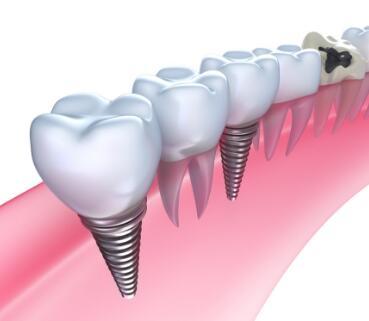
1. Extracting all problem teeth before dental implants
Although dental implants have many advantages, real teeth that can be saved through treatment should still be treated, rather than being extracted at every turn. Extraction should be considered only as a last resort.
2. Dental implants = porcelain crowns placed on natural tooth roots
Placing a porcelain crown on a natural tooth root is medically called a "post-and-core crown", which belongs to the category of tooth restoration, while dental implants belong to the category of tooth implantation. A "post-and-core crown" involves placing a post in the original tooth root and then fitting a porcelain crown over it, so the prerequisite for a "post-and-core crown" is that the tooth root is in good condition. Dental implants, however, do not need to rely on the original tooth root, so the idea that dental implants are equal to placing porcelain crowns on natural tooth roots is incorrect.
3. Once all teeth have fallen out, dental implants are impossible
Although after teeth are lost, part of the alveolar bone will be absorbed, there is still remaining alveolar bone or jawbone where "titanium screws" can be placed. Dental implants place these "titanium screws" in the remaining alveolar bone or jawbone as artificial tooth roots. In addition, pure titanium has good biocompatibility with bone tissue. Bone cells will combine with titanium and grow on the surface of the titanium screws, firmly binding together.
4. Dental implants are a one-time permanent solution
The service life of dental implants has so far been observed to reach at least 10 years or more, and this is also related to each person's usage habits and care methods. Generally speaking, the pure titanium artificial tooth root after implantation is usually very stable and does not need to be replaced, but if the crown of the dental implant is not well protected, it may need to be replaced.

5. Once you get dental implants, your whole mouth must be implanted
It is not the case that once you choose dental implants, you must "implant" every place where a tooth is missing. For elderly people who have lost an entire row of teeth or many teeth, only a small number of dental implants are needed as fixed supporting "bridge piers", and the full set of dentures firmly performs its function on these "bridge piers".
6. Dental implants are a frightening major surgery
Dental implants are actually minor surgery, and now they have even developed to the point where minimally invasive procedures are possible, with little bleeding after surgery, no swelling or pain, and all missing teeth can be implanted in one session. The pain and trauma are even less than tooth extraction. However, the surgical procedure is precise.
7. Completing dental implants takes 3-6 months
Previously, dental implants required extracting the bad tooth root, and only after three months could the artificial tooth root be implanted, and only after another three months could the crown be placed. Now, with the gradual increase in understanding of dental implants, in some cases the artificial tooth root can be implanted and the crown placed immediately after tooth extraction, shortening the time by 6 months compared with before.