There's more to planting trees at home than meets the eye: a detailed guide to the planting principles for various woody plants
Gardeners often ask how far trees should be planted from a house to be safe, and what the effects of planting them incorrectly might be.
Others ask whether planting flowers, grasses, and trees right beside a wall will, when watered, seep into the foundation and damage it. The fact is, most houses are designed well enough to channel water from beside the walls into the groundwater system; otherwise, every house's foundation would be damaged in heavy rain.
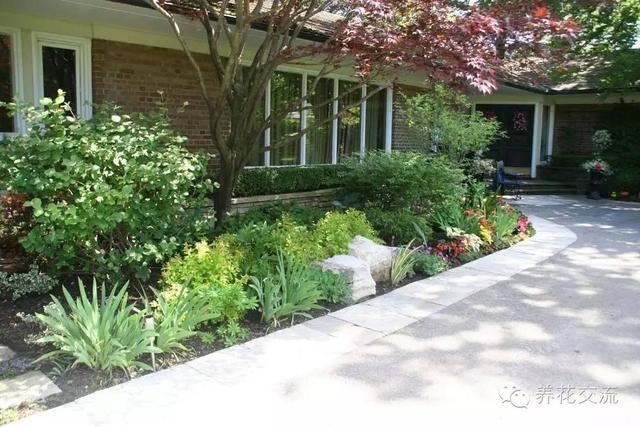
As for how far plants should be from a wall foundation, here are the basic principles.
1. Herbaceous plants:
Herbaceous plants include ordinary flowers (both annuals and perennials) and vegetables. These can be planted right up against a wall without any problem.
Of course, if they are too close, it is not good for flowers to get no sunlight, so a distance of one or two chi is best. As shown in the picture below, all kinds of herbaceous flowers can be planted beside a wall, and there is no fear of their roots becoming too thick.
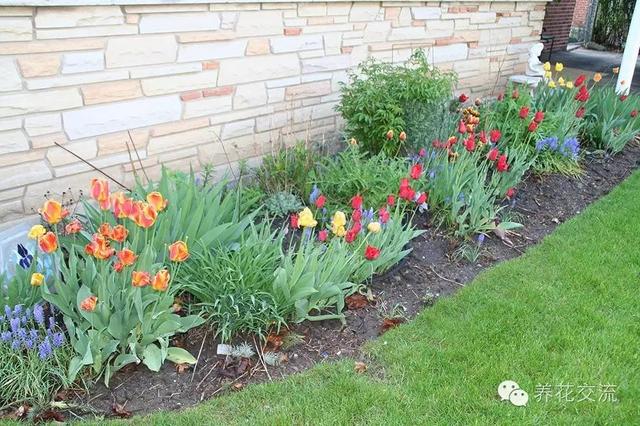
You can also plant shrubs and small trees to bring some shade by the window, such as red maple. But it is best to leave some distance.
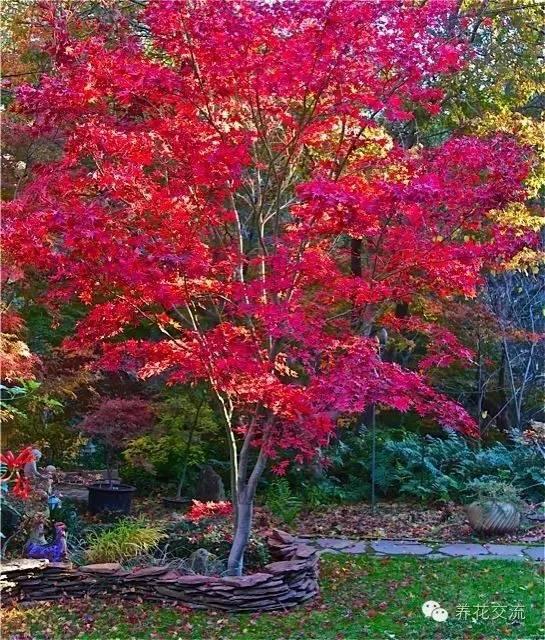
2. Shrubs:
Generally speaking, a shrub only needs to be 1 m from the house wall, because the root spread of most shrubs does not exceed 1.5 m. Smaller shrubs do not exceed 1 m.
In general, a plant's height and the thickness of its trunk and branches are also closely related to the extent of its root spread. Although it may not be as precise as science, it is roughly accurate.
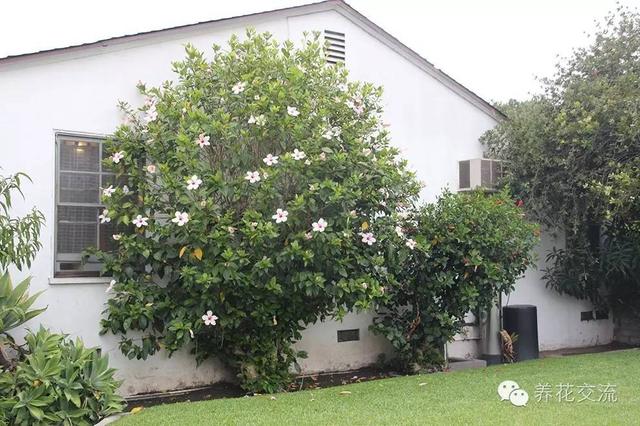
(What is planted beside the wall was originally shrubs or small trees, but planted too close to the wall, after many years they have grown into trees with very thick trunks and very thick, large roots, which is very bad.)
If you have already planted a shrub beside a wall and hope it will not spread excessively, you can saw off the thickest few trunks at the base each year. (At most one third of the branches and trunks can be sawed off at the base without harming the tree; it may even have the effect of replacing the old with the new.)
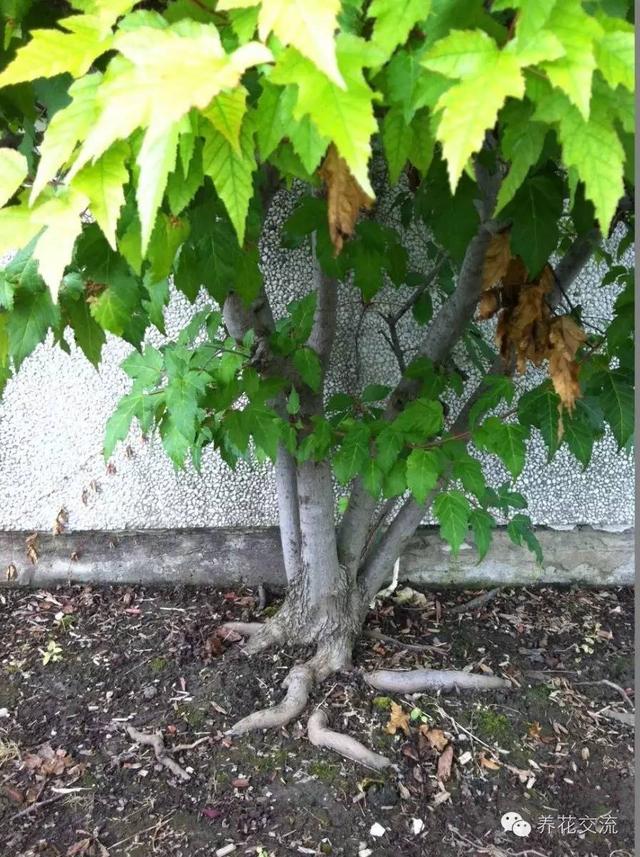
(This tree was clearly planted too close when it was young, and was not properly pruned afterward.)
On the other hand, you can "root prune," that is, use a sharp spade, insert it into the ground, and prune the tree's roots to stop excessive growth. Using both methods together can also stop the roots from extending excessively. (Root pruning must not be excessive, otherwise it will definitely affect the plant.) Do not root prune too close to the trunk; about 30 cm away from the trunk is fine.
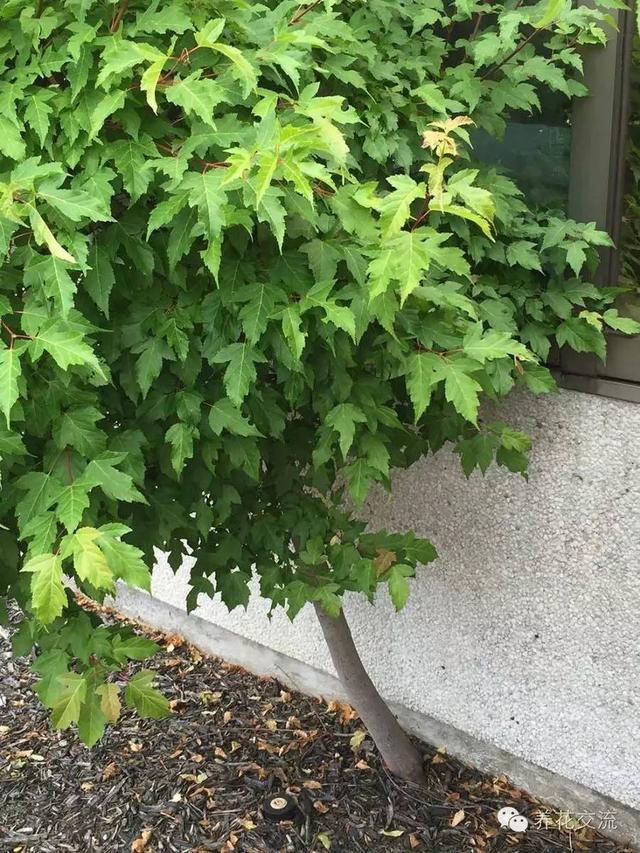
(The treatment in these books is to cut the thicker trunks off at the base.)
So when planting shrubs, you should also keep a distance of 1.5 m, and at the same time regularly cut the thicker trunks off at the base; otherwise, they must be treated as trees and planted farther away.
The result shown in the picture above is being pressed against the wall and against the window, which is good for neither the house, nor the tree itself, nor the people inside.
(Unless grown in a container like this)
Common shrubs include:Lilac, weigela, shrub roses, forsythia, deutzia, rhododendron, camellia, dogwood, peony and Chinese peony, hibiscus mutabilis, hydrangea, oleander, laurel, holly, mock orange, euonymus, smoke tree, smokebush, and so on.
These small flowering trees can also be planted outside the 1 m range from the house.
The picture above shows a small magnolia tree, and the picture below shows an ornamental peach blossom; both count as small trees or shrubs and can be planted close to the house. However, both plants in the pictures are obviously a bit too close.
3. Trees:
Trees are divided into evergreens and arborescent trees (deciduous trees). Generally speaking, the roots of deciduous trees are more developed and grow farther and deeper, while the roots of evergreens are shorter.
To roughly judge the extent of each kind of tree's root spread, there is a very good method: look at the "drip line."
What the drip line is can be seen in the picture below. The root spread of most plants is roughly similar to the spread of their branches.
Generally speaking, allowing one or two chi beyond the drip line should be enough.
The drip line also has a measuring function: it must not touch the house structure, so as to avoid blocking air circulation or damaging parts attached to the house, including eaves, windows, chimneys, and so on. Therefore, the safest distance between a tree and the house is two or three chi beyond the drip line.
(But with container planting, there is no need to consider so much)
However, a tree's drip line is not an absolute indicator either. For example, some trees grow upward, such as poplars among deciduous trees; among evergreens, several common cypresses are also slender and tall, growing upward, and are often seen in tropical regions planted as hedges. But this is not absolute either: poplars and cypresses are very prone to spreading roots.
Another thing to note is that trees can break, especially when the tree shape grows unhealthy; for example, when the trunk is not straight, or when side branches are stronger than the main trunk, they are prone to breaking and will threaten the house.
(A wild hawthorn in the yard)
When planting a tree, it must be straight (so a support stake should be set up from the beginning), and at the same time, side branches that are too close to the main trunk (side branches at an angle of less than 45 degrees) should be cut off from the start, so that the branches all extend outward.
(Oak)
Some trees' roots spread very readily, mainly extending to seek water. The roots of this type of plant may even pass through building walls; especially some older buildings may be damaged, so prevention is necessary.
In addition, if there are water pipes or sewer pipes underground in your yard, and tree roots may wrap around the pipes and cause the underground pipes to burst, you must be careful.
4. Trees with well-developed roots:
The extent of root spread differs for every kind of tree. Some are thick and substantial, while others have many fibrous roots. Most roots extend to near the drip line, while some extend even farther. Below are well-known plants whose roots spread relatively readily.
1. Poplars:
This category includes cottonwoods, cottonwood poplars, aspens, and so on. The roots of this type of plant spread outward the most, for the purpose of reaching water sources, so do not plant them near a house foundation. (This type of plant should be at least 10 m or more from the house.)
2. Willows:
This family of trees is also famous for roots that extend, on the one hand reaching far away and on the other reaching deep down, all due to their nature of seeking water sources.
So few people plant them in front or back yards. Most are planted by the water, as far from the house as possible. (The safe distance between this type of tree and a house should be beyond 15 m.)
(Willows are famous for extending their roots to seek water sources. In the picture above, a willow is planted in the center of the front yard of this house, which is very dangerous.)
3. Elms:
This is a common landscaping tree seen in daily life, because it grows fast, but it is notorious and often damages underground water pipes.
4. Silver maple:
Its roots are very shallow, but very dense, and also spread readily. Besides needing to be far from the house foundation, do not think of planting any plants (flowers or grasses) on the surface.
5. Other treesAll should be based on the drip line, with an additional 1 m of distance. Larger trees should have one and a half times that distance.
Make flower growing more enjoyable and simpler! Follow the WeChat public account: Yanghua Jiaoliu [yanghuajiaoliu]