What is the suitable planting density for fruit trees? Key points of autumn fertilization techniques
Autumn is the fruit harvest season. In this season farmers are busy harvesting and bringing fruit to market, but do not forget fertilization. Autumn is a very important fertilization period for fruit trees. Its main role is to increase the reserve nutrients in the tree body and prepare for good growth the following year. After the tree absorbs fertilizer, it processes and manufactures nutrients through photosynthesis, which are transported to the tree body and stored. The more that is stored, the stronger the tree body will be the following year. In the following spring, when the plant blooms, unfolds leaves and grows new shoots, it all uses the nutrients stored from the previous year. This can effectively avoid the occurrence of alternate bearing, so autumn fertilization is essential.
1 Planting density
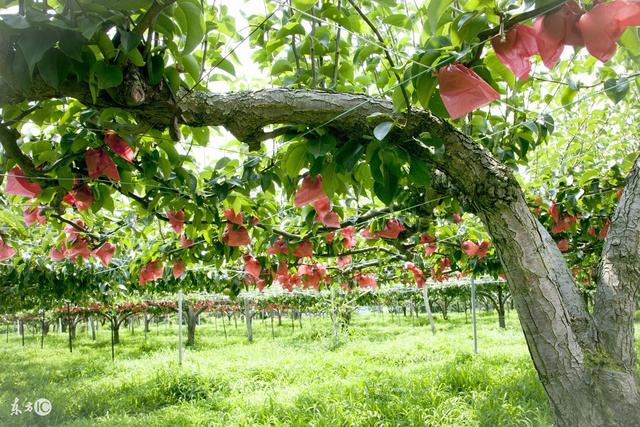
Planting density determines the state of the fruit tree's growth process. Density that is too high or too low is not acceptable, and both will affect the normal growth of fruit trees. When planting, the rootstock and scion-rootstock combination should be selected according to the site conditions of the orchard and the water and fertilizer conditions. Then, according to the growth vigor of the selected scion-rootstock combination, the suitable planting density should be determined. On poor soil and sandy gravel land or mountainous land that is difficult to improve, generally choose a vigorous rootstock that suits the local climate conditions and has strong stress resistance, so the root system can reach deep soil layers, absorb more water and nutrients, improve the tree's drought resistance and poor-soil resistance, and increase yield and quality. If a long-branch type or a variety with strong growth vigor is chosen, a spacing of 3 m x 4 m between plants and rows can be used when planting, planting about 55 fruit trees per mu. For short-branch type or moderately growing varieties, a spacing of 2 m x 3-4 m between plants and rows can be used, planting about 70 trees per mu.
2 Fertilization techniques
2.1 Fertilization methods.
There are many fertilization methods: hole application, strip and band application, ring fertilization, and radial strip fertilization. It is best to use radial trenches, 1-2 m away from the main trunk, opening radial trenches outward, that is, following the direction of root growth. Dig 6-8 radial trenches per tree, and the depth of the trenches should not be less than 35 cm. The reason is that where the fertilizer is, the roots are; the purpose is to lead the roots downward, because only with deep roots can the leaves flourish.
2.2 Fertilizer types.
Organic fertilizer must be applied. Autumn fertilization should be mainly organic fertilizer, supplemented by phosphorus and potassium fertilizer. First, organic fertilizer has a high organic matter content and provides high nutrition. Second, organic fertilizer is purely fermented and is well absorbed by the root system. Third, it contains probiotics, with 20 million probiotics per gram of organic fertilizer. Fourth, organic fertilizer can improve the soil and regulate soil water, fertilizer, air and heat conditions. Fifth, organic fertilizer is rich in minerals. In addition to the major elements N, P and K, it also contains trace elements such as Fe, Zn, Cu and Mn. In short, increasing the application of organic fertilizer solves the shortcoming of inorganic fertilizer's single composition and can meet the fruit tree's demand for various nutrients. Therefore, the amount of chemical fertilizer should be gradually reduced and the application of organic fertilizer increased.
2.3 Fertilization time.
Autumn fertilization should be chosen from mid-September to the end of September, and should not be delayed until early October, because in early October the ground temperature is already low, which is not conducive to the root system's absorption of fertilizer. In September, however, the ground temperature is high. After digging trenches, the root system is cut, and many new roots will soon grow from the callus tissue on the roots. These new roots will grow right on the fertilizer we applied and begin to absorb nutrients, then transport them upward to supply the leaves in manufacturing nutrients, and then transport them downward to be stored in the roots and stems, preparing for growth the following year.
2.4 Fertilization amount.
For fruit trees in full fruit-bearing stage, the amount of organic fertilizer per mu is best 1 t, and at minimum must not be less than 0.5 t. Each tree must not be less than 10 kg of organic fertilizer, which is 500 kg per mu. If it is farmyard manure, it should be one jin of fertilizer for one jin of fruit. If one jin of fertilizer for one jin of fruit cannot be achieved, then the application of organic fertilizer must be increased, and a fertilizer with medium nitrogen, medium phosphorus and low potassium should be applied, such as Genliduo 20-20-5, or Genliduo 369, and also 16-18-6, etc., or apply 2 bags of Shikefeng compound fertilizer with 3 17s, then apply 7-8 bags of bacterial fertilizer per mu. The soil-improving effect of bacterial fertilizer then becomes prominent, and the utilization rate of organic fertilizer is also improved.
[Text] Huo Yuqin, Liu Fuchun. Modern Rural Science and Technology