Detailed Explanation of Cutting Propagation Methods and Planting Techniques for Long-stalked Golden Osmanthus
Cutting Propagation and Planting Techniques for Long-stalked Golden Osmanthus
Long-stalked Golden Osmanthusstands out and is a rare variety within the Golden Osmanthus groupof Osmanthus fragrans. This variety shows good adaptability and resistance, with a tree form that is tall,upright, clean and resolute. In the industry it is also known as "Golden Osmanthus."
1 Strengthen nursery stock cultivation and ensure a good source of varieties
There are many propagation methods for Osmanthus fragrans, commonly used ones include grafting, layering, and cuttingpropagation. Due to differences in varieties, the methods used also differ. Long-stalked GoldenOsmanthus is usually propagated mainly by cuttings, which has the advantage of simple propagation operation.
1.1 Nursery site selection
The nursery site should preferably be well-drained sandy loam or light loam. If the soiltexture is too clayey, some sand or perlite can be appropriately mixed in to adjust the soil texture, which canbetter prevent the occurrence of damping-off and root rot. Before cutting, spraypesticide on the seedbed to disinfect the soil. To ensure smooth drainage, the cutting bed should be slightly higher, which can preventwater accumulation after rain, which causes cutting rot, and waterlogging of the seedbed during the rooting period of the cuttings.
1.2 Propagation shade shed
Build a shade shed for enclosed propagation. The height of the shade shed is 2 m, and the width of the cutting bed is1.2 m, but both ends of the shade shed need ventilation and should be able to open and close freely, facilitating air circulation,lowering the temperature inside the shade shed, and in addition, direct sunlight must also be prevented.
1.3 Cutting time
Combined with the local climate, late April to late May is the most suitable period(autumn cutting can be from early September to late October), when the cuttings have a relatively high degreeof lignification, and air and soil temperatures gradually rise, making rooting and survival easy after cutting.。
1.4 Cutting operation and treatment
Cuttings must use tender shoots sprouted in the current year.。In winter, strengthen fertilizer and water management of themother trees used for cutting collection to promote plump and robust cuttings. 40 d before cutting collection,apply 2-3 times of compound fertilizer to promote shoot growth. In spring drought, water and fertilizer should also be balanced tocultivate plump and well-developed branches, promote new root formation, and improve the survival rate.。Thelength of the cuttings should preferably be 8-10 cm. After cutting, the cuttings should be quickly placed indoorsin a ventilated and cool place and sprayed with water to keep the leaf surface moist. When trimming the cuttings, retain2-3 leaves.。Long-stalked Golden Osmanthus cuttings mostly root at the nodes, while rooting at the internodesis less common. The part inserted into the soil should preferably retain 1-2 nodes, and keeping a node at the end makesrooting easier. Before cutting, quickly dip in 500 mg/L naphthalene acetic acid (8 s), spread out briefly to air-dry,and then cut, promoting early and rapid rooting of Osmanthus fragrans.。
1.5 Cutting
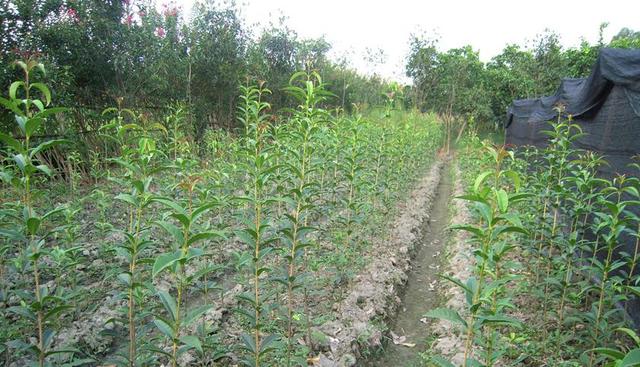
Insert the cuttings into the soil to 1/2 of their length, with a plant spacing of 3-5 cm and a row spacing of6-10 cm. Leaves should not overlap each other. After cutting, spray thoroughly with water.。After new shoots emerge,open the film at both ends of the shade shed and harden the seedlings for 7-10 d, spraying water 2-3 times a day.After the seedlings reach 40-50 cm in height, they can be transplanted with soil.。Long-stalked Golden Osmanthus formscallus tissue at the end of the cutting, and forms nodular protrusions between the cortical part and the xylem.After treatment with naphthalene acetic acid, callus tissue forms in 7-10 d and newroots begin to develop.。
2 Focus on transplanting key points to ensure growth after transplanting
Long-stalked Golden Osmanthus has a well-developed root system and a short seedling recovery period. The best transplanting time is spring.The best。transplanting site should be chosen as a warm、and sunny place, and transplanting is best done on cloudy days orduring periods without scorching sun. It should be transplanted with a soil ball to ensure the survivalrate.。After transplanting, wrap the trunk with straw rope or film to retain moisture until the tree survives.Because the bark of Osmanthus fragrans is relatively thin, water is easily lost through the bark. Strong direct lightand dry hot wind must be avoided to reduce water evaporation, and before new roots grow, ensurewater balance within the tree.。After transplanting large seedlings, set up supports to fix the tree body,preventing the roots from loosening.。The plant and row spacing for seedling transplanting is about 25 cm.×25cm。Aftertransplanting, apply farmyard manure 3-4 times each year,、nitrogen fertilizer,、and potassium fertilizer, providing sufficient water, fertilizer and nutrientsto promote robust growth of Osmanthus fragrans.。Long-stalked Golden Osmanthus likes moisture and fears waterlogging. After transplanting, water thoroughlyonce and replenish water in time to ensure seedling survival.。However, water accumulation in the rootsoil can also cause root rot and leaf drop. Long-term water accumulation causes root rot and directlyleads to plant death.。Osmanthus fragrans is not tolerant of waterlogging. After entering August, beginto gradually control water to facilitate overwintering, prevent freezing, and at the same time prevent the invasion of pests and diseases.。
3 Scientific pruning
3.1 Pruning
Long-stalked Golden Osmanthus has the advantages of fast growth,、high branching,、early shaping,、tilleringability that is extremely strong,、and a good tree form. Its trunk is straight and smooth, and its crown is compact,steady and upright,、straight and clean,、and imposing, with“a manly”masculinebeauty.。Key points for pruning the branch framework: cultivate a clear central axis and a strong, powerful trunk.。The main trunk of Long-stalked Golden Osmanthus is a single stem, and the central leader is also a single stem growing upward,with few forks, and it does not branch until it grows to about 1.8 m.。Pruning should clearly distinguish primary and secondary, and thesubordinate relationships of branches should be clear, forming an umbrella shape.。That is, the main branches are borne on the central trunk, and secondary main branches sproutfrom the main branches, with clear layers of backbone branches at all levels.。The number of backbone branches should grow appropriately,with reasonable distribution and well-arranged spacing.。The growth vigor of each main branch should be comparable and distributedevenly, achieving fewer but finer large branches and more and denser small branches.。
3.2 Removal of sprouts、and bud wiping
In the early stage when new buds have just sprouted or new shoots have emerged but not yet lignified,begin removing sprouts、and wiping buds to save tree nutrients and promote rapidand healthy development of retained branches.。Removal of sprouts、and bud wiping should focus mainly on the root crown near the ground of young trees.This should be done multiple times each year, especially promptly before new shoots flourish,to prevent the appearance of clustered branches、and water sprouts that compete in parallel with the main trunk and disrupt the originaltree form.。If sprouts are not removed in time、and buds are not wiped, then during pruning the sproutsand tillers should be thoroughly removed from the base.。Young Osmanthus fragrans trees should be pruned mainly lightly, minimizing theloss of branches and leaves, and using methods such as bud wiping,、sprout removal,、pinching,、and shoot twisting, with less use of scissors.。
4 Strengthen cultivation management and improve plant resistance
During the nursery planting period of osmanthus trees, fertilization is required 3~4 times a year。In early springbefore bud break, apply decomposed soybean cake per plant、organic fertilizers such as pig manure and poultry manure8kg, which can promote the growth of spring shoots。In autumn after osmanthus flowering, to restore tree vigor andreplenish nutrients, apply decomposed organic fertilizer in the tree dish from after flowering to before winter。Duringthis period, according to the growth of the osmanthus, apply quick-acting nitrogen fertilizer 1~2 times additionally, and combinewith the application of phosphorus、and potassium fertilizer, to promote the trunk growth of the osmanthus and the expansion of the crownspread。In order to make the seedling root system well developed and concentrated and easy to survive after transplanting, when fertilizingthe fertilizer must be applied where the roots can absorb it, such as applying the fertilizer withina 1~2m diameter of the tree dish, otherwise the root system will expand outward excessively, which is not conducive to the digging of the soil ball, and the survival rate of seedling transplanting will also be affectedIf the root ball is dug poorly, the survival rate of transplanted seedlings will also be affected。However, avoid applyingit under the trunk; the roots should not come into direct contact with the fertilizer, so as to avoid burning the tree andaffecting fertilizer absorption。It is best to apply the fertilizer diluted with water or by shallow tillage and mulchingand try not to dig the soil deeply, otherwise when digging the soil ball, it is easy tohave the soil ball loosen or fail to hold together。
5 Strengthen disease control and reduce management costs
In the natural environment, osmanthus planted sporadically rarely suffers from pests and diseases,but with the widespread use of organochlorine、and organophosphorus pesticides over the years, thenatural enemies of pests have been greatly killed by broad-spectrum pesticides, and mites,、whiteflies,、and scale insects stilloccur in small amounts; in addition, in the last dozen years or so, the large-scale circulation of seedlings has madepest and disease quarantine difficult to carry out fully in place, causing some seedlings carrying pests and diseasesto spread faster and cross-transmit, and large-scale single-species seedling cultivation、and the creation of osmanthusgroves have also made the pests and diseases of osmanthus stand out。
5.1 Control of the main disease, dieback
It mainly occurs on larger-sized newly transplanted osmanthus plants。Due tobruising during digging、scratches during long-distance transport、strangulation injury during lifting and planting、accidental impact injuryand other reasons, the outer bark of the main trunk or large branches of the osmanthus is severely damaged and notproperly protected in time, causing the wound to rot,、the xylem to be exposed, or a cankerto form, causing poor plant growth,、massive leaf drop,、and death of large branches, and in severecases causing the death of the entire osmanthus plant。Control method: clean the wound locallyand thoroughly, and promptly apply a wound healing agent to promote the wound to heal as quickly as possible。Forold large wounds on the trunk, the exposed and already rotted xylem can be cleanedthoroughly, and lime sulfur mixture can be applied regularly to the antiseptic wound; for thick large osmanthus plants whose main trunk has already formed a hollowcavity, the rotted part can be completely removed, taking care to protectthe isolation layer of the unrotted xylem, and fill the cavity with polyurethane foam。
5.2 Control of main insect pests
At present, the osmanthus pests cottony cushion scale、and whiteflies occur in small amounts。
5.2.1 Cottony cushion scale。After hatching, the larvae disperse and move, from the tender shoots、and leaf backs migratingto the branches and trunk where they gather to cause damage, sucking the tree's sap and excreting honeydew, inducingsooty mold。Because the insects and disease damage each other, they often cause the leaves of the osmanthus plant to turnyellow,、and the branch tips to wither。Control method: reduce the use of pesticides to protect natural enemies; whena small number of insects are found, promptly wipe them off and crush them to remove them; in winter spray0.3~0.5°Be lime sulfur mixture to kill overwintering pests; at the peak of egg hatching,spray with 15% buprofezin wettable powder 2000 times dilution,、40% dimethoate emulsifiable concentrate1500 times dilution, or 40% methidathion emulsifiable concentrate 3000 times dilution。
5.2.2 Whiteflies。They mainly use the mouthparts of adults、and larvae to pierce into the leaf mesophyll on the leaf backand suck the sap, causing osmanthus leaves to curl, lose greenness and turn yellow, or even dry up, and they willexcrete large amounts of honeydew, causing sooty mold, seriously polluting the branches and leaves of the osmanthus,leading to poor growth of the osmanthus, thereby affecting the normal flowering of the plant and itsdisplay and ornamental value。Control method: protect natural enemies such as Amitus spiniferus,、Prospaltellalongifuniculata,、and Encarsia smithi, use yellow sticky traps to trap and kill adults, and in orderto improve the control effect and inhibit the pesticide resistance of whiteflies, pay attention to the principles of alternating useand mixed use of pesticides, for example, 10% buprofezin emulsifiable concentrate 1000 times dilution,、10% imidacloprid wettable powder 2000 times dilution,、40% omethoate emulsifiable concentrate1500 times dilution,、25% buprofezin wettable powder 2000 times dilution, or 20%fenvalerate 2000 times dilution, etc., used alternately。
6 Prospects for promotion and application
Long-stalked golden osmanthus combines greening,、beautification,、and fragrance, and can be said to be“form,、color,、charm,、and scent”all excellent, thus deeply loved by Chinese people, and is a rare osmanthus varietyPlant。Its tree shape is upright、and neat, and its leaf color is deep green and soft。Long-stalked golden osmanthus beginsflowering at 5 years, with the full flowering period after 7~8 years of age, flowering 2~3 times a year, at9~10 months, and in April of the following year, with golden flower color, abundant flowers, andrich fragrance from the flowers and leaves that lingers, and it does not have alternate bearing。Long-stalked golden osmanthus has strong tilleringability; from a cutting seedling to a total height of 2m takes only 2 years, and at the same timethe meter diameter can reach more than 1.2cm; when the meter diameter reaches 4cm, the annual diameter thickeningcan reach 2cm。Long-stalked golden osmanthus has a developed root system, is resistant to cold、and drought, has strong disease resistance、and stressresistance, and is highly ornamental、and artistic, with great value for promotion。