When to Plant Brussels Sprouts? A Detailed Guide to Planting Time and Cultivation Methods
Brussels sprout planting time varies depending on the production region. In the Yangtze River Delta plain area, where open-field cultivation predominates, the suitable sowing period is from late June to mid-July, with supply from November to March of the following year. In high mountain areas, sowing is best done in April in spring, with supply from September-October through February-March of the following year; for spring sowing, seedlings are raised in protected cultivation in January-February, transplanted in March-April, and supplied in May-June. Below we take a closer look at Brussels sprout cultivation techniques.
Raising Brussels Sprout Seedlings
Cultivating strong seedlings is key to Brussels sprout cultivation. Since the seeds are mostly F1 hybrids and expensive, sowing in summer and autumn should be done in plug trays under a rain shelter with shade netting to improve the emergence rate, which helps cultivate strong seedlings and reduce seed costs. If sowing in a seedbed, choose a plot with good ventilation and convenient drainage and irrigation; 25 grams of seed is needed per mu, and the sowing bed area needs 4 sq m. After sowing, cover lightly with soil, place black shade netting directly over the bed surface, then water thoroughly and keep moist. When the seeds begin to emerge, remove the shade netting promptly. To lower the temperature and prevent rainstorms, build a low flat frame over the bed and continue covering it with shade netting, covering by day and uncovering at night. From emergence to transplanting, one pricking-out is needed, and the transplant bed area requires about 35 sq m-40 sq m. Transplant to the field when there are 5-6 true leaves. The seedling age is generally 35 days-45 days.
Land Preparation and Transplanting of Brussels Sprouts
The field should be plowed early, plowed deep, the soil clods sun-dried, and sufficient base fertilizer applied, with decomposed compost and barnyard manure applied per mu.
The field should be plowed early, plowed deep, the soil clods sun-dried, and sufficient base fertilizer applied, with 3000 kg of decomposed compost and barnyard manure, 15 kg of urea, and 25 kg of superphosphate applied per mu. Break up the soil and make high beds 1.2 m wide. For dwarf varieties, plant two rows per bed with a plant spacing of 40 cm, planting 2000 plants per mu; for tall varieties, plant one row per bed, planting about 1200 plants per mu.
Field Management of Brussels Sprouts
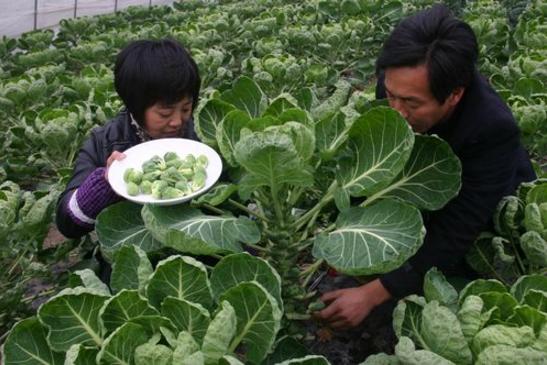
Brussels sprouts have a long growing period, so in addition to applying sufficient base fertilizer, topdressing is needed in 4 applications. 4 days-5 days after transplanting, water with a seedling-establishment fertilizer; one month after transplanting, apply a seedling-promoting fertilizer to boost vegetative growth so that the outer leaves reach about 40 before entering the heading stage; the 3rd topdressing is done during the sprout swelling stage, and the 4th during the sprout harvest stage. Apply liquid fertilizer each time, usually urea solution, with 10 kg-15 kg of urea per mu applied in holes or furrows, combined with watering. Pay attention to intertillage weeding and earthing up around the roots, so that wind and rain do not cause the plants to sway and affect sprout formation and swelling. In windy areas, set up supports with bamboo poles and branches. Once small sprouts form on the middle part of the stem, remove the lower leaves promptly to improve ventilation and light penetration, promote head development, and make harvesting easier; at the same time, pinch out the growing tip to reduce nutrient consumption.
Harvesting and Uses
Sow in February-March and harvest in May-June; sow in May-June and harvest from November until March of the following year. The sprouts produced in each leaf axil mature gradually from bottom to top, so multiple harvests are needed, finishing only after 6-7 rounds; the yield is generally 1000 kg-1200 kg per mu.
Small sprouts can be eaten in many ways: stir-fried, boiled plain, pickled, made into pickles, served cold with dressing, and in soups, etc.