Factory-style aeroponic vegetable cultivation technology in Jiangmen City
Factory-style aeroponic vegetable cultivation technology in Jiangmen City
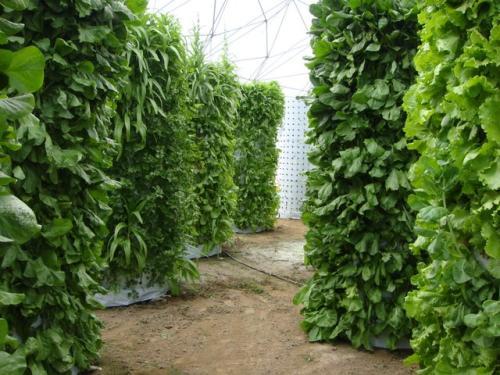
Aeroponic cultivation technology is an emerging soilless vegetable cultivation technique in recent years, and in our country it is only grown on a small scale in pilot form, lacking experience and difficult to promote. In order to explore the advantages and disadvantages of aeroponic cultivation technology, summarize practical experience, and provide reference information to agricultural science and technology enterprises and farmers, the Jiangmen City Agricultural Science and Technology Innovation Center established about 1000 sq m of tower-type aeroponic cultivation equipment and conducted trial planting for 1 year.
1 Application of aeroponic cultivation technology
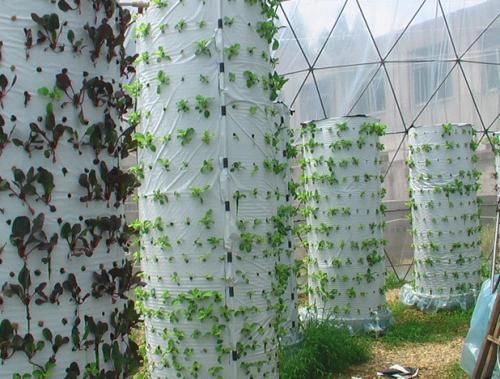
In terms of facility construction, high-strength foam planting boards are laid at an angle on planting racks whose longitudinal section is triangular, so that a closed space called an aeroponic chamber is formed in the middle of the planting rack, and aeroponic nozzles are installed inside it. Vegetable seedlings with a plant height of 8 cm are fixed with sponge into the holes of the foam planting boards, so that the vegetable roots are exposed in the aeroponic chamber. The aeroponic chamber sprays nutrient solution at regular intervals, so that the vegetables obtain sufficient water, oxygen and nutrient elements.
1.1 Aeroponic cultivation is a resource-saving cultivation method
Compared with traditional hydroponics, aeroponic cultivation directly sprays mist-form nutrient solution onto the vegetable roots, requires less stored nutrient solution, saves about 60% of water and fertilizer, and improves the utilization rate and precision of the nutrient solution. The atomized nutrient solution that is not utilized will be collected and reused after ultraviolet sterilization, until its conductivity is lower than the hydroponic index value, at which point it is replaced. According to practical experience, usually during the 1-2 month leafy vegetable cultivation cycle, there is no need to replace the nutrient solution. In addition, aeroponic cultivation technology uses intermittent aerosol spraying, requires no continuous operation, and has low power consumption.
1.2 Vegetables grow faster under aeroponic cultivation than under traditional hydroponics and soil cultivation
The characteristic of aeroponic cultivation is that it exposes the roots to the air, allowing them to obtain sufficient oxygen for respiration, thereby optimizing the root environment and improving the growth rate and absorption rate of the roots. In practice, it has been found that the root systems of leafy vegetables are very well developed. For example, the roots of lettuce reach up to 1 m in length, which is 2-3 times that of traditional hydroponics. The well-developed root system increases the absorption area of the vegetables for the nutrient solution, so that under the strong absorption of the root system, the growth rate of the vegetables is greatly improved; compared with traditional floating-raft hydroponics, the growth cycle of leafy vegetables is shortened by 1/5.
2 Aeroponic cultivation is a model of three-dimensional planting, with a high space utilization rate
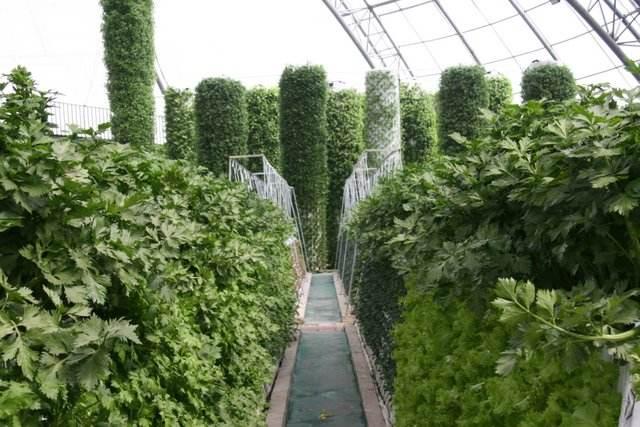
Tower-type aeroponic cultivation plants vegetables on inclined reinforced foam boards, which helps to make full use of the space in the intelligent greenhouse and increase yield. In addition, aeroponic cultivation enables intensive production under artificial conditions, allows control of the cultivation environment, and requires no soil or substrate cultivation, which is also of great significance for vegetable supply in areas with harsh environments and even on ocean-going ships.
2.1 Disadvantages of aeroponic cultivation and improvement methods
Aeroponic cultivation requires fine management and has high maintenance costs. Because the nutrient solution must be atomized through aeroponic nozzles, and the spray holes are very fine, the nutrient solution needs to be filtered before spraying to prevent nozzle clogging. The recommended filtration condition is 400 mesh.
2.2 Aeroponic cultivation requires strict sanitary conditions
Because the aeroponic chamber is a closed space, dark and humid, if improperly managed, it will breed bacteria and fungi, affecting the normal growth of vegetables. Therefore, 2 points should be noted in management. (1) Ultraviolet sterilizers should be installed to ensure that all nutrient solution is disinfected before entering the aeroponic chamber, preventing the spread of disease. (2) After harvesting in each production cycle, the planting boards can be opened, and the planting boards and aeroponic chamber can be dried in the sun for 3 d, which can not only sterilize through sunlight, but also dry the planting boards, thereby destroying the conditions for bacterial growth.
2.3 Different vegetables have different adaptability to aeroponic cultivation
In terms of planting, because the seedlings need to be wrapped in sponge and then fixed in the holes of the foam boards, damage may occur during planting. It is recommended that different vegetables be planted at different stages to ensure that their stems grow to sufficient hardness and toughness. Usually, when the vegetable plant height is 8 cm, it is suitable for planting. In addition, aeroponic cultivation plants vegetables in an inclined three-dimensional manner, so the vegetables need to adapt to this planting angle. Practice has found that water spinach and Guangdong choi sum have poor adaptability to inclined three-dimensional planting. In terms of cultivation, vegetables also differ in their adaptability to hydroponics. For example, the traditional hydroponic vegetable varieties of bok choy, mustard greens and lettuce have the best growth conditions, and their growth period is shorter than that of traditional hydroponics, so in actual production, various vegetables should be trial-planted, and then the vegetables with the best adaptability should be selected for aeroponic cultivation, so as to give full play to its advantages.