Saffron's place of origin is not Tibet, but it has now been successfully cultivated there
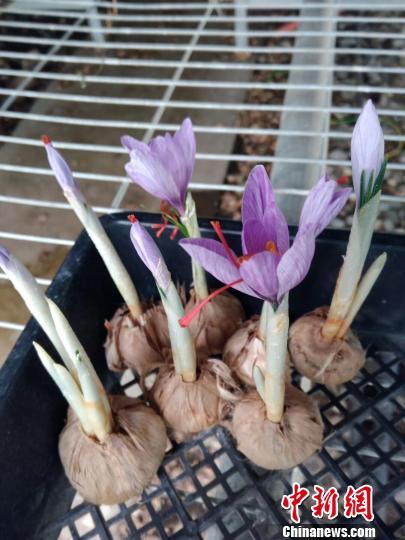
China Tibet Online reports: Many people believe that the place of origin of "saffron" is Tibet, but the true "identity" of "saffron" is actually "saffron crocus," native to the mountains of Asia and to countries such as Spain and Iran. Among these, Iran has the highest saffron crocus production, accounting for three-quarters of the world's output. It was later introduced to China from India, and when it was introduced to China, it first arrived in Tibet. Therefore, people called the saffron crocus introduced via Tibet "saffron," and this name has continued ever since. With the course of history, people seem to have gradually "forgotten" its real name. However, in recent years, with the continuous improvement and development of science and technology, Tibet has also begun to cultivate saffron artificially, and has even achieved impressive results.
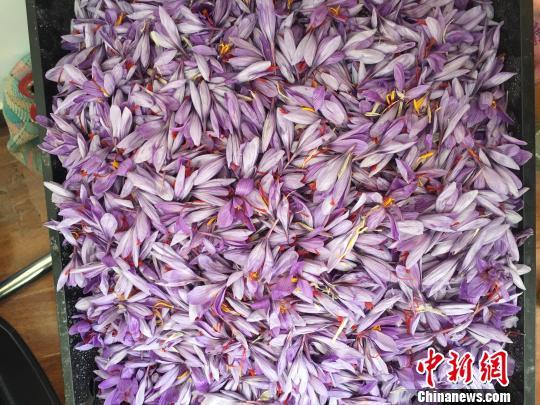
Saffron is hailed as "plant gold"
It is reported that saffron blooms only once a year, each corm keeps only 2 shoots, and 1 shoot produces only 3 flowers, and 1 flower has only 3 stigmas. In other words, one saffron corm produces only 18 stigmas per year. Precisely because of this, it has always been regarded as a precious medicinal material.
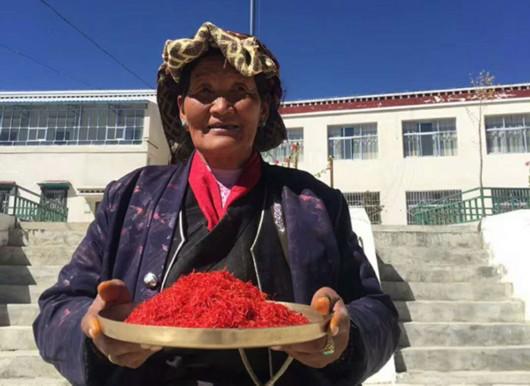
Photo courtesy of Lu Jiantao, a member of Shanghai's eighth batch of aid-Tibet cadres
Shanghai helps Tibet end its history of not producing saffron
Now, saffron cultivation in Tibet has gradually developed into an industry, and has even become a new path to escape poverty and achieve prosperity.
Through the efforts of Lu Jiantao, a member of Shanghai's eighth batch of aid-Tibet cadres and member of the Gyantse County Party Standing Committee and deputy county head of the government, Gyantse introduced a saffron enterprise from Shanghai and invested 46 million yuan in the Honghe Valley Agricultural Park in Gyantse County to build a 25,000 sq m breeding base. Researchers overcame the technical difficulties of artificially cultivating and growing saffron on the plateau, and formed a unique set of plateau planting standards and techniques.
In November 2017, 12,000 Tibetan original seed plants and 450,000 introduced seed corms from the interior underwent three stages - bud removal, summer dormancy and sprouting - at the saffron breeding and planting base in the Honghe Valley Agricultural Park, and ushered in the flowering period, ending Tibet's history of not producing saffron.
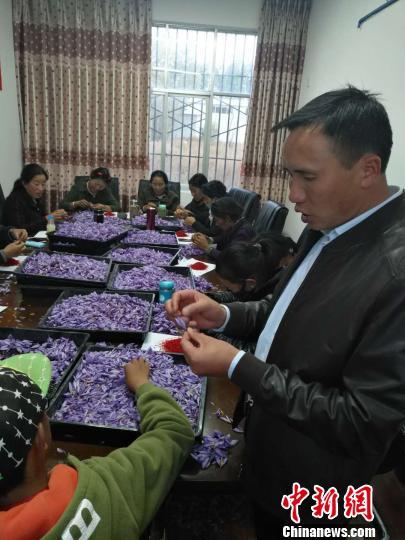
Saffron becomes a flower of poverty alleviation and prosperity
After saffron achieved mass production, 7 Japanese companies successively contacted them for supply. So far, the saffron base has provided flexible employment opportunities to more than 130 impoverished farmers and herders in Gyantse Town, Niandui Township and Rilang Township, paying out more than 150,000 yuan in wages.
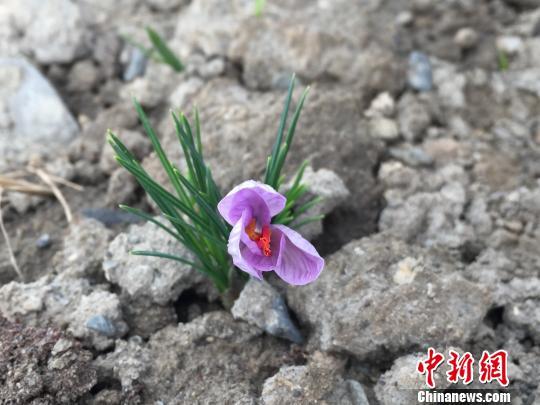
Saffron already planted in the soil and in full bloom, photo by Zhao Lang
Saffron is planned as a key poverty alleviation industry
It is understood that saffron has been listed in Gyantse County's "13th Five-Year Plan" as a key poverty alleviation industry, with plans to integrate various funds within 3 years to expand the planting area to more than 300 mu and build the largest planting base in the country. By 2020, through the incubation of this demonstration zone, an industrial chain integrating saffron planting and sales, saffron medicine research and development, and the production of saffron honey, handmade soap, essential oil, flower cakes and other foods and daily necessities will be formed. By creating cooperative organizations and an industrialized operation model, it will drive impoverished farmers and herders out of poverty, with a coverage rate exceeding 20%, reaching 2,500 households, and achieving annual sales output value of 1 billion yuan. (China Tibet Online Comprehensive/Chen Mengmeng)
Operations staff: Zhou Hui MZ019