What is the difference between porcelain-fused-to-metal crowns and dental implants? Read this one article to understand
Dental implants and porcelain-fused-to-metal crowns are both very good tooth restoration methods, and they are also the most popular restoration methods for missing teeth. Many friends actually do not know much about dental implants and porcelain-fused-to-metal crowns, so they hesitate when choosing a tooth restoration method.
A detailed explanation of the differences between dental implants and porcelain-fused-to-metal crowns
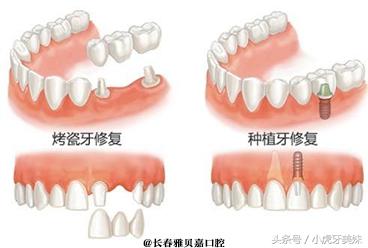
1. Dental implants do not involve adjacent teeth, let alone damage them. They directly replace one missing tooth with one tooth, while porcelain-fused-to-metal crowns need to build a "porcelain-fused-to-metal bridge" to support the false tooth.
2. The retention methods are different. Dental implants place an implant into the alveolar bone to restore missing teeth, with good retention, and the chewing force reaches more than 90%; while porcelain-fused-to-metal crowns use the existing teeth to make a dental bridge and require grinding down adjacent teeth, and this grinding is damaging.
3. Their indications and contraindications are different, and the choice should be made according to the patient's own conditions.
4. There is also a difference in time between dental implants and porcelain-fused-to-metal crowns. For dental implants, the implant and alveolar bone undergo "osseointegration", which takes at least 3 months. Porcelain-fused-to-metal crowns take at least about one week, which is more convenient. Yabeijia experts point out that if a dental implant is done and maintained well, it can be used for a lifetime. If a porcelain-fused-to-metal crown is done and maintained well, it can also be used for about 20-30 years.
5. Porcelain-fused-to-metal crowns are more suitable for broken teeth, while dental implants tend to be for missing teeth.
6. The lifespan is different. Dental implants are more solid, and their service life is more than twice that of porcelain-fused-to-metal crowns. Dental implants and natural teeth have the same biomechanical principle. Natural teeth transmit the chewing pressure in the oral cavity through the tooth root to the alveolar bone. Dental implants transmit chewing pressure through the artificial tooth root (implant) to the alveolar bone, so dental implants can withstand strong forces. However, because the false tooth of a porcelain-fused-to-metal crown itself needs to rely on the natural teeth at both ends of the porcelain-fused-to-metal bridge for support, when eating, all the chewing pressure borne by the false tooth is transmitted to both ends of the porcelain-fused-to-metal bridge, increasing the burden on the natural teeth. Over a long period, problems are also likely to occur, affecting the service life of the false tooth.
7. The required costs are also different. After porcelain-fused-to-metal crown restoration, repair may be needed 5-10 years later, and a second repair also requires a sum of money; while dental implants only need one implantation, and if maintained well, they can still be used for a lifetime. Therefore, the costs required for these two tooth restoration methods are also different.

Warm reminder: Although dental implants and porcelain-fused-to-metal crowns are different, the results of tooth restoration are both good. When friends undergo tooth restoration, they can choose dental implants or porcelain-fused-to-metal crowns according to their own situation. Only a tooth restoration method that suits you is the best.