How to grow melons (muskmelons) for higher yields? 5 major growing tips
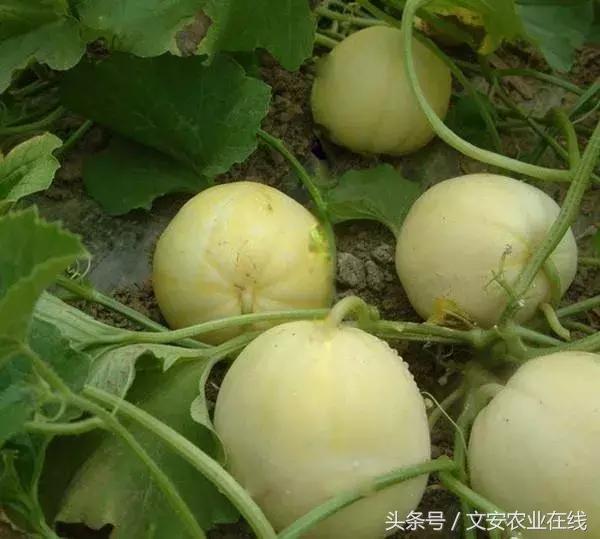
1. Use cooked soybeans as fertilizer
Boil soybeans, let them cool, and use them as a base fertilizer when planting; this can effectively provide nutrients for the yield increase and growth of melons. Soybeans are rich in phosphorus, iron, and calcium. Every 100 g of soybeans contains 571 mg of phosphorus, 11 mg of iron, and 367 mg of calcium respectively, and their biological availability is long-lasting.
2. Grafting method for increasing yield
Black-seeded pumpkin (Cucurbita ficifolia) is often used as the rootstock for grafting. When sowing, sow the melon seeds first, then sow the pumpkin seeds 3-4 days later, so that the stem thickness of the two is similar at the time of grafting, which is favorable for grafting.
After the pumpkin seeds emerge, once the two cotyledons have flattened out and the true leaves have just appeared, grafting can begin. When grafting, first use a razor blade to remove the true leaf growing point and side buds of the rootstock, then at 0.5 cm below the growing point, on one side of the narrow face of the flat stem, cut a slanted notch about 1/2 of the stem thickness from top to bottom; on the melon seedling, at 1.5 cm below the growing point, cut a slanted notch about 2/3 of the stem thickness from bottom to top. The slanted cut surfaces of the rootstock and scion should be about 1 cm long, and the cuts should be smooth and even to facilitate wound healing.
Then insert the cuts of the two into each other to fit them together, so that the cotyledons of both form a "cross" shape, and secure them with a grafting clip. At the same time, bury the melon roots in the rootstock's nutrient pot, and pour a little water along the edge of the nutrient pot to promote recovery of the seedlings.
When grafting, be careful to keep a certain distance between the roots and stems of the two seedlings, so as to facilitate later root cutting of the melon. About 7 days after grafting, when the junction has healed, promptly cut off the root of the scion. The cutting point should be as close to the junction as possible, not close to the ground, to avoid adventitious roots forming self-rooted seedlings and affecting the grafting effect.
3. Prune and train in time
Based on a comprehensive analysis of the fruiting habits of melons, if pruning and training are not carried out in time, excessive vegetative growth will occur, vines will run badly, there will be many flowers but few fruits set, forming a field of leaves with only scattered egg-sized melons.
Through pruning and training, early fruit set and good fruit set can be promoted, ensuring both high yield and quality. When the main vine grows to 4-5 leaves, promptly pinch off the growing tip to encourage 3-4 side vines, then select and keep one strong main vine and cut off all the rest. Using the side vines on the kept main vine, after setting 3-5 fruits, pinch off the tips.
Use the 1st-2nd nodes of the side vines to set fruit. If a certain side vine has no fruit set, you can continue to keep 1-2 nodes and pinch off the tip.
4. Measures that can be taken to prevent melon "fruit abortion" and increase the fruit-setting rate
Artificial supplementary pollination:Collect male flowers that will open the next day in the afternoon of the previous day, or collect male flowers just about to open in the early morning of the same day, peel off the petals of the male flowers, and gently touch the male flower to the stigma of the female flower (fruit-bearing flower).
Prune and pinch off tips in time:Pruning and training can not only regulate the contradiction between vegetative growth and reproductive growth, but also improve ventilation and light conditions. For the reserved fruit-bearing vines, 2-3 days before the female flowers open, promptly keep 2-3 leaves and pinch off the tips. After the fruit is set securely, top the plant at the appropriate time, so that nutrient supply is concentrated and fruit enlargement is promoted.
Hormone treatment:Using p-chlorophenoxyacetic acid to dip the flowers can also increase the fruit-setting rate. The method is to select female flowers that open that day every morning from 8-10 a.m., and dip the fruit stalk in a 20 mg/liter (ppm) solution. Be careful not to let the ovary come into contact with the solution. Avoid repeated use, to prevent fruit cracking and deformed fruit. This method saves labor compared with artificial pollination, and the fruit-setting rate reaches more than 95%.
5. Reasons for failure to set fruit
The main reason melons fail to set fruit is that nutrient supply is not balanced enough; that is, vegetative growth is too vigorous, affecting reproductive growth. No matter what kind of melon, the principle is that if no fruit is set or the fruit cannot be retained, the tips must be pinched off, and the number of melon vines must be strictly controlled. Never pinch randomly and form too many vines.
Notes:When planting, it is necessary to make good use of the time difference; different harvest times bring very different prices. In order to obtain higher income, according to the growth period of muskmelons, he accurately calculated the planting time and strictly controlled temperature and humidity, so that when the muskmelons are harvested, it coincides with a festival.
Western Melon and Watermelon Planting Alliance