How to Grow Oncidium? Master These Growing Methods and Precautions
Oncidium Encyclopedia
Oncidium, also known as the "lucky orchid," dancing lady orchid, dancing girl orchid, golden butterfly orchid, tuberculate-lipped orchid, etc., has 1 to 3 leaves and can be divided into thin-leaved species, thick-leaved species and sword-leaved species. It is the general term for plants of the genus Oncidium in the orchid family; this genus has more than 750 native species worldwide, while the commercially used varieties in all their diverse forms are mostly hybrids. The plants are light and elegant, with slender, drooping flower stems, and the flowers are strange and lovely, shaped like flying golden butterflies, full of movement, making it one of the world's important potted flower and cut flower types. Its story has spread far and wide: it is said that when Song Meiling visited the White House, she fell in love with this flower at first sight and discovered that its petals closely resemble the Chinese character "ji" (meaning auspicious), symbolizing good fortune, and so it was named the "lucky orchid."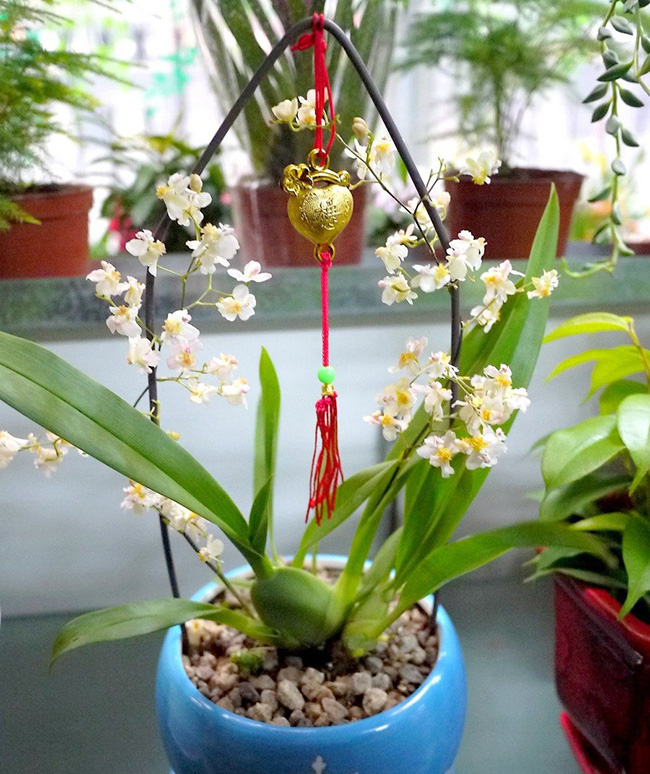
Oncidium Growing Environment
Temperature Conditions
Oncidium is native to the United States, Mexico, Guyana and Peru. The original leaf type (also called the hard-leaf type) of Oncidium prefers a warm environment, while the thin-leaf type (also called the soft-leaf type) and the sword-leaf type of Oncidium prefer a cool climate. The suitable growing temperature for the thick-leaf type of Oncidium is 18 to 25°C, and the winter temperature should not fall below 12°C. The suitable growing temperature for the thin-leaf type is 10 to 22°C, and the winter temperature should not fall below 8°C.
Environmental Conditions
Oncidium prefers a moist and semi-shaded environment. In addition to watering to increase the substrate's moisture, spraying water on the leaves and the ground is even more important; increasing air humidity is more beneficial to the growth of leaves and flower stems. Hard-leaf varieties have strong drought tolerance; not watering for a long time in winter did not cause them to dry out and die.
Strong Tolerance
This phenomenon shows that its tolerance is very strong. For large-scale production, shade netting is needed, with a shading rate of 40% to 50% being suitable. In winter, sufficient sunlight is needed, and shade netting is generally not used, which is beneficial for flowering.
Main Value of Oncidium
Cut Flower Varieties
Oncidium is an extremely beautiful orchid with great ornamental value and is one of the world's important orchid cut flower varieties. It can be placed in vases in homes and offices, and is also a high-end floral material for making bouquets and small flower baskets. It is now cultivated all over the world. The dancing lady orchid is Oncidium; it has a bright yellow color, and each flower is like a beautiful maiden, with skirts fluttering, dancing gracefully. Its flower language is "happy and carefree," symbolizing forgetting one's worries.
Ornamental Value
Oncidium is an extremely beautiful orchid with great ornamental value and is one of the world's important orchid cut flower varieties. It is suitable for vases in family rooms and offices, and is also a high-end floral material for making bouquets and small flower baskets. Oncidium
Oncidium Propagation Methods
Division Propagation
Oncidium is a sympodial type of tropical orchid; after maturing, it will grow daughter plants, and once the daughter plants have pseudobulbs, they can be cut away from the mother plant. Cut off the pseudobulb with 2 buds and plant it directly in a pot of sphagnum moss, maintaining relatively high air humidity, and it will quickly recover and sprout new buds and grow new roots. Division propagation is generally carried out after flowering or in spring and autumn; it is best to carry out division in spring before new buds sprout, combined with repotting.
Oncidium Growing Methods
1. Soil:
Oncidium prefers a relatively dry environment. When growing it, we can spread some broken bricks or broken tiles at the bottom of the pot. For the growing medium, it is best to choose an airy medium; we can mix 4 parts broken fern roots, 1 part peat soil, 2 parts broken charcoal, 2 parts vermiculite, and 1 part sphagnum moss.
2. Light:
Oncidium is a semi-shaded plant. Generally, in winter, we should let sunlight shine directly on it, which is beneficial for Oncidium's flowering. However, in the other seasons, shading measures should be taken well to avoid scorching the leaves; shading about half is optimal.
3. Temperature:
Oncidium is generally not suitable for growing in a relatively low-temperature environment, so the minimum growing temperature for Oncidium is recommended not to be lower than 12°C. The suitable growing temperature for Oncidium is 18 to 25°C; the growing temperature for the thin-leaf type of Oncidium should not be lower than 8°C, and the suitable growing temperature is 10 to 22°C.
4. Water:
Oncidium relatively prefers dryness, so when the soil surface is already dry, we should water thoroughly. During the growing season, the amount of watering can be increased; watering once in the morning and once in the evening is more suitable. Of course, if it is winter, we should reduce the amount of watering and the frequency of watering. This can promote flowering. When the temperature is below 10°C, watering should be stopped.
5. Fertilizing:
From spring to autumn, apply a low-concentration compound fertilizer with a nitrogen:phosphorus:potassium ratio of 1:1:1 about once every 20 days, or spray the leaves with a 0.05% to 0.1% concentration. Do not fertilize when the temperature is low in winter.
Growing Precautions
1. Cultivation materials: In hot and humid places, use tree ferns, boards and pots made from oil-free broadleaf hardwood, etc., while in dry climates, sphagnum moss, fern roots, moss, etc. can be used to plant in pots with many holes.
2. Daily management: Oncidium generally has relatively low requirements for the environment.
3. Normally, we follow the principle of watering when dry and stopping when wet. In summer, water every day, and also sprinkle water on the leaves and in the pot to increase humidity and lower temperature. In winter, watering needs to be reduced; during the growing period, apply fertilizer 2 to 3 times a month, while in winter fertilizing should be stopped.
4. In spring and autumn, provide 30% shading; in summer, provide 50% to 70% shading. However, it should not be placed in too dark a place, lest the branches and leaves grow leggy and affect the appearance.
5. Repotting is needed every year to replace the growing medium with new material.
Fertilizer and Water Management for Growing
Fertilizer and Water Management for Seedlings
After full hardening off and washing clean, use dried sphagnum moss as the substrate and plant in Ф3cm soft plastic cups. On the day of planting, spray with a mixture of 65% Hǎo Shēng Líng at 1000 times dilution and 72% agricultural streptomycin sulfate at 3000 times dilution to prevent disease. When the sphagnum in the pot is relatively dry, water with clean water at half strength, so that the sphagnum is in a moist state. After about 15 days, new roots begin to grow, and 20-20-20 Peter's fertilizer at 3000 times dilution can be used for watering, once a week.
Fertilizer and Water Management for Medium and Large Pots
After 3 to 4 months, the seedlings grow to 4 to 6 pseudobulbs, the root system becomes dense, and some roots grow out of the pot; at this time they should be repotted. When repotting, first take the seedlings out of the pot and place them in a plastic pot with a small amount of charcoal pieces as a bottom layer, then add an appropriate amount of charcoal pieces around the plants. After 5 to 6 months, the medium seedlings grow to 6 to 8 pseudobulbs, and the root system wraps the charcoal pieces well; at this time the medium seedlings should be repotted.
Fertilizer and Water Management for Medium and Large Seedlings
On the day of repotting for small and medium seedlings, spray once with a mixture of 65% Hǎo Shēng Líng at 1000 times dilution and 72% agricultural streptomycin sulfate at 3000 times dilution to prevent disease. After planting, water once every 3 to 5 days. Because of summer and autumn and dry weather, the number of waterings should be increased and leaf-surface water should be sprayed once daily. In dry and cold winter weather, spray leaf-surface water once every 2 to 3 days, and water thoroughly once every 6 to 7 days. From April to October is the peak growing period for Oncidium; at this time, 5-11-26 Peter's fertilizer should also be applied 1 to 2 times a month to prevent leggy growth and improve disease resistance. In addition, calcium should be appropriately supplemented to increase leaf thickness.
Oncidium Growing Methods and Precautions
Oncidium Growing Methods
Soil Requirements
Oncidium prefers a relatively dry environment. Before planting, spread a layer of broken tiles and broken bricks at the bottom of the flower pot. For the soil, it is best to choose one with relatively good drainage and air permeability; you can mix 4 parts broken fern roots, 1 part peat soil, 2 parts broken charcoal, 2 parts vermiculite, and 1 part sphagnum moss.
Light and Temperature Requirements
Oncidium prefers a semi-shaded environment. In winter, it can be grown under full sun without shading, which can promote the plant's flowering. In the other seasons, shading treatment should be done well to avoid scorching the leaves.
Different varieties of Oncidium have different temperature requirements. The temperature for thick-leaf varieties should not be lower than 12°C, and the most suitable growing temperature is 18 to 25°C; the most suitable growing temperature for thin-leaf varieties is 10 to 22°C, and the minimum temperature should not be lower than 8°C.
Water and Fertilizer Requirements
Oncidium prefers a relatively dry environment, and it can be watered when the soil surface becomes dry. During the growing season, the amount of watering can be appropriately increased, watering once each in the morning and evening, ensuring there is no water accumulation. In winter, reduce the amount and frequency of watering; controlling water is beneficial for flowering. When the temperature is below 10°C, watering should be stopped to avoid frost damage.
In spring and autumn, apply organic fertilizer once every 20 days, with all elements balanced; it can be applied by root drenching or leaf spraying. Do not fertilize when the temperature is too low in winter.
Oncidium Growing Precautions
Repotting Time
Repotting Oncidium is usually done after flowering. Small Oncidium seedlings should be repotted before the growing period, such as in early spring or after autumn when the weather is cool. When repotting, according to the plant's growth condition, either switch to a larger pot or replace part of the soil.
Watering Method
In summer, attention should be paid to shading, and when the temperature is high, it should be cooled in time. In midsummer, water once a day, watering thoroughly, that is, until water flows out from the bottom of the flower pot. At ordinary times, water when the soil is half dry.
What Soil to Use for Oncidium, Oncidium Growing Methods and Precautions / Avoiding Low Temperatures
We know there are many benefits to growing Oncidium, and the most important among them is flower viewing. However, to make it produce pure yellow, elegant flowers, it is not only necessary to choose the right variety, but also to master certain care techniques. For flower lovers, what is the best way to grow Oncidium? What soil should be used for growing Oncidium? Let's take a look at Oncidium growing methods and precautions.
How to Grow Oncidium
Oncidium originates from the tropical regions of the Americas. It prefers a high-temperature, humid environment, and some varieties, such as the sword-leaf type of Oncidium, prefer a cool environment, but most Oncidium plants prefer warmth and fear cold, so attention should be paid to keeping them warm in winter. In addition, Oncidium is also suitable for being grown in a semi-shaded and humid environment, so attention should be paid to watering and moisture retention, and strong light should be avoided.
Oncidium Growing Methods and Precautions
I. Growing Methods
1. What soil to use for growing Oncidium
In choosing soil, broken fern roots, peat soil, broken charcoal, vermiculite and sphagnum moss should be mixed in a ratio of 4:1:2:2:1. Of course, leaf mold, garden soil and fine sand can also be mixed together, but it must be ensured that the soil is sufficiently fertile and has very good drainage and air permeability.
2. Choosing a Flower Pot
When growing Oncidium in pots, for the choice of flower pot, one with relatively many air holes is suitable, and it is best to use a shallow pot, such as a 15 cm pot, etc. When potting, some weathered stones or small brick pieces, tiles, etc. can be placed at the bottom of the pot, which is beneficial for moisture retention and drainage.
3. Light
In Oncidium growing methods and precautions, light is an important factor. Since it does not like a semi-shaded environment, when growing it, the light should not be too strong, otherwise it is easy to cause scorching and damage the plant, possibly causing the leaves to turn yellow and thus triggering anthracnose. The light should also not be too weak, otherwise the leaves will droop and the number of flowers will be small.
4. Temperature
The suitable temperatures for different Oncidium varieties differ. For example, the suitable temperature for the thick-leaf type is 18-25 degrees, while for the thin-leaf type it is 10-22 degrees. But no matter which type of Oncidium, attention should be paid not to let the temperature be too low, otherwise frost damage can easily occur.
5. Humidity
The ideal humidity is 60%-80%, but when growing it, flower lovers need to choose moisture retention according to climate changes. Another relatively important and useful technique is to keep the environment ventilated, which is very helpful for increasing air humidity.
6. Fertilizer and Water
Watering: Oncidium has relatively strong drought tolerance, so the soil can be kept appropriately on the dry side. However, when the soil surface is found to be relatively dry, it needs to be watered thoroughly. In spring and summer, when growth is relatively vigorous, it is best to water once each in the morning and evening.
Fertilizing: Usually, fertilizing should mainly use fertilizers with relatively slow fertilizer effect. During the growing process, some carbendazim or thiophanate-methyl solution can often be applied to prevent the possibility of disease and pests.
II. Precautions
1. Appropriate shading. If it is large-scale planting, it is best to add shade netting for Oncidium, keeping the light transmission rate at about 40%. In winter, light can be appropriately increased so that it can flower smoothly when the flowering period arrives. If the light is too weak, it is not conducive to flower bud differentiation.
2. Regular repotting. When growing Oncidium in pots, the flower pot and soil can be replaced every 2-3 years. The repotting time is generally chosen after the flowering period, and it is best to choose spring. During repotting, attention should be paid to protecting the roots to avoid root damage.
3. Alternating dry and wet. When watering, attention should generally be paid to alternating dry and wet, trying to keep the soil slightly moist, and watering after the soil surface is slightly dry. When the winter temperature is below 10 degrees, watering needs to be stopped in time, while in spring and summer, appropriate spraying is needed.