How to Grow a False Aralia? Detailed Guide to Care Methods and Precautions
False Aralia (Araliaceae)
False Aralia is also known as: Finger Plant, belonging to the order Apiales, Araliaceae, an evergreen foliage small tree or shrub. Native to Australia and the Pacific Islands. The leaves are leathery, dark green, shaped like slender fingers, with coarsely serrated leaf margins, arranged radially and alternately.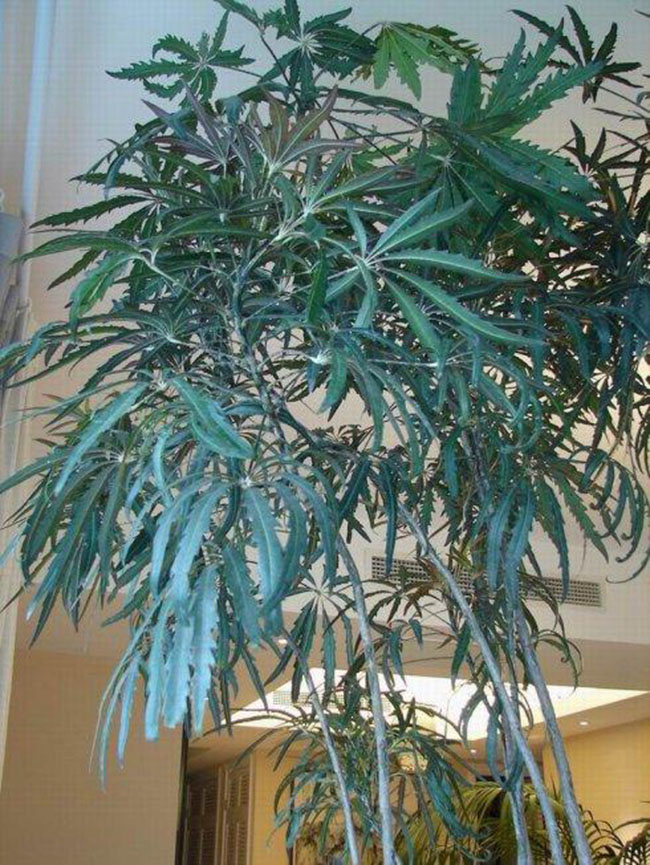
Morphological Characteristics of False Aralia
False Aralia is an evergreen foliage small tree or shrub, often under 2 m when potted. The trunk and leaf stalks both have milky white spots. Leaves are alternate, palmately compound, with 7-11 leaflets, linear-lanceolate, 7-15 cm long, 1-1.5 cm wide, with serrated or pinnately lobed margins; young leaves are purplish-red, later turning dark green. Leaf veins are brown, and the common petiole is slender. Compound umbel inflorescence, borne at the leaf axils at the top of the stem, with small, inconspicuous yellow-green flowers.
Growing Environment of False Aralia
False Aralia prefers a warm and humid environment. It is a light-loving plant, not cold-tolerant, and not tolerant of direct strong light. A fertile, loose loam soil is best. Provide appropriate shade in summer, and more sun in autumn and winter. The suitable temperature is 20°C-29°C. In winter, the temperature should not be lower than 5°C. Pay special attention that the temperature must not fluctuate abruptly, otherwise False Aralia is prone to cold damage.
Distribution Range of False Aralia
Native to Australia and the Polynesian Islands in the Pacific Ocean. It was introduced and cultivated relatively early in South China, and is now introduced as a cultivated plant in many regions. It is also distributed in India, Sri Lanka and Indochina.
Main Varieties of False Aralia
There are about 15 species in the same genus as False Aralia. Commonly cultivated varieties include:
(1) Broad-leaf False Aralia:
Palmately compound leaves, with 3-5 leaflets, leaves relatively broad; Variegated False Aralia, palmately compound leaves, with yellow-white markings on dark green leaflets.
(2) Narrow-leaf False Aralia:
Also known as Veitch's False Aralia, Finger Plant, palmately compound leaves, shaped like a palm, leaflets narrow and long, gray-green, with dark red margins on the leaflets and pink midribs.
Propagation Methods of False Aralia
Seed Propagation
In some parts of South China, seedlings can be raised by sowing. After the seeds are harvested, they must be sown promptly, otherwise poor storage will cause the seeds to lose their germination capacity. The cleaned seeds can first be stored in wet sand, and sown after they crack and show white. Sow in spring; the suitable germination temperature for seeds is 20-25°C, and seedlings emerge about 25-30 days after sowing. Low-temperature conditions will seriously affect the germination rate. In addition, variegated varieties are not suitable for propagation by sowing.
Cutting Propagation
In a greenhouse, cutting propagation can be carried out in both spring and autumn, but for production cultivation, May to June is the best. The cutting medium can be vermiculite, perlite, peat soil, etc.; rice husk ash can also be used, or a mixed medium made of 2 parts alkaline-leached rice husk ash and 1 part wet sand. Under conditions with an electric heating bed, treating the lower cut end of the cuttings with 500 mg/l indolebutyric acid or No. 1 ABT rooting powder for 5-10 s gives a more ideal rooting effect. The cuttings are 10-15 cm long; remove 1-2 leaves at the base, insert to a depth of about 1/2 the cutting length, spray thoroughly with water, then set up bamboo arches, cover with plastic film to retain moisture, provide appropriate shading, and maintain a suitable rooting temperature of 20-25°C; roots can form in about 20 days.
Layer Propagation
For clustered plants grown in the ground, low layering can be carried out in April; for taller potted plants, air layering can be used. Because its stems are relatively thin, when performing air layering, first insert 1 bamboo pole as a support, and tie the soil ball at the layering site against the bamboo pole.
Care Methods for False Aralia
Temperature Conditions
False Aralia likes warmth and is not cold-tolerant. Its suitable growing temperature is between 18°C-28°C. The overwintering temperature in winter should not be lower than 10°C. In summer, if the temperature is too high, shade it and spray water to cool it down. As the weather gradually turns cooler in autumn, move False Aralia indoors to a warm place for the winter in time. After placing False Aralia indoors, be careful that the indoor temperature does not fluctuate between hot and cold, which will cause the plant to freeze.
Light Conditions
False Aralia likes sufficient light but is not tolerant of direct sunlight. When growing False Aralia, in spring and autumn it can be given sufficient light, while in summer it should be slightly shaded to avoid direct strong light. In winter, shading is not necessary, and appropriate supplemental light should be provided. Be careful to give False Aralia sufficient sunlight, otherwise the plant will become leggy and lose its ornamental appeal.
Water Conditions
False Aralia likes a humid environment. In spring and autumn, water should be sufficient, but watering should follow the principle of "dry then wet." Maintain a certain air humidity, and frequently spray water on the leaves and around the plant to prevent the leaves from curling and dropping due to dry air. In winter, when the temperature drops, control watering, and spraying water can be used instead of watering.
Fertilizer Conditions
False Aralia has a relatively high demand for fertilizer. When growing False Aralia, apply some compound fertilizer granules or mixed fertilizer water frequently during the growing season. In summer, stop fertilizing when the temperature is above 30°C; after autumn begins, gradually reduce fertilizing; when the temperature drops below 10°C, stop fertilizing.
Precautions for Growing False Aralia:
1. Provide appropriate shade in summer, and more sun in autumn and winter. The suitable temperature is 20°C-29°C. In winter, the temperature should not be lower than 5°C.
2. When the temperature reaches above 30°C, pause fertilizing. When it drops to 10-13°C, stop all forms of topdressing. When its leaves show physiological yellowing, appropriately apply or spray a 0.2% ferrous sulfate solution.
3. Repot once every two years as needed.
4. False Aralia is susceptible to leaf spot and anthracnose. It can be controlled by spraying a 500-fold dilution of 50% thiophanate wettable powder.
5. When the air is too dry, scale insects are likely to harm the leaves. Check promptly, remove manually, or spray omethoate for control.
6. At the turn of spring and summer, it is susceptible to red spider mite damage. Strengthen ventilation and control it early.
Care Methods and Precautions for False Aralia
Care Methods for False Aralia
Temperature
False Aralia likes warmth and is not cold-tolerant. Its suitable growing temperature is between 18°C-28°C. The overwintering temperature in winter should not be lower than 10°C. In summer, if the temperature is too high, shade it and spray water to cool it down. As the weather gradually turns cooler in autumn, move False Aralia indoors to a warm place for the winter in time. After placing False Aralia indoors, be careful that the indoor temperature does not fluctuate between hot and cold, which will cause the plant to freeze.
Light
False Aralia likes sufficient light but is not tolerant of direct sunlight. When growing False Aralia, in spring and autumn it can be given sufficient light, while in summer it should be slightly shaded to avoid direct strong light. In winter, shading is not necessary, and appropriate supplemental light should be provided. Be careful to give False Aralia sufficient sunlight, otherwise the plant will become leggy and lose its ornamental appeal.
Water
False Aralia likes a humid environment. In spring and autumn, water should be sufficient, but watering should follow the principle of "dry then wet." Maintain a certain air humidity, and frequently spray water on the leaves and around the plant to prevent the leaves from curling and dropping due to dry air. In winter, when the temperature drops, control watering, and spraying water can be used instead of watering.
Fertilizer
False Aralia has a relatively high demand for fertilizer. When growing False Aralia, apply some compound fertilizer granules or mixed fertilizer water frequently during the growing season. In summer, stop fertilizing when the temperature is above 30°C; after autumn begins, gradually reduce fertilizing; when the temperature drops below 10°C, stop fertilizing.
Precautions for Growing False Aralia
Pruning
To promote the growth of False Aralia and adjust the plant shape, it needs frequent pruning. Also cut off diseased branches, dead branches and rotten branches that appear on False Aralia.
Pests and Diseases
False Aralia is susceptible to leaf spot and anthracnose. When the air is dry, scale insects may also appear, and at the turn of spring and summer, red spider mites are likely to appear.
Care Methods and Precautions for False Aralia
False Aralia has a very pleasant name, with a beautiful tree shape and leaf shape. Its leaves are palmately compound, purplish-red, very elegant, and very suitable for decorating homes and venues. So how do you grow False Aralia? Next, let's look at the care methods and precautions for False Aralia.
I. Care Methods for False Aralia
1. Soil: For potted False Aralia, a culture soil mixed with leaf mold, garden soil and river sand is best, kept loose and fertile. When potting, to improve ornamental value, plant 3-4 young seedlings per pot. When cultivating seedlings, water thoroughly during the summer and autumn growing seasons, and also spray water on the leaves.
2. Temperature: The suitable growing temperature for False Aralia is 18-23°C. Young seedlings need a slightly higher temperature, especially in winter, when the temperature should preferably not be lower than 15°C. Old trees can tolerate short-term low temperatures of 5-10°C; if the temperature is lower still, they will suffer cold damage.
3. Light: Give an appropriate amount of light normally. If the light is insufficient, branches tend to become leggy, affecting its ornamental value. During production cultivation, do not shade excessively; it can be placed in a bright area inside a shed for care, but avoid strong summer light. If placed in a dark place for a long time, supplement light in time.
4. Watering: Adult plants should be watered appropriately during the growing season; avoid the potting soil being too dry or too wet. It is best to water thoroughly when the potting soil is slightly dry, following the principle of "dry then wet." False Aralia likes humidity, so it must be sprayed frequently throughout the year to keep it vigorous.
5. Fertilizing: False Aralia generally grows normally from early spring to late autumn. During the growing season, apply a dilute cake fertilizer water once every 1-2 weeks. In winter, growth is slow; appropriately control water, stop fertilizing, and increase its cold resistance.
II. Precautions for Growing False Aralia
To ensure the beauty and good growth of False Aralia, pruning and repotting should be carried out during the growing process. Generally, False Aralia is repotted once every two years. Pruning mainly involves cutting dead branches and weak branches. For thin and weak plants, heavy pruning should be carried out when new leaves sprout.
False Aralia is susceptible to leaf spot and anthracnose. It can be controlled by spraying a 500-fold dilution of 50% thiophanate wettable powder. When the air is too dry, False Aralia is prone to scale insects harming the leaves, and at the turn of spring and summer it is susceptible to red spider mite damage. Check promptly and control early.
The above isCare Methods and Precautions for False Araliaan introduction. Growing False Aralia is relatively simple, and I hope the above content is helpful to everyone.