How to Grow Norfolk Island Pine (Araucaria heterophylla)? Detailed Growing Methods and Precautions
Introduction to the Araucaria Plant
Araucaria is a tree that reaches 60-70 m tall in its native habitat, with a trunk diameter of over 1 m, and grayish-brown or dark gray bark that is thick and transversely fissured; the large branches spread horizontally or slant outward, the crown of young trees is spire-shaped, becoming flat-topped with age, and the side branchlets are densely borne, drooping, and nearly pinnately arranged. Araucaria is not cold-tolerant and dislikes drought; in winter it needs plenty of sunlight. It is native to the southeastern coastal regions of Oceania, and is now cultivated outdoors in courtyards in Guangdong, Fujian, Taiwan, China, Hainan, Yunnan, Guangxi and other places in China.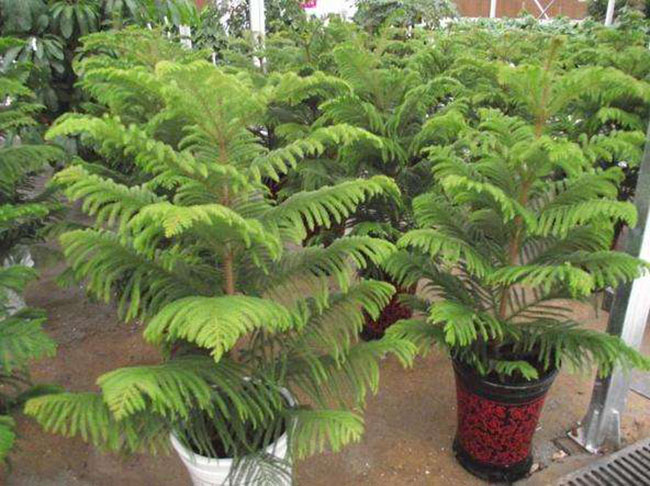
Araucaria Growing Environment
It prefers a warm, humid environment and grows well in sunny spots. It has some tolerance for shade, but strong summer sunlight should be avoided. It is not tolerant of cold or drought, and is suited to well-drained, humus-rich, slightly acidic sandy loam.
1. Summer and autumn are the growing season for Araucaria heterophylla. Potted plants can be placed in a semi-shaded spot outdoors, or kept in a well-ventilated, sunny spot by a window. Avoid blazing sun above 35°C, and do not leave them for long in a lightless, shaded place, as either will cause the branches and leaves to turn yellow and wither or to grow leggy, reducing their ornamental value.
2. During the growth of Araucaria heterophylla, to prevent the trunk from leaning to one side, it is best to turn the pot once every half month so the plant receives light evenly. In addition, the trunk of young trees is fragile and easily bends and becomes deformed, so a support stake should be set up from the seedling stage to stabilize the main trunk. To prevent the plant from growing too tall, it should be repotted once every 2-3 years after the weather warms in spring. Usually, take care to protect the side branches so they are not damaged, which would affect the plant's shape.
3. Under normal conditions, Araucaria heterophylla does not need branch pruning; let it grow naturally. The optimum growing temperature is 10-25°C, and the wintering temperature should be above 5°C. During the wintering season, give it some light, do not let the potting soil get too dry, and spray water on clear days to increase humidity.
Araucaria Propagation Methods
Seed Propagation
Because the seed coat is hard and the germination rate is low, it is best to break the seed coat before sowing to encourage germination. In addition, seedlings from sowing are susceptible to pests and diseases, so the soil used should be strictly sterilized. The seeds are best sprouted in a sand bed or sown using the above shell-breaking method to increase the germination rate; they generally germinate in about 30 days.
Cutting Propagation
Cutting propagation is relatively easy and widely used. Cuttings are usually taken in spring and summer, but the main branch must be chosen as the cutting material; plants grown from side-branch cuttings are crooked and not upright. The cuttings are 10 to 15 cm long, and after insertion, under conditions of 18°C to 25°C and high air humidity, they root in about 4 months. If the base of the cutting is soaked in 200 ppm indolebutyric acid (IBA) for 5 hours before insertion, rooting can be accelerated.
Araucaria Growing Methods
1. Soil:
For potted Araucaria, the most suitable soil mix is leaf mold, garden soil and river sand at 1/3 each, plus a small amount of base fertilizer.
2. Watering:
Araucaria likes a humid environment, so during dry seasons and in summer, take care to spray the leaves with clean water frequently, which both increases air humidity and keeps the leaves fresh and glossy, and is very beneficial for photosynthesis. Water appropriately during care; in summer, water generously to promptly replenish what the leaves lose through transpiration and avoid drought damage. But do not overwater to the point of waterlogging the potting soil. Usually it is best to keep the potting soil consistently moist.
3. Light:
Araucaria likes plenty of sunlight. In northern regions, it is usually moved in early May to a south-facing balcony or a sunny spot in the courtyard, and after summer arrives, take care to shade it appropriately to avoid sunscald. When grown in northern regions, it should be moved indoors by late September to early October, placed in a sunny spot, and watering controlled.
4. Temperature:
Araucaria can grow at a range of different temperatures, but its cold tolerance is not strong. The optimum growing temperature is 7-24°C. If the temperature rises, increase the air humidity around the plant.
5. Fertilizing:
Araucaria grows relatively quickly, so during its vigorous growing season it needs frequent topdressing to replenish the nutrients needed for growth. Generally, starting from when new buds sprout in spring, apply diluted decomposed cake fertilizer water 1-2 times a month so it can absorb and use it, which is necessary for robust growth.
6. Pruning:
Araucaria tends to gradually turn yellow and drop its lower branches and leaves, making the whole plant top-heavy and affecting its appearance, so careful management and necessary pruning are required during care.
7. Pests and Diseases:
Araucaria's diseases include leaf spot, branch blight and root nodule disease. For leaf spot and branch blight, spray 70% thiophanate-methyl at 8(” times dilution or 65% zineb wettable powder at 500-600 times dilution for control; for canker, smear 40% asomate at 100 times dilution or potassium permanganate at 1001〕 times dilution for disinfection; for root nodule disease, soak with streptomycin at 1000 times dilution. The main pest is scale insects; when few occur, rinse the leaves with clean water, and when more severe, spray 40% omethoate emulsion at 500-100() times dilution to kill them.
Araucaria Growing Conditions
Soil and Fertilizer Requirements
For potted Araucaria, it is best to use a mix of leaf mold, peat soil, clean river sand and a small amount of decomposed organic fertilizer. A potting soil of 3 parts loam, 1 part leaf mold, 1 part coarse sand and a small amount of plant ash is good; the depth of the soil layer should be such that the rooting buds on the upper layer are just exposed at the soil surface. Starting from when new buds sprout in spring, apply diluted decomposed organic liquid fertilizer and calcium fertilizer 1-2 times a month, which keeps the plant's form fresh and the leaves glossy.
Repotting, Pruning and Shaping
Araucaria is prized for an upright, straight form. In the second year of a cutting-grown plant, or when a seed-grown plant reaches about 50 cm, a stake should be set up and wrapped around it for support to prevent the plant from twisting, which would affect its ornamental effect. Young trees should be repotted once a year or every other year in spring, and plants over five years old should be repotted and given fresh soil once every two or three years, combined with spraying chlormequat to control the height of the Araucaria. In northern regions, move it outdoors in late April or early May to a wind-sheltered, sunny spot for care; in midsummer, shade it appropriately, and during the growing season turn the pot in good time to prevent the tree's form from growing lopsided and affecting its ornamental value. Araucaria is not tolerant of severe cold; in northern regions, move it indoors in late September or early October (Cold Dew), place it in a sunny, well-ventilated spot, stop fertilizing and control watering, and the room temperature must not be below 8°C.
Watering and Maintaining Humidity
Usually, water Araucaria moderately; during the growing season, water frequently, 2-3 times a week, with the water penetrating 10-15 cm deep. As the Araucaria grows, reduce the frequency of watering, keep the potting soil and surrounding environment consistently moist, and strictly guard against drought and waterlogging. In hot, dry periods, frequently spray or mist the Araucaria's leaves and the surrounding environment to increase air humidity and keep the soil moist. Avoid potting soil that is too dry in summer or too much water in winter; either too dry or too wet easily causes the lower leaves to droop and soften. In summer, avoid strong sunlight; it can be placed in a shaded spot in a shed, with frequent sprinkling to maintain relatively high air humidity.
Precautions for Growing Araucaria
1. Young Araucaria trees are best repotted once a year or every other year in spring, and plants over five years old are best repotted and given fresh soil once every two or three years.
2. Maintain environmental humidity. Araucaria is not drought-tolerant, so in hot, dry seasons, frequently spray and mist the leaves and surroundings to increase air humidity and keep the soil moist.
3. By no means let the potting soil become too dry or too wet, as this easily causes the lower leaves to droop and soften.
4. Fertilize frequently. For potted Araucaria, it is best to use a mix of leaf mold, peat soil, clean river sand and a small amount of decomposed organic fertilizer. When new buds sprout in spring, apply diluted decomposed organic liquid fertilizer and calcium fertilizer 1-2 times a month to keep the leaves glossy.
5. Araucaria's diseases include leaf spot, branch blight and root nodule disease. For leaf spot and branch blight, spray 70% thiophanate-methyl at 8(” times dilution or 65% zineb wettable powder at 500-600 times dilution for control; for canker, smear 40% asomate at 100 times dilution or potassium permanganate at 1001〕 times dilution for disinfection; for root nodule disease, soak with streptomycin at 1000 times dilution. The main pest is scale insects; when few occur, rinse the leaves with clean water, and when more severe, spray 40% omethoate emulsion at 500-100() times dilution to kill them.
Growing Methods for Araucaria heterophylla
Araucaria heterophylla likes warmth and humidity, tolerates shade, and is not cold-tolerant. Seed-grown seedlings have a long taproot and few fibrous roots. Seedlings are prone to dying when transplanted. To improve the transplant survival rate of Araucaria heterophylla seedlings, pay close attention to the following technical points.
Because Araucaria heterophylla seedlings have few lateral roots and fine fibrous roots that wither and dry out with the slightest neglect, protecting the seedling root system is very important. First, transport them with the pot and soil, and keep the original potting soil moist. Second, plant the seedlings immediately after buying them; if planting cannot be done right away, place them in a cool, humid spot and do not expose them to the sun, so as to protect the seedlings, especially the roots, and keep them fresh. In addition, when winter temperatures are low, the roots are easily frozen during transport, so pay attention to keeping them warm.
When planting, keep as much of the original soil around the seedling as possible; the planting soil should be loose and fine, do not press the soil around the roots too hard, and water thoroughly after planting. In addition, seed-grown Araucaria heterophylla seedlings have a long taproot, so plant them somewhat deep to avoid exposing the root system and causing lodging, which would affect survival.
Araucaria heterophylla is not cold-tolerant. If you buy and plant seedlings in winter or early spring, in addition to protecting against freezing during transport, take warmth-preserving measures after planting, such as growing them in a greenhouse or covering with an arched plastic film.
Araucaria heterophylla seedlings are tender and easily broken. The following methods can be used to remedy this. For seedlings with broken roots, wash them with clean water and insert them in plain sand; at a suitable temperature, they will re-root from the cut surface in 1-2 weeks, and can be planted once the root system is well developed. For seedlings with broken buds or stems but still bearing leaves, plant them as usual; after they survive, they will sprout new buds after a certain period.
Araucaria Growing Methods: Teaching You the Seven Major Precautions for Growing Araucaria
Araucaria has elegant branches and leaves, luxuriant foliage, and a graceful, sturdy and elegant tree form. It is a beautiful-leaved plant with high ornamental value, and many people use it in places such as the home living room. Below, let's learn about the growing methods for Araucaria:
Basic Information on Araucaria:
Araucaria (Latin scientific name: Araucaria cunninghamii) is an evergreen tree native to Norfolk Island, Australia. It has many names: by place of origin it is called English pine, Australian pine, Norfolk Island pine and Araucaria. By leaf it is called Araucaria heterophylla, small-leaved Araucaria and beautiful Araucaria, and by form it is called tower Araucaria, Hainan Araucaria and so on. Varieties introduced to China include Araucaria columnaris and Norfolk Island Araucaria. Araucaria columnaris has an upright trunk, the whole tree is tower-shaped, and the branches are whorled and extend horizontally, with even spacing and distinct tiers, no spines, and a neat appearance. It is a top-grade foliage plant, mostly grown as a potted plant.
Araucaria Growing Methods:
1. Soil:For potted Araucaria, the most suitable soil mix is leaf mold, garden soil and river sand at 1/3 each, plus a small amount of base fertilizer.
2. Watering:Araucaria likes a humid environment, so during dry seasons and in summer, take care to spray the leaves with clean water frequently, which both increases air humidity and keeps the leaves fresh and glossy, and is very beneficial for photosynthesis. Water appropriately during care; in summer, water generously to promptly replenish what the leaves lose through transpiration and avoid drought damage. But do not overwater to the point of waterlogging the potting soil. Usually it is best to keep the potting soil consistently moist.
3. Light:Araucaria likes plenty of sunlight. In northern regions, it is usually moved in early May to a south-facing balcony or a sunny spot in the courtyard, and after summer arrives, take care to shade it appropriately to avoid sunscald. When grown in northern regions, it should be moved indoors by late September to early October, placed in a sunny spot, and watering controlled.
4. Temperature:Araucaria can grow at a range of different temperatures, but its cold tolerance is not strong. The optimum growing temperature is 7-24°C. If the temperature rises, increase the air humidity around the plant.
5. Fertilizing:Araucaria grows relatively quickly, so during its vigorous growing season it needs frequent topdressing to replenish the nutrients needed for growth. Generally, starting from when new buds sprout in spring, apply diluted decomposed cake fertilizer water 1-2 times a month so it can absorb and use it, which is necessary for robust growth.
6. Pruning:Araucaria tends to gradually turn yellow and drop its lower branches and leaves, making the whole plant top-heavy and affecting its appearance, so careful management and necessary pruning are required during care.
7. Pests and Diseases:Araucaria's diseases include leaf spot, branch blight and root nodule disease. For leaf spot and branch blight, spray 70% thiophanate-methyl at 8(" times dilution or 65% zineb wettable powder at 500-600 times dilution for control; for canker, smear 40% asomate at 100 times dilution or potassium permanganate at 1001〕 times dilution for disinfection; for root nodule disease, soak with streptomycin at 1000 times dilution. The main pest is scale insects; when few occur, rinse the leaves with clean water, and when more severe, spray 40% omethoate emulsion at 500-100() times dilution to kill them.
Araucaria is often placed in home living rooms, studies and courtyards, and is not uncommon among home greenery. The growing methods for Araucaria are introduced here, and we hope they are helpful to everyone.