How to Grow and Propagate the Indian Rubber Tree
Indian Rubber Tree
The Indian rubber tree (Ficus elastica) is a tree in the mulberry family (Moraceae), genus Ficus, reaching 20-30 m tall with a diameter at breast height of 25-40 cm; the bark is grayish-white and smooth; it is epiphytic when young, with stout branchlets. The achene is ovoid, with small tubercles on the surface, a long persistent style, and an enlarged, nearly head-shaped stigma. Flowering period is winter. Native to Bhutan, Sikkim, Nepal, northeastern India (Assam), Myanmar, Malaysia (northern), and Indonesia (Sumatra, Java). In China, it grows wild in Yunnan (Ruili, Yingjiang, Lianshan, Longchuan) at elevations of 800-1500 m.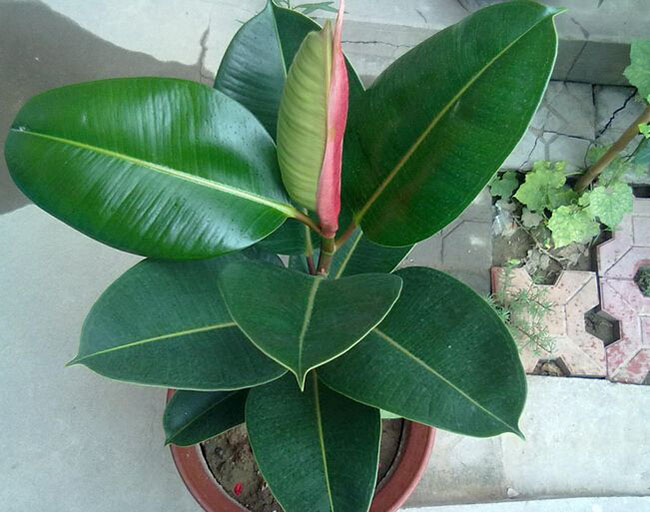
Morphological Characteristics of the Indian Rubber Tree
Tree, reaching 20-30 m tall with a diameter at breast height of 25-40 cm; bark grayish-white, smooth; epiphytic when young, branchlets stout. Leaves thickly leathery, oblong to elliptic, 8-30 cm long, 7-10 cm wide, apex acute, base broadly cuneate, margin entire, upper surface dark green and glossy, lower surface light green, lateral veins numerous, inconspicuous, extending parallel; petiole stout, 2-5 cm long; stipules membranous, deep red, up to 10 cm long, leaving a distinct ring-like scar after falling. Figs borne in pairs in the leaf axils of branches that have shed their leaves, ovoid-oblong, 10 mm long, 5-8 mm in diameter, yellow-green, with a hood-shaped basal bract, leaving a ring-like trace at the base after falling; male flowers, gall flowers, and female flowers all borne on the inner wall of the fig; male flowers stalked, scattered on the inner wall, perianth segments 4, ovate, stamen 1, anther ovoid, without a filament; gall flowers with perianth segments 4, ovary smooth, ovoid, style nearly terminal, curved; female flowers sessile. Achene ovoid, with small tubercles on the surface, style long, persistent, stigma enlarged, nearly head-shaped. Flowering period is winter.
Distribution Range of the Indian Rubber Tree
Native to Bhutan, Sikkim, Nepal, northeastern India (Assam), Myanmar, Malaysia (northern), and Indonesia (Sumatra, Java). In China, it grows wild in Yunnan (Ruili, Yingjiang, Lianshan, Longchuan) at elevations of 800-1500 m.
Growing Environment of the Indian Rubber Tree
It likes a hot, humid environment with plenty of sunlight, and can also tolerate shade but not cold. The suitable growing temperature is 20-25°C, and it dislikes direct sunlight. It can also tolerate shade but not cold, and the safe overwintering temperature is above 5°C. It tolerates dry air. It dislikes clayey soil, cannot tolerate barren or dry conditions, and prefers loose, fertile, well-drained, slightly acidic soil.
Propagation Methods of the Indian Rubber Tree
The main propagation methods for the Indian rubber tree are cuttings and layering. Cuttings are relatively simple, and the rubber tree's survival rate and growth rate are also relatively high. Generally speaking, rubber tree cuttings are mainly done in late spring and early summer together with pruning. Choose healthy branches from the middle of the rubber tree as cuttings, keep three buds on each cutting, and let the latex at the cut end coagulate, or use some charcoal ash and rice-hull ash to absorb it dry, then insert the cuttings into a cutting bed with river sand or vermiculite as the substrate, keeping the growing environment for the cuttings between 18-25°C. After about 30 days, the cuttings will root. When the rooted rubber tree cuttings grow 2 leaves, they can be transplanted into pots.
The survival rate of rubber tree air layering is very high. When layering, it is best to choose branches that grew in the second year. First, girdle the rubber tree branch to a width of 0.5-1 cm, then wrap it with moist moss or plastic film and peat soil. While keeping it moist, wait for the rubber tree to root, then cut off the rooted branch and plant it in soil to grow into a new rubber tree.
Choosing Potting Soil for the Indian Rubber Tree
For potted plants, use peat soil and leaf mold plus 1/4 river sand and a small amount of base fertilizer to make a potting mix; fine sandy soil can also be used. The rubber tree grows quickly and likes fertilizer; apply fertilizer once a week. Usually, repot or change the soil before new shoots grow in spring. When seedlings are 80 cm to 100 cm tall, pinch off the growing tips as needed to promote the sprouting of side branches. Generally, keep 3 main branches and remove the extra ones. If cultivated well, it can grow into a large plant of 2 m in about 3 years.
The rubber tree likes strong sunlight; from spring to autumn, during the entire growing season, it should be grown in full sunlight, and in winter it should also be placed in the brightest spot indoors. If placed indoors for ornamental display, generally change its location about once every 2 weeks, and do not leave it too long. The rubber tree grows very quickly in high-humidity, moist environments, producing a new leaf every 5 to 7 days. During this period, sufficient fertilizer and water must be guaranteed. In autumn, gradually reduce fertilization and watering to help the branches grow firm.
Because the rubber tree has strong resistance to dry environments, it is also relatively easy to cultivate in North China. It should be kept indoors above 10°C for overwintering; prolonged low temperatures and wet potting soil easily cause root rot. From the end of April to the beginning of October each year, move it outdoors for cultivation.
How to Grow the Indian Rubber Tree
1. Temperature
It likes warmth, and the most suitable growing temperature is 20-25°. It tolerates high temperatures and can grow well even above 30°. It is not cold-tolerant, and the safe overwintering temperature is 5°; variegated varieties are slightly less cold-tolerant, and the overwintering temperature should preferably be maintained above 8°0. When the temperature is low, it will produce a large amount of leaf drop.
2. Light
It likes bright, indirect light and has a certain ability to tolerate shade. It cannot tolerate strong direct sunlight; when the light is too intense, it will scorch the leaves, causing yellowing and burnt leaf edges. It should also not be placed in too shady a spot, otherwise it will cause a large amount of leaf drop and make the beautiful patches on variegated varieties fade. From May to September, shade it or place the plant in a spot with plenty of indirect light. At other times, give it plenty of sunlight.
3. Watering
It likes a moist soil environment, and during the growing period it should be given plenty of water to keep the potting soil moist. In winter, watering needs to be controlled; when the temperature is low and the potting soil is too wet, it easily leads to root rot.
4. Environmental Humidity
It likes a humid environment. During the growing season, when the weather is clear and the air is dry, frequently spray water on the branches, leaves, and surrounding environment to increase the relative air humidity.
5. Fertilization
Because it grows rapidly, nutrients should be supplied in time to keep the plant growing vigorously. Apply a nitrogen-based fertilizer 2-3 times a month. Variegated varieties grow relatively slowly, so the number of fertilizer applications can be reduced, while increasing the application of phosphorus and potassium fertilizer to make the colors of the patterns on the leaves bright and beautiful. If too much nitrogen fertilizer is applied, or if only nitrogen fertilizer is used, the color of the patterns will fade and may even disappear. In September, stop applying nitrogen fertilizer and apply only phosphorus and potassium fertilizer to improve the plant's cold resistance. In winter, the plant goes dormant, so fertilization should be stopped.
6. Pruning
In spring, prune together with moving the plant out of the shed, removing forked branches, inward-growing branches, dead branches, and thin weak branches inside the canopy, and cutting back the rampant branches that stick out beyond the canopy, so that the interior of the plant has good ventilation and light and the tree shape remains round and neat. If the canopy is too large, the outer branches can be shortened as a whole. During the growing period, remove overly dense branches at any time and shorten long branches.
7. Repotting
Usually repot once every 2 years. It likes fertile, loose, well-drained sandy loam. The growing medium can be made from garden soil, leaf mold, and plain sand, mixed with farmyard manure as a base fertilizer.
8. Pest and Disease Control
It is harmed by leaf spot disease and pests such as red spider mites, Ficus thrips, and scale insects.
How to Grow the Indian Rubber Tree, Growing Methods for the Indian Rubber Tree
The Indian rubber tree is a tropical tree species. Its leaves are large and glossy, and it is evergreen all year round, making it a very common foliage plant species, so many people like to keep it in pots in the living room or bedroom, adding a bit of green and vitality to the room. As for its growing environment, the rubber tree likes warmth and moisture, and also likes sunlight; its optimal growing temperature is between 20-25°C. In China, it is widely grown in pots. Below, the editor gives a brief introduction to the growing methods for the Indian rubber tree.
Propagation Methods
The main propagation methods for the Indian rubber tree are cuttings and layering. Cuttings are relatively simple, and the rubber tree's survival rate and growth rate are also relatively high. Generally speaking, rubber tree cuttings are mainly done in late spring and early summer together with pruning. Choose healthy branches from the middle of the rubber tree as cuttings, keep three buds on each cutting, and let the latex at the cut end coagulate, or use some charcoal ash and rice-hull ash to absorb it dry, then insert the cuttings into a cutting bed with river sand or vermiculite as the substrate, keeping the growing environment for the cuttings between 18-25°C. After about 30 days, the cuttings will root. When the rooted rubber tree cuttings grow 2 leaves, they can be transplanted into pots.
The survival rate of rubber tree air layering is very high. When layering, it is best to choose branches that grew in the second year. First, girdle the rubber tree branch to a width of 0.5-1 cm, then wrap it with moist moss or plastic film and peat soil. While keeping it moist, wait for the rubber tree to root, then cut off the rooted branch and plant it in soil to grow into a new rubber tree.
Care Methods
The Indian rubber tree likes fertility, and newly grown seedlings need a lot of nutrients, so choose fertile, loose sandy loam rich in humus, leaf mold, and garden soil as the potting mix. In addition, during the seedling growth period, pay attention to applying a small amount of cake fertilizer as a base fertilizer to ensure the soil's fertility. The rubber tree dislikes nitrogen fertilizer; when there is too much nitrogen fertilizer, the rubber tree's plant shape is unattractive, so apply less nitrogen fertilizer.
The Indian rubber tree likes water and moisture, and its water demand is even greater in summer. When growing it, pay attention to watering the rubber tree every day. On the premise of keeping the potting soil moist, increase the frequency of sunning the water. It is worth noting that the Indian rubber tree dislikes waterlogging and cannot tolerate drought; when caring for the Indian rubber tree in winter, the soil only needs to be moist.
As a tropical tree species, the Indian rubber tree has relatively strict requirements for light and temperature. The rubber tree likes light, and from spring to autumn it should be placed outdoors in a sunny spot for care. If kept indoors for a long time, it can very easily cause the rubber tree's leaves to turn yellow and fall off. After winter begins, the temperature drops sharply, and the rubber tree should be moved indoors to a sunny spot for care, taking care to keep the indoor temperature above 10°C. When the temperature rises again at the end of April and the beginning of May the following year, move the rubber tree outdoors again for care.
After the rubber tree is transplanted into a pot, pay attention to loosening the soil in the pot. Generally, the best time is in spring each year when the rubber tree grows new buds. When the rubber tree grows too large, you can also replace its pot with a larger one.
Conclusion: The above is the editor's introduction to how to grow the Indian rubber tree and its growing methods. Friends who like the Indian rubber tree may as well give it a try. A fully grown Indian rubber tree is green all over; placed in the living room or study, it can both green the environment and purify the air, so why not do it?
Can the Indian Rubber Tree Be Kept Indoors? Growing Methods for the Indian Rubber Tree
The Indian rubber tree is a fine ornamental plant. Its leaves are very distinctive, and its sap is also the raw material for rubber. So can the Indian rubber tree be kept indoors? Will keeping it indoors harm the human body? And what are the growing methods for the Indian rubber tree? Below, the editor will answer these questions one by one for you.The Value and Uses of the Indian Rubber Tree
The value of the Indian rubber tree is reflected in its ornamental value and functional uses. The Indian rubber tree is a common foliage plant. It is evergreen all year round and has a beautiful plant shape. It is often grown in pots in living rooms, hotels, guesthouses, and other places, and has a very good role in decorating and beautifying the environment. The sap of the Indian rubber tree is also the raw material for making rubber.Indian Rubber Tree Pictures
Can the Indian Rubber Tree Be Kept Indoors?
The Indian rubber tree is an outdoor plant with a relatively large plant shape, but it can also be placed indoors for decorative embellishment, and it is not harmful to our bodies. In the market, we can see small and medium-sized potted Indian rubber trees sold in many places, and you can choose according to your needs.
The Living Habits of the Indian Rubber Tree
The Indian rubber tree likes to grow in a warm, humid environment with plenty of sunlight. It is not cold-tolerant, and it is very difficult for the Indian rubber tree to survive in a relatively cold environment. In addition, the Indian rubber tree relatively likes fertilizer, so when growing it, it is best to choose fertile soil for planting the Indian rubber tree.Indian Rubber Tree Bonsai
Propagation Methods for the Indian Rubber Tree
The Indian rubber tree is mainly propagated by cuttings, and can also be propagated by layering. The best time for propagating the Indian rubber tree by cuttings is from May to September. When taking cuttings, choose 1-2 year old Indian rubber tree branches and cut them into sections of 3-4 nodes each for rooting. Note that when taking cuttings, immediately apply slaked lime powder or plant ash to the cut surface of the severed branch, and press firmly with your thumb for three to five minutes to prevent the loss of sap. Each branch section should retain one to two leaves to allow for better rooting. In addition, the cutting temperature should preferably be kept above 15°C.
Growing Methods for the Indian Rubber Tree
The growing methods for the Indian rubber tree are the same as those for the rubber tree; they are often grown in pots indoors. For potted rubber trees, place them in a semi-shady spot during the seedling stage. When growing Indian rubber tree seedlings, in order to help them grow better, repot them every spring. Mature plants grow relatively slowly, so they can be repotted once every 2-3 years. When repotting, cut off old roots and diseased roots, and replace the potting soil.Growing Methods for the Indian Rubber Tree
To make the rubber tree seedling's shape attractive, when the plant height reaches about 0.6 m, pinch off the top at about 0.4 m to encourage new branches, forming 3-5 side branches. After that, shorten the side branches every spring to encourage more new branches. In addition, the rubber tree seedling should be turned regularly to prevent it from growing leaning to one side, which would reduce its ornamental value.
The rubber tree relatively likes fertilizer and likes water. During the peak growing season, sufficient fertilizer and water must be given to ensure that the rubber tree grows luxuriantly and its leaves are deep green. Normally, keep the potting soil moist. In hot seasons, water once in the morning and once in the evening every day, and frequently spray water on the branches and leaves, otherwise the edges of the rubber tree's leaves easily become scorched and withered.
The rubber tree likes sunlight, and when growing it, make sure to give it sufficient light, but provide shade during the strong sunlight of summer. Low temperatures are not good for the growth of the rubber tree, so when growing the rubber tree in winter, it is best to keep its growing environment at about 10°C, and the temperature should not be lower than 3°C, otherwise the rubber tree's leaves will turn yellow and fall off.Growing the Indian Rubber Tree in the Courtyard
Control of Gray Mold in the Indian Rubber Tree
Gray mold in the Indian rubber tree is a common disease of the rubber tree. After infection, it causes the rubber tree's new leaves to wither and die, and old leaves to rot and fall off. To prevent the occurrence of gray mold in the Indian rubber tree, pay attention to not placing the rubber trees too crowded after moving them into the greenhouse in winter, and the day-night temperature difference should not be too large. When watering, pour from the edge of the pot, and do not spray with a rubber hose. Remove diseased leaves, diseased fallen leaves, and diseased dead shoot tips in time to reduce sources of infection.
Summary: Keeping the Indian rubber tree indoors can play a very good decorative role, and friends who need it can grow it indoors. That is all the editor has to introduce about the growing methods for the Indian rubber tree, and I hope it is helpful to you.