What are the cultivation methods and precautions for the grape ivy (Cissus)?
Morphological characteristics of the grape ivy
Branches
The grape ivy is a herbaceous vine. The branchlets are cylindrical, with longitudinal ridges, often covered with a white powdery bloom, and hairless. Tendrils are bifurcated, separated by 2 nodes, and opposite to the leaves.
Leaves
The leaves of the grape ivy are heart-shaped ovate, 5-13 cm long, 4-9 cm wide, with an acute or acuminate apex and a heart-shaped base, with 9-12 fine sharp serrations on each side of the margin, green above, light green below, hairless on both sides; 3-5 basal veins, the midrib has 3-4 pairs of lateral veins, and the reticulate veins are indistinct; the petiole is 2.5-7 cm long, hairless; the stipules are brown, membranous, kidney-shaped, 5-6 cm long, 2-3 cm wide, hairless.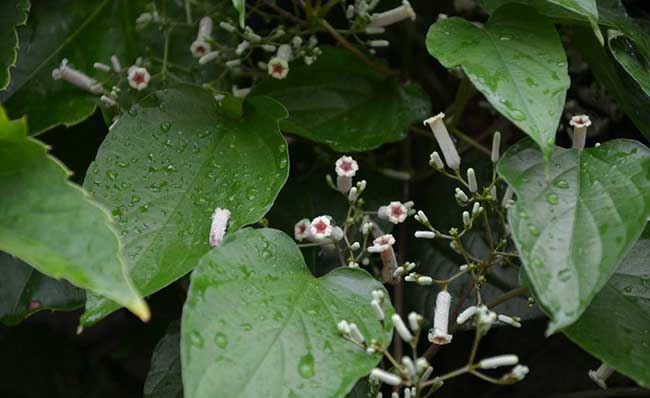
Flowers
The inflorescence of the grape ivy is terminal or opposite to the leaves, with 4-5 secondary branches gathered into an umbel; the peduncle is 1-3 cm long, hairless; the pedicel is 2-4 mm long, nearly hairless; the flower buds are ovate, about 4 mm high, with a rounded obtuse apex; the calyx is cup-shaped, with an entire or wavy margin, hairless; 4 petals, ovate-triangular, about 3 mm high, hairless; 4 stamens, anthers ovate-elliptic, slightly longer than wide or nearly as long as wide; the disk is distinct, slightly 4-lobed; the lower part of the ovary is fused with the disk, the style is nearly subulate, and the stigma is not distinctly enlarged.
The flowering period of the grape ivy is July to October.
Fruit
The fruit of the grape ivy is obovate, 0.8-1.2 cm long, 0.4-0.8 cm wide, containing 1 seed; the seed is obovate, with a rounded apex and a short beak at the base, the surface has sparse prominent ridges, the hilum is at the lower 1/4 of the dorsal side of the seed and is no different from the raphe, the raphe is prominent, the ventral median ridge is prominent, extending upward to the upper 1/3 of the seed, and the lateral pits are groove-shaped, reaching the upper part of the seed. The fruiting period of the grape ivy is from November to May of the following year.
Distribution area of the grape ivy
The grape ivy is produced in Guangdong, Guangxi, Guizhou, and Yunnan. The grape ivy is also distributed in Vietnam, the Philippines, Malaysia, and Australia.
Ecological habits of the grape ivy
The grape ivy prefers a warm, humid environment with plenty of sunlight. The grape ivy grows in sparse forests in valleys or thickets on hillsides, at an altitude of 100-1800 m.
Propagation methods of the grape ivy
The grape ivy is usually propagated in spring, summer, and autumn by selecting one-year-old semi-lignified shoot tips or side branches as cuttings. Cut 10-15 cm long, remove half of the lower leaves, and insert into a substrate mixed with vermiculite or peat soil and coarse sand, keeping the temperature at 25-30°C. Roots can form in about 10 days. The cuttings can also be placed in water (be careful to keep the water clean), and potted after rooting.
Cultivation methods of the grape ivy
Soil, fertilizer, and water
For potted grape ivy, a mixture of 3 parts garden soil and 2 parts leaf mold can be used as the substrate, or peat soil and leaf mold plus 1/4 river sand and a small amount of base fertilizer can be used as the substrate. For old plants cultivated for many years, repotting can be carried out in early spring before the large growth of new buds, combined with heavy pruning. When repotting, remove part of the old roots and old potting soil, and repot with new soil. Apply liquid fertilizer once every 1-2 weeks during the growing season.
Watering method
Water alternately between dry and wet; it is best to spray the leaves every day to promote growth; in winter, watering should be accompanied by slight spraying to prevent leaf curling and red spider mite damage; in other seasons, the potting soil should also be kept moist regularly.
Light and temperature
The grape ivy is suitable for a bright light environment and can also adapt to darker places; it dislikes direct sunlight, and if exposed to strong direct light, scorched brown spots will appear. It can generally grow at room temperature, and its growth can still be seen at 10-16°C. However, if the winter temperature is below 5°C, it is prone to cold damage, with leaves turning yellow, losing luster, and even falling off.
Home cultivation
Clean the leaf surface once every 2-3 weeks to remove smoke and dust and keep the leaves glossy. This plant tends to grow very quickly, and the branches become too long, so the messy branches should be pruned frequently and the branches guided to extend, in order to maintain a good plant shape.
Disease control of the grape ivy
Powdery mildew
The most common disease of the grape ivy is powdery mildew, mostly caused by excessive watering and poor ventilation. It mainly damages the leaves. Nearly circular white powdery spots appear on the leaf surface, merging into large white powdery areas with indistinct edges, covered with a powdery mildew layer, namely the pathogen's mycelium, conidiophores, and conidia. In severe cases, the leaves turn yellow and curl. In the later stage, the white powder turns grayish white.
Control methods
It usually appears in summer; plants growing in a cool, dry climate and weak plants growing in damp shaded areas are commonly and severely affected. Autumn drought with little rain also easily leads to the formation of cleistothecia.
1. Use fertilizer reasonably, avoid close planting, and improve field ventilation conditions.
2. At the early stage of the disease, promptly spray 15% triadimefon (Bayleton) wettable powder at 1000-1500 times dilution, or 20% triadimefon emulsifiable concentrate at 2000 times dilution.
Cultivation methods of the grape ivy
The grape ivy is usually propagated in spring, summer, and autumn by selecting one-year-old semi-lignified shoot tips or side branches as cuttings. Cut 10-15 cm long, remove half of the lower leaves, and insert into a substrate mixed with vermiculite or peat soil and coarse sand, keeping the temperature at 25-30°C. Roots can form in about 10 days. The cuttings can also be placed in water (be careful to keep the water clean), and potted after rooting.
For potted grape ivy, a mixture of 3 parts garden soil and 2 parts leaf mold can be used as the substrate, or peat soil and leaf mold plus 1/4 river sand and a small amount of base fertilizer can be used as the substrate.
For old plants cultivated for many years, repotting can be carried out in early spring before the large growth of new buds, combined with heavy pruning. When repotting, remove part of the old roots and old potting soil, and repot with new soil. Apply liquid fertilizer once every 1-2 weeks during the growing season.
In summer, water alternately between dry and wet; it is best to spray the leaves every day to promote growth; in winter, watering should be accompanied by slight spraying to prevent leaf curling and red spider mite damage; in other seasons, the potting soil should also be kept moist regularly. The grape ivy is suitable for a bright light environment and can also adapt to darker places; it dislikes direct sunlight, and if exposed to strong direct light, scorched brown spots will appear. It can generally grow at room temperature, and its growth can still be seen at 10-16°C. However, if the winter temperature is below 5°C, it is prone to cold damage, with leaves turning yellow, losing luster, and even falling off.
For home cultivation, clean the leaf surface once every 2-3 weeks to remove smoke and dust and keep the leaves glossy. This plant tends to grow very quickly, and the branches become too long, so the messy branches should be pruned frequently and the branches guided to extend, in order to maintain a good plant shape.
Cultivation methods and growing techniques of the grape ivy
Other names of the grape ivy: rhombus-leaved vine, rhombus-leaved grape ivy, false ivy, grape-leaf spider plant.1. Morphological characteristics: Vitaceae family, Cissus genus. Perennial evergreen woody vine. It can reach 3 m in length. It has forked tendrils, compound leaves alternate, with three leaflets on each petiole, the middle leaflet larger than those on both sides, ovate-rhombic, leaves light green or dark green. The surface is glossy, the underside is sparsely pubescent, the inflorescence is axillary, and the flowers are greenish and inconspicuous.
2. Growth habits: Native to the tropics of Central and South America. It is currently cultivated all over the world. It likes warmth and is suitable for semi-shaded and humid environments. It is not cold-tolerant, and the overwintering temperature should be kept at around 10°C; when the temperature is below 8°C, the leaf color turns yellow and curls, showing symptoms of cold damage. The grape ivy has strong adaptability and can tolerate indoor environments with weak light and low humidity.
3. Propagation method: Softwood cuttings root easily. Selection: choose semi-lignified side branch tips as cuttings, cut off some leaves, and insert into a substrate mixed with river sand and peat soil. Water propagation can also be used; insert the base of the cuttings shallowly into clean water, keep the water temperature at 25-30°C, and roots will form in about two weeks.
4. Cultivation management: It has strong adaptability to the environment, is not particular about soil, grows vigorously, and is easy to manage. It should be placed in a semi-shaded place, and it can also grow normally in a darker environment. During the growing season, watering should follow the principle of alternating moisture and dryness, and frequent excessive watering should be avoided. In winter, the amount of water is generally just enough to keep the potting soil appropriately moist. During the growing period, apply dilute liquid fertilizer once every 1-2 weeks; the fertilizer should be light and not excessive, so as to avoid excessive leggy growth of the branches that is difficult to control and causes the plant shape to lose its ornamental effect. The training and shaping of the branches can be done according to one's preference. Repot once every spring, cut off part of the old roots, and replace with new potting soil to keep the plant strong. The grape ivy is susceptible to red spider mite damage and powdery mildew infection, so strengthen management and control.