What are the cultivation methods and uses of Sanchezia nobilis?
Sanchezia nobilis
Sanchezia nobilis is a shrub in the genus Sanchezia of the family Acanthaceae, growing up to 2 m tall. The leaves have petioles 1-2.5 cm long, and the blades are oblong or obovate, with acuminate or caudate-acuminate tips, cuneate to broadly cuneate bases that run down the stem, and wavy-crenate margins.
Morphological characteristics of Sanchezia nobilis
Shrub, up to 2 m tall. The leaves have petioles 1-2.5 cm long, and the blades are oblong or obovate, with acuminate or caudate-acuminate tips, cuneate to broadly cuneate bases that run down the stem, and wavy-crenate margins, 9-15 cm long and 3.7-5.2 cm wide, with 7-12 lateral veins. When dry (?) often yellow. The terminal spike is small, the bracts are large, 1.5 cm long and 8 mm wide, the calyx is 2.2 cm, the corolla is 5 cm, the corolla tube is 4.5 cm, and the corolla limb is 5-6 mm; there are 4 stamens, the filaments are slender and exserted beyond the corolla, sparsely covered with long soft hairs, the anthers are 2-celled, densely covered with white hairs, dorsifixed, and slightly forked at the base; the style is slender, and the stigma is exserted beyond the tube and higher than the anthers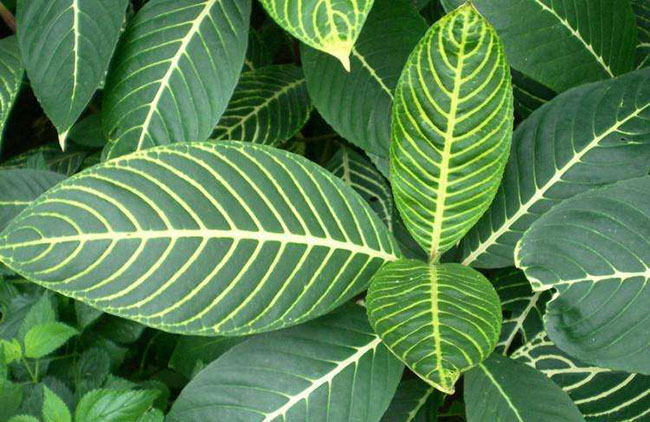
Growing environment of Sanchezia nobilis
It prefers a hot, humid and semi-shaded environment, dislikes direct sunlight, and requires loose, fertile soil with good moisture retention. It is not cold-tolerant.
Cultivation methods of Sanchezia nobilis
Sanchezia nobilis is a short-day plant and flowers every winter; if the light exceeds 12 hours, flowering will be delayed until early spring. Repot after flowering in spring, and prune the whole plant to control its height and encourage more branching; when new shoots sprout, watering can be increased somewhat. During the growing season, fertilize once a month, applying less nitrogen fertilizer and more phosphorus and potassium fertilizer, so the leaf markings become even more beautiful. In midsummer, provide a little shade, but too much shade makes the stems and leaves leggy and soft, and the leaf color dull and lacking luster. At a winter room temperature of 10-12°C, Sanchezia nobilis can flower normally.
Select plump, firm terminal stems, cut 10-12 cm lengths, let the cut ends dry slightly, then insert them into a sand bed; they can root in about 7-10 days, and when the roots are 2-3 cm long, transplant them into pots. Leaf cuttings can also be used: cut off a single leaf, let the cut dry, then insert it obliquely into a sand pot, and in about 10 days after insertion new roots will grow.
Uses of Sanchezia nobilis
In South China, the flowering period of Sanchezia nobilis coincides with festivals such as New Year's Day, the Spring Festival, Christmas and Valentine's Day; strings of colorful bells hang all over the branches, adding a festive atmosphere to the holidays and making it very appealing.
The Sanchezia nobilis plant stands upright, with densely growing stems and leaves. Its upright inflorescences, with small orange-red flowers in full bloom, are extremely attractive. Grown in pots for ornament, it is suitable for display in family living rooms and studies. It is suitable as a potted flower for decorating halls, entrances, flower terraces and flower stands, or for planting in the ground to accent flowerbeds, rockeries and other places, where the scenery is especially fine. It is also an important cut flower; giving a sprig to someone expresses special affection. As an important ornamental plant resource, it is one of the leaf-budding types with relatively high development prospects.
After the stems and leaves of related plants of the same genus are pounded into a paste, they can reduce inflammation and draw out toxins, and can be applied to treat sores, boils and various swellings and toxic conditions. Roof greening technology with Sanchezia nobilis: With the rapid development of the economy and the acceleration of urbanization, high-rise buildings are springing up one after another, and the heat island effect of the city's concrete forest is becoming more obvious. To increase green space area, the demand for roof greening, rooftop greening and the like has become stronger. At present, the applied technology of roof greening mainly focuses on improving planting substrates and on new types of roofing and the discovery and application of new wild greening resource plants. These traditional greening technologies are unsuitable for greening the roofs of the considerable number of old-style buildings in cities, because the roofs of these buildings have low load-bearing capacity; for newly built buildings in cities, real estate developers generally have regulations and requirements for roof greening, and developers, considering economic costs, also need lightweight, low-cost roof greening technology. These requirements cannot be met by current roof greening technology.
Cultivation methods of Sanchezia nobilis Propagation methods of Sanchezia nobilis
Sanchezia nobilis is an excellent foliage and flowering ornamental plant. Today we will take everyone to learn about the cultivation methods of Sanchezia nobilis and the propagation methods of Sanchezia nobilis.
Cultivation methods of Sanchezia nobilis:
1. Soil: The growth of Sanchezia nobilis is greatly affected by the choice of potting soil. To ensure that the purchased Sanchezia nobilis can grow healthily, for potted Sanchezia nobilis you can use garden soil, peat soil and river sand mixed in equal amounts, then add a small amount of base fertilizer to prepare the substrate.
2. Light: Sanchezia nobilis is a foliage plant and likes light; only with sufficient light will the leaves be bright and glossy. When cultivating Sanchezia nobilis, if the light is too weak, it easily leads to elongated internodes and dull, lusterless leaves; while if the light is too strong, it may scorch the leaves. Therefore, when cultivating it, it is best to place Sanchezia nobilis in a spot indoors with strong scattered light, and in summer pay attention to appropriate shading.
3. Watering and fertilizing: During the growing season of Sanchezia nobilis, water more and maintain relatively high air humidity; applying liquid fertilizer 1-2 times a month can make the leaves of Sanchezia nobilis large and brightly colored. When fertilizing, phosphorus fertilizer should be the main type, with less nitrogen fertilizer, otherwise the leaf veins will fade and affect the beauty of Sanchezia nobilis. In winter, stop fertilizing Sanchezia nobilis and reduce the frequency of watering, otherwise Sanchezia nobilis is prone to root rot. Sanchezia nobilis is a foliage plant, so when cultivating it also pay attention to cleaning the leaf surface, and frequently spray-wash the leaves with warm water.
4. To keep the plant shape of Sanchezia nobilis attractive, it must be pruned or pinched regularly to control plant height and promote side branch growth, making the branches and leaves lush.
5. Pests and diseases: During the cultivation of Sanchezia nobilis, it is easily harmed by scale insects. If found, immediately wash the leaf surface with water and promptly remove the diseased leaves. In severe cases, spray with a 1000-fold dilution of 40% omethoate emulsifiable concentrate to kill them.
Propagation methods of Sanchezia nobilis:
Sanchezia nobilis can be propagated by cuttings or division, among which cutting propagation is the most commonly used. Division propagation can be carried out together with repotting in spring. Cutting propagation can be carried out in early spring or autumn when the temperature is 25-30°C. When taking cuttings, choose healthy branches, cut 4-5 nodes long, remove the lower leaves and 1/3-1/2 of the upper leaves, and insert them into river sand or vermiculite. After insertion, maintain relatively high air humidity; they can root in about 20 days after insertion.
More informationCultivation methods of Sanchezia nobilis Key points for propagating Sanchezia nobilis
Sanchezia nobilis is an excellent foliage plant, with golden-yellow leaf veins on the young leaves, and in summer it also produces yellow flowers; it is excellent for decorating living rooms as a potted plant. So how do you cultivate Sanchezia nobilis? And what are its propagation methods? Let's learn about them together.
1. Cultivation methods of Sanchezia nobilis
1. Soil: The growth of Sanchezia nobilis is greatly affected by the choice of potting soil. To ensure that the purchased Sanchezia nobilis can grow healthily, for potted Sanchezia nobilis you can use garden soil, peat soil and river sand mixed in equal amounts, then add a small amount of base fertilizer to prepare the substrate.
2. Light: Sanchezia nobilis is a foliage plant and likes light; only with sufficient light will the leaves be bright and glossy. When cultivating Sanchezia nobilis, if the light is too weak, it easily leads to elongated internodes and dull, lusterless leaves; while if the light is too strong, it may scorch the leaves. In summer cultivation, pay attention to appropriate shading.
3. Water and fertilizer: During the growing season of Sanchezia nobilis, water more and maintain relatively high air humidity; applying liquid fertilizer 1-2 times a month can make the leaves of Sanchezia nobilis large and brightly colored. When fertilizing, phosphorus fertilizer should be the main type, with less nitrogen fertilizer, otherwise the leaf veins will fade and affect the beauty of Sanchezia nobilis. In winter, stop fertilizing Sanchezia nobilis and reduce the frequency of watering, otherwise Sanchezia nobilis is prone to root rot.
4. Pruning: To keep the plant shape of Sanchezia nobilis attractive, it must be pruned or pinched regularly to control plant height and promote side branch growth, making the branches and leaves lush.
5. Pests and diseases: During the cultivation of Sanchezia nobilis, it is easily harmed by scale insects. If found, immediately wash the leaf surface with water and promptly remove the diseased leaves. In severe cases, spray with a 1000-fold dilution of 40% omethoate emulsifiable concentrate to kill them.
2. Key points for propagating Sanchezia nobilis
Sanchezia nobilis can be propagated by cuttings or division, among which cutting propagation is the most commonly used. Division propagation can be carried out together with repotting in spring. Cutting propagation can be carried out in early spring or autumn when the temperature is 25-30°C. When taking cuttings, choose healthy branches, cut 4-5 nodes long, remove the lower leaves and 1/3-1/2 of the upper leaves, and insert them into river sand or vermiculite. After insertion, maintain relatively high air humidity; they can root in about 20 days after insertion.
The above isCultivation methods of Sanchezia nobilisandPropagation methods of Sanchezia nobilisintroduction. Sanchezia nobilis likes a hot and humid environment, so during cultivation do not let direct sunlight hit it.