How to Grow Neoregelia? Cultivation, Propagation Methods and Precautions
Growth Habits of Neoregelia
Ornamental bromeliads like warm, humid environments with plenty of sunlight. Only under bright light conditions can they flower normally and produce the most beautiful leaves, but direct midday sunlight must still be avoided in summer. The suitable growing temperature is 20-30°C in summer and 15-18°C in winter. Below 10°C they struggle to grow, and the nighttime minimum should be kept at 5°C. The soil should be a neutral or slightly acidic sandy loam mixed with leaf mold or peat soil.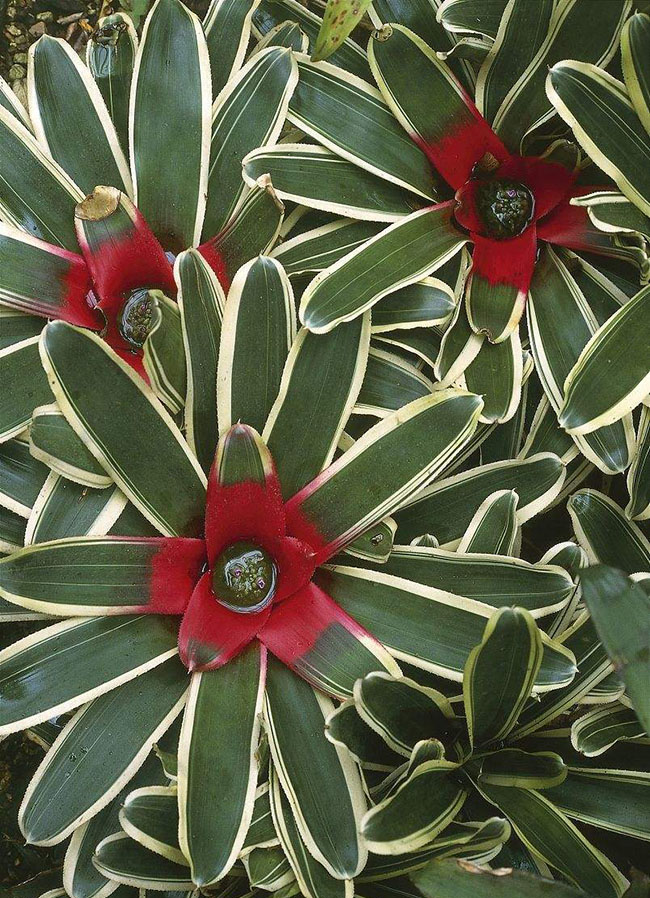
Neoregelia Cultivation Methods
Planting Neoregelia
Seedlings should be planted immediately upon arrival. The planting depth is generally kept at 1 to 2 cm. If too deep, the medium will enter the center of the seedling and affect its growth. In addition, the medium should not be pressed too tightly; keep it as breathable as possible. Water immediately after planting, and water thoroughly, to ensure good contact between roots and soil (Note: after planting, there must be no lack of water between the leaves).
Temperature for Neoregelia
The suitable temperature for ornamental bromeliads is 21°C to 28°C during the day and around 18°C to 21°C at night. It should not exceed 35°C or drop below 15°C. If the temperature is above 35°C, it will cause heat damage, resulting in slow plant growth, small flowers, and fewer flower branches. If the temperature stays below 10°C for a long time, the leaves and bracts will show reddening, white spots, white tips or loss of color, and the affected parts will dry out and become scorched. If the temperature continues to drop, the plant will die.
Generally, seedlings are relatively tender, so the temperature should be controlled at 20°C to 25°C, and large day-night temperature differences must be strictly avoided. After 3 months of planting, the temperature can be adjusted to between 18°C and 28°C, and the day-night temperature difference should be appropriately increased to benefit growth. In summer, cooling can be achieved by opening a water curtain or fan system; in winter, thermal screens and heating systems are used for insulation or heating.
Humidity for Neoregelia
Bromeliads like high-humidity environments, and the air humidity should be maintained between 75% and 85%. Within this humidity range, the plants become plump and full, and the leaf color is bright and lustrous. If the humidity is too low (below 50%), the leaves will curl inward or fail to extend, and the leaf tips may even become scorched. However, the humidity should not be too high either. If the humidity is too high, brown spots will appear on the leaves, and in severe cases heart rot will occur. During the seedling stage, the relative humidity should be controlled between 80% and 85%; after 3 months of planting, it should be controlled between 75% and 85%. Air humidity can be increased by sprinkling water below the growing beds and along the walkways, which also achieves a cooling effect.
Light for Neoregelia
Light intensity is an important factor determining plant growth rate, plant form, flower shape, flower color and so on. The suitable light intensity for bromeliads is around 18,000 lux. Within the suitable light range, increasing light intensity will promote smaller leaves, a more compact plant form, larger flowers, and faster flower coloring. If the light is too strong, spots will appear on the leaves, and in severe cases the leaves will be scorched. If the light is too weak, the plants will become leggy, the color will be dull, and the inflorescence will be thin and lose color. Generally, during the seedling stage, light intensity should be controlled at around 15,000 lux. Excessive light will affect the speed of seedling establishment. After 3 months, light intensity can be increased to 20,000 to 25,000 lux. If the light is too strong, a shading system can be used for shade; in the morning, evening and on cloudy days, make full use of the light.
Ventilation for Neoregelia
Ventilation is also closely related to bromeliad growth. When the weather is cool, ventilation is not important, but during hot, humid summer periods, good ventilation is extremely important for the plants. With good ventilation, the plants are sturdy, the leaves are wide and thick, the flower spikes are large and long, and the flower color is brilliant. With insufficient ventilation, the plants tend to become leggy, the leaves are narrow and long, the flower spikes are short, the flower color lacks luster, and pests and diseases are likely to occur. When necessary, ventilation can be carried out by opening top windows and side windows.
Water for Neoregelia
Water quality is very important for ornamental bromeliads. Generally, the lower the salt content, the better. Water with high calcium and high sodium salt will cause the leaves to lose luster, hinder photosynthesis, and easily trigger heart rot and root rot. The EC value should be controlled below 0.3, and the pH value should be between 5.5 and 6.5. When the pH value is above 7, it will affect the plant's nutrient absorption.
The root system of epiphytic ornamental bromeliads is relatively weak; it mainly serves to anchor the plant, and its absorption function is secondary. The nutrients and water needed for growth and development are mainly stored in the leaf cup formed by the clasping leaf bases, and are absorbed by the absorption scales at the leaf bases. Even if the root system is damaged or there are no roots, as long as there is some water in the leaf cup, the plant can grow normally. Summer and autumn are the peak growing seasons for ornamental bromeliads, and water demand is higher. Water the leaf cup once every 4 to 5 days, and water the medium about once every 15 days, keeping water in the leaf cup and the medium moist. After entering dormancy in winter, water the leaf cup once every 2 weeks, and do not water the medium unless it is dry; too wet conditions easily cause root rot.
Fertilizer for Neoregelia
Among the three major fertilizer elements nitrogen, phosphorus and potassium, nitrogen can promote leaf elongation and deep green leaf color, phosphorus can promote transport within the plant, and potassium has the function of making leaves shorter and wider and can improve leaf quality. Therefore, when preparing fertilizer, the ratio of nitrogen, phosphorus and potassium must be appropriate; this is the prerequisite for cultivating high-quality bromeliads. The suitable ratio of nitrogen, phosphorus and potassium is 1:0.5:1. In addition, bromeliads are very sensitive to boron; even a trace amount of boron can cause scorched-top symptoms in bromeliads.
Neoregelia Care and Management
Repotting:
After 4 months of planting, repotting is needed. When repotting, first place a layer of medium at the bottom of the pot, then take the bromeliad plant out of the small pot together with the soil and place it in the center of the pot, then put medium around it and press lightly to ensure the plant stands upright. Likewise, the medium should not be pressed too tightly, to ensure good breathability. A planting depth of 3 to 4 cm is suitable. After repotting, immediately water thoroughly with clear water, and fertilizer can be applied after one month.
Spacing:
After a period of growth, the plants will become too densely packed, with insufficient light, ultimately leading to narrow and long leaves, stalled growth, and a widening growth gap. Therefore, 2 to 3 months after repotting, the spacing between plants needs to be adjusted.
Grading:
According to plant size, plants need to be graded regularly. This helps improve light for smaller plants and also facilitates management.
Removing old leaves: promptly remove old leaves at the base that have turned yellow and dried out and have no ornamental value.
Neoregelia Propagation Methods
Sowing Neoregelia
Under natural conditions, ornamental bromeliads rarely produce seeds. Even when seeds are obtained through methods such as artificial pollination, the traits of the offspring will segregate and cannot maintain the fine traits of the mother plant. Therefore, seed propagation is only used for preserving germplasm of native species and breeding new varieties. Most ornamental bromeliad seeds quickly lose viability after leaving the mother plant, so they should be sown immediately after collection. Bromeliads generally take 3-4 months from flowering to seed maturity. Bromeliad seeds are very small; one fruit can produce dozens of seeds, and one plant can produce thousands of seeds. Bromeliad sowing can be done by indoor pot sowing or seedling tray sowing. The sowing substrate can be a mixture of river sand, perlite and peat soil, and must be sterilized at high temperature before sowing. Scatter the seeds on the surface of the substrate and press lightly; no soil covering is needed, just cover with plastic film or glass to retain moisture. Under the suitable germination temperature of 24°C-26°C, they germinate in about 7-14 days. When seedlings have 3-4 true leaves, they can be transplanted into 4-5 cm flower pots. Bromeliad seedlings need to be cultivated for 3-4 years before the central leaves can change color and flower for ornamental purposes.
Division of Neoregelia
After ornamental bromeliads finish flowering, multiple offsets will be produced at the leaf axils at the base. Generally, April to June is the suitable period for division. Wait until the offsets grow to about 10 cm with 3-5 leaves. First take the whole plant out of the pot, remove some of the potting soil, hold the mother plant with one hand, and with the thumb and index finger of the other hand tightly pinch the base of the offset; with a downward slanting force, the offset can be broken off. Disinfect the wound with fungicide and let it dry slightly, then insert it into perlite or coarse sand. Keep the substrate and air moist, provide appropriate shade, and after 1-2 months when new roots have grown, normal management can be resumed.
Cutting of Neoregelia
For small-scale production and home cultivation of ornamental bromeliads, offset cuttings are generally used. Before and after the original ornamental bromeliad blooms, multiple offsets are produced at the leaf axils at the base. When the offsets grow to about 10 cm and have 3-5 leaves, use a sharp knife to cut them off close to the mother plant together with a short section of the compressed stem. Disinfect the wound with fungicide and let it dry slightly, dip it in naphthalene acetic acid at a concentration of 300-500 mg/kg, then insert it into perlite, coarse sand or culture soil. Keep the substrate and air moist and provide appropriate shade. After 1-2 months new roots will grow, and normal management can be resumed. Note that if the offsets are too small, they are not easy to root when cut and rot very easily; if too large, dividing them consumes too many nutrients and reduces the propagation coefficient.
Does Neoregelia Bear Fruit? Neoregelia Cultivation Methods
Neoregelia is one of the ornamental plants with very strong ornamental value for both flowers and leaves. As an offshoot of bromeliads, does Neoregelia bear fruit? And how should it be cultivated? Next, let's see whether Neoregelia bears fruit and the cultivation methods for Neoregelia.
1. Does Neoregelia Bear Fruit?
Neoregelia has peculiar flowers and leaves, and is novel, but it cannot bear fruit. Bromeliad flowers, also called pineapple flowers, are crops native to the jungles of Mexico and Brazil, and are an offshoot of the pineapple. Their shape is very peculiar, more like the throne of Guanyin Bodhisattva, and they have very high ornamental value. They are very popular bonsai plants on the market.
2. Neoregelia Cultivation Methods
1. Soil: The culture soil for Neoregelia should have good water retention and breathability. Peat soil, tree fern fragments, coal cinder and the like are suitable and can meet Neoregelia's requirements for regulating moisture and aeration.
2. Watering: Neoregelia is a moisture-loving epiphytic bromeliad, so special attention must be paid to watering in daily management. Summers are hot and Neoregelia has a high evaporation rate, so it needs to be watered thoroughly every day to keep the water at the leaf bases from being interrupted. In winter, watering should be appropriately controlled; just keep the bottom of the leaf tube moist.
3. Sunlight: Neoregelia likes light, and its leaves are more brilliant under sufficient light, but strong direct sunlight should be avoided in summer to prevent scorching the leaves. Generally, first cultivate leaves with beautiful color under relatively strong sunlight, then place the plant indoors in a bright spot for appreciation. Too dark light will cause the leaf color to fade.
4. Temperature: The most suitable growing temperature for Neoregelia is 22-25°C. In winter it should be placed indoors at a temperature above 15°C. Below 15°C, Neoregelia will stop growing, and long-term exposure below 10°C will cause cold damage.
5. Fertilizing: During the growing season, apply a compound flower fertilizer or chemical liquid fertilizer once every half month to Neoregelia, and foliar spraying is effective. But be sure to avoid too high a concentration, so that fertilizer does not accumulate at the stem of the plant and damage the leaves.
6. Pests and diseases: Neoregelia commonly suffers from leaf spot disease. Bordeaux mixture at 100 times dilution can be sprayed once every half month, for 3-4 consecutive sprays.
Neoregelia does not bear fruit and can only be used for ornamental purposes. After understandingNeoregelia Cultivation Methods, everyone can try growing some in pots for ornamental purposes.
A Detailed Explanation of Neoregelia Cultivation Methods!
Neoregelia is native to Central and South America and the West Indies. It likes warmth, humidity and bright light. The suitable growing temperature is 20—27°C, and the overwintering temperature is 10°C. It is best to have 3—4 hours of direct sunlight every day to promote flowering. Today I will briefly introduce the cultivation methods for Neoregelia.
Neoregelia Cultivation Methods
The roots of Neoregelia are especially difficult to wash, densely packed and tightly wrapping the soil. It is best to first soak them in water for a day, then rinse off most of the soil with water, then swish them back and forth in water to let some attached clumps of soil fall off, and finally use your hands to pick off the soil inside the roots little by little.
The soil must be washed completely clean; this is an important step in hydroponics. After washing, trim the roots, cutting off all the tangled and intertwined roots, that is, the outer ring of roots. It is better to keep more than half. Next, dry them, then disinfect and acclimatize them, following the usual method for flowers.
Neoregelia has a leaf tube. Whether during hydroponics or after hydroponics has succeeded, you must ensure there is water in this leaf tube, and ensure that the water in this leaf tube is clean. It is best to change it once every three days. This is the most important step in growing bromeliads well. Do not find it troublesome; the most important thing in growing flowers is patience.
After Neoregelia is placed in a bottle, the roots can be fully submerged for the first three days. After that, only half of the roots need to be submerged. The base of the roots is best placed in the planting basket, covered with small ceramic granules, and then fixed on top with pebbles. Normally, do not spray water on the leaves, and certainly do not spray water on the torch. Just spray the ceramic granules moist.
The roots of Neoregelia are thin and hard, like small iron wires. Growing roots is not very easy, and toxins are easily produced, so it is best to change the water once a day. Neoregelia has relatively high requirements for air humidity. Do not take it out into the sun to bake, and do not place it in places with air conditioning or heating, so as not to affect its normal growth.
If its leaves curl stubbornly toward the middle, it means the air is too dry. Quickly change its living environment, and then spray the leaves moist. Many flower shops simply soak Neoregelia in water, and it can live for about a month. In northern China, Neoregelia generally cannot survive the winter, mainly because the weather is too cold.