A Detailed Guide to Growing and Caring for Begonia maculata
Begonia maculata
Begonia maculata, also known as: White-spotted Begonia, is native to Brazil in South America and has already been introduced and cultivated in China. Begonia maculata is a shrub with relatively thin stems and elliptic-lanceolate leaves bearing silvery-white spots. The flowers are white-green. It has a long flowering period and many flower colors with rich variation, making it a flower with both beautiful blooms and foliage.
Morphological Characteristics of Begonia maculata
Small shrub, much branched. Stems are relatively thin, 60-100 cm tall, new branches green, old branches purplish-brown, branch tips drooping. Leaves elliptic-lanceolate, surface bright green, glossy, with countless silvery-white spots. Flowers white-green.
Common cultivated species in the same genus include: Begonia president-carnot (B. presiden-carnot): the whole plant has smooth stems, and the stem nodes closely resemble bamboo nodes. Leaves alternate, oblong and oblique, surface green, bearing many small spots, with both leaf undersides and petioles dark red.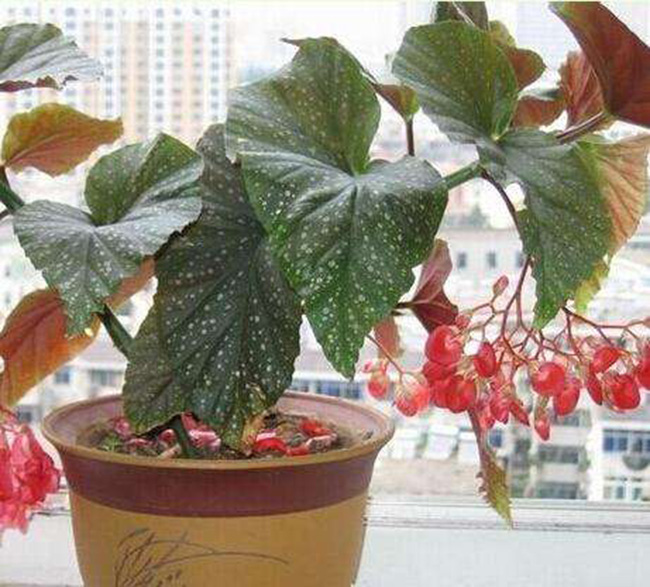
Distribution Areas of Begonia maculata
Begonia maculata is distributed across the provinces and regions south of the Yangtze River. It is produced in Hebei, Henan, Shandong, Shaanxi, Sichuan, Guizhou, Guangxi, Hunan, Hubei, Anhui, Jiangxi, Zhejiang, Fujian, Liaoning, Jiangxi, Jiangsu, Yunnan, and others. It is cultivated in Kunming. It grows on moist mountain walls in valleys, on mountain rocks in dense forests beside valley streams, on rocks at the edges of mountain gullies, and in valley shrub forests, at an altitude of 100-1100 m
Growing Environment of Begonia maculata
Begonia maculata is a temperate species that likes diffused light and a moist environment, and is not strongly cold-tolerant. The soil should be loose and well-drained.
Main Value of Begonia maculata
The dwarf, free-flowering ornamental Begonia maculata is used for arranging flower beds and lawn edges. Potted Begonia maculata is mostly used for; embellishing living rooms, display windows, or for decorating family balconies, windowsills, and tea tables. It is not only applied to outdoor cultivation in courtyards and flower beds, but is also an excellent choice for indoor decoration of family desks, tea tables, table tops, and shop windows. Moreover, its stems and leaves also have good medicinal and edible value
Propagation Methods of Begonia maculata
It is commonly propagated by sowing or cuttings, and can also be propagated by division.
1. Sowing propagation can be carried out in early spring. Sow mature seeds in a propagation pot filled with leaf mold, maintain around 16°C and a certain humidity, and they will root. When the seedlings have 2-3 true leaves, they can be transplanted into pots.
2. Cuttings propagation works best in May-June. Select tender shoots from the top of the plant as cuttings, about 10-15 cm long, and insert them into a sand bed. Mist the sand bed daily; generally, they can root 2-3 weeks after insertion.
3. Clump-forming varieties can also be propagated by division. Divide the root system of a plant that has filled the pot into several clumps, avoiding damage to the roots, then plant them separately in pots.
Cultivation Techniques for Begonia maculata
The growing medium is best as an equal mix of leaf mold, peat soil, and garden soil. The plant should be placed in a semi-shaded area inside a shed or in a bright location for care. The leaves are relatively tender and prone to rot, so after summer begins, attention should be paid to shading, avoiding direct sunlight as much as possible to prevent scorching of the leaf edges.
During the growing season, watering should be frequent to keep the potting soil moist. When the winter room temperature is below 15°C, watering should be strictly controlled, or spraying can replace watering. The optimal growing temperature is 18-21°C; too high a temperature easily causes leaf scorch. In hot seasons, pay attention to the surrounding air humidity and spray 2-3 times a day. During the growing period, apply a compound fertilizer rich in phosphorus and potassium once a month, or apply a dilute liquid fertilizer once every 2 weeks.
The overwintering temperature should not be lower than 8°C. If management is poor during overwintering, such as low room temperature and poor light, when the plant is in a semi-dormant state, excessive watering or fertilizing can easily cause root and leaf rot. Generally, in winter the plant should be placed inside a shed where morning and evening sunlight can be seen, fertilizer should be stopped and water controlled, and once a week the leaf surface can be rinsed with water close to room temperature. Usually, proper pruning should be carried out to maintain a graceful plant shape and good ventilation.
If root-knot nematodes harm the root system, they will affect root absorption, causing the plant to become stunted and lose green color. Nematicides such as cadusafos can be buried around the root system for control. In addition, when air humidity is too high and ventilation is poor, gray mold is likely to occur, so ventilation should be strengthened and medication used.
Growing Methods and Precautions for Begonia maculata
It is commonly propagated by sowing or cuttings, and can also be propagated by division.
1. Sowing propagation can be carried out in early spring. Sow mature seeds in a propagation pot filled with leaf mold, maintain around 16 degrees Celsius and a certain humidity, and they will root. When the seedlings have 2-3 true leaves, they can be transplanted into pots.
2. Cuttings propagation works best in May-June. Select tender shoots from the top of the plant as cuttings, about 10-15 cm long, and insert them into a sand bed. Mist the sand bed daily; generally, they can root 2-3 weeks after insertion.
3. Clump-forming varieties can also be propagated by division. Divide the root system of a plant that has filled the pot into several clumps, avoiding damage to the roots, then plant them separately in pots.
If root-knot nematodes harm the root system, they will affect root absorption, causing the plant to become stunted and lose green color. Nematicides such as cadusafos can be buried around the root system for control. In addition, when air humidity is too high and ventilation is poor, gray mold is likely to occur, so ventilation should be strengthened and medication used.
Growing Methods for Begonia maculata
Light
Begonia maculata greatly likes diffused light and a moist environment, and is not strongly cold-tolerant.
Soil
The soil for Begonia maculata should be loose and well-drained.
Watering
During the growing season, watering should be frequent to keep the potting soil moist.
Fertilizing
During the growing period, apply a compound fertilizer rich in phosphorus and potassium once a month, or apply a dilute liquid fertilizer once every 2 weeks.
Usually, proper pruning should be carried out to maintain a graceful plant shape and good ventilation.
Precautions for Begonia maculata
Seasonal Watering Precautions
When the winter room temperature is below 15°C, watering should be strictly controlled, or spraying can replace watering. The optimal growing temperature is 18-21°C; too high a temperature easily causes leaf scorch.
In hot seasons, pay attention to the surrounding air humidity and spray 2-3 times a day.
Overwintering
The overwintering temperature should not be lower than 8°C. In winter, the plant should be placed inside a shed where morning and evening sunlight can be seen, fertilizer stopped and water controlled, and once a week the leaf surface can be rinsed with water close to room temperature.
Propagation Methods for Begonia maculata
Sowing Propagation
This can be carried out in early spring. Sow mature seeds in a propagation pot filled with leaf mold, maintain around 16°C and a certain humidity, and they will root. When the seedlings have 2-3 true leaves, they can be transplanted into pots.
Cuttings Propagation
This works best in May-June. Select tender shoots from the top of the plant as cuttings, about 10-15 cm long, and insert them into a sand bed. Mist the sand bed daily; generally, they can root 2-3 weeks after insertion.
Division Propagation
Clump-forming varieties can also be propagated by division. Divide the root system of a plant that has filled the pot into several clumps, avoiding damage to the roots, then plant them separately in pots.
Pest and Disease Control for Begonia maculata
If root-knot nematodes harm the root system, they will affect root absorption, causing the plant to become stunted and lose green color. Nematicides such as cadusafos can be buried around the root system for control.
In addition, when air humidity is too high and ventilation is poor, gray mold is likely to occur, so ventilation should be strengthened and medication used.