How to Grow Zamia furfuracea (Cardboard Cycad, Broadleaf Cycad)? Detailed Guide to Cultivation Methods and Precautions
Zamia furfuracea
Zamia furfuracea, also known as the cardboard cycad or broadleaf cycad, is a plant in the genus Zamia, native to the Americas and other regions.
Morphological Characteristics of Zamia furfuracea
Trunk height 15-20 cm, single trunk or rarely branched, sometimes clumping, thick stem, cylindrical, surface densely covered with rows of dark brown leaf scars. At the base of the stem disc of old multi-year trunks, adventitious buds can sprout to produce small offshoots called suckers. Underground, it has a fleshy fibrous root system. The leaves are large even-pinnate compound leaves, growing at the top of the trunk. Leaf length 60-120 cm, hard and leathery, petiole length 15-20 cm, sparsely covered with hard small spines.
Pinnate leaflets 7-12 pairs, leaflets oblong, asymmetrical on both sides, entire at the basal 2/3, densely small obtuse serrations on the upper part, apex obtuse and acuminate, margins revolute, no midrib, 40 prominent parallel veins visible on the underside from base to leaf tip. Dioecious; male inflorescence cone-shaped, 10-15 cm long; female inflorescence palm-like.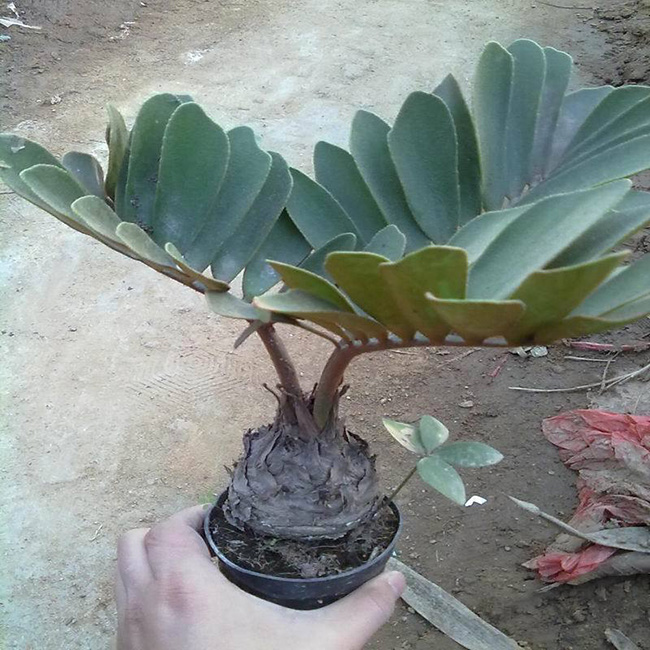
Growing Environment of Zamia furfuracea
Prefers warm, humid and sunny environments. Relatively cold-tolerant and drought-tolerant. Optimal growing temperature: 12-24°C from March to October, 13-16°C from October to March of the following year, winter temperature not below 2°C. Prefers fertile, loose and well-drained sandy loam soil.
Propagation Techniques for Zamia furfuracea
1. Seed sowing:
Because the seeds are relatively large, sow indoors in pots in spring. The optimal germination temperature is 24-30°C, and germination occurs about 15 days after sowing.
2. Division:
Best done from April to May. Separate the suckers beside the main stem, taking care to minimize damage to the stem skin during cutting. After the cut surface dries slightly, first insert into a sand bed, maintain room temperature at 26-30°C, and pot up after roots have formed.
Key Care Points for Zamia furfuracea:
1. Before potting Zamia furfuracea, select a flower pot. For planting Zamia furfuracea, choose clay pots, porcelain pots or ceramic pots as much as possible; try not to use plastic pots, as their drainage is poor.
2. The size of the pot should be chosen according to the size of the Zamia furfuracea plant, neither too large nor too small. A pot that is too small will affect the plant's growth, while one that is too large will affect the overall appearance. For small Zamia furfuracea, choose a pot with a diameter about 1/2 of the leaf spread; for medium and large Zamia furfuracea, choose a pot with a diameter about 1/4-1/3 of the leaf spread.
3. For already planted Zamia furfuracea, in addition to routine management, regular pruning and weed clearing should also be carried out.
4. When growing Zamia furfuracea, be sure to give it sufficient sunlight and water, and take pest prevention measures.
Zamia furfuracea is commonly propagated by division. Best done from April to May. Usually, the suckers beside the main stem are separated, taking care to minimize damage to the stem skin during cutting. After the cut surface dries slightly, plant in well-drained coarse sand. The dark green, broad pinnate compound leaves are very fresh and elegant, making it a new type of foliage plant. Potted specimens are particularly suitable for display in hotels and guest rooms, appearing quiet and elegant.
Cultivation Points for Zamia furfuracea
For potting, a mixed soil of leaf mold and coarse sand is commonly used. Place more tile pieces at the bottom of the pot to facilitate drainage and aeration, which benefits root growth and development. During the vigorous summer growing season, in addition to watering, spray water 2-3 times a day to keep the leaves green and vibrant. Avoid strong direct sunlight, otherwise the leaves will turn yellow and lose their luster; place in a semi-shaded area for care. During the growing season, fertilize once a month; a 20-20-20 general-purpose fertilizer can be used. Repot once every 2 years. When new pinnate compound leaves have grown 2 rounds, the basal leaves often age and turn yellow, and should be cut off one by one. On the stem disc at the base of old multi-year trunks, adventitious buds often sprout; if not used for propagation, they should be cut off promptly.
Pest and Disease Control for Zamia furfuracea
Leaf spot disease is common; spray with 50% carbendazim wettable powder at 1000 times dilution. Pests include scale insects and root-knot nematodes. Scale insects can be killed by spraying with 50% malathion at 1500 times dilution; root-knot nematodes can be controlled with soil fumigation nematicides.
Flower Pot Selection for Zamia furfuracea
Before potting Zamia furfuracea, select a flower pot. For planting Zamia furfuracea, choose clay pots, porcelain pots or ceramic pots as much as possible; try not to use plastic pots, as their drainage is poor. The size of the pot should be chosen according to the size of the Zamia furfuracea plant, neither too large nor too small. A pot that is too small will affect the plant's growth, while one that is too large will affect the overall appearance.
Repotting Tips for Zamia furfuracea
The current time is suitable for transplanting Zamia furfuracea
Usually, potted flowers are repotted once a year or every other year. The best time to repot is when the potted plant's dormancy has ended and new buds are sprouting, and the plant has just been moved from indoors to the balcony but has not yet put out new shoots. However, the transplanting time varies slightly for different plants; potted flowers in the north are generally best repotted from mid-March to mid-April.
The replacement pot size for Zamia furfuracea should be appropriate
When repotting, choose a pot according to the size of the root spread. A pot diameter 3-6 cm larger than the root spread diameter is appropriate. You can also choose a pot according to the size of the plant's canopy; a canopy diameter 20-40 cm larger than the pot diameter is appropriate.
Repotting Procedure for Zamia furfuracea Should Be Done Step by Step
Before repotting, do not water the plant for a few days so that the root ball separates from the pot wall. Before entering the new pot, trim away some circling roots and old roots, and also cut off overly long roots and damaged roots. If too many roots are damaged, some leaves should also be trimmed off. Plants that have just been watered are not suitable for repotting.
Careful Care for Zamia furfuracea with Light Fertilizer and Frequent Application
Generally, if a plant is repotted during the suitable transplanting period, it will survive as long as it is cared for by ordinary methods. After repotting a potted flower, water thoroughly once so the soil absorbs enough water. Do not water too frequently; be sure to wait until the soil is dry before watering again. It is best to spray the leaves with water once a day.
Tips for Successfully Growing Potted Zamia furfuracea
How to Choose a Flower Pot for Zamia furfuracea
Before potting Zamia furfuracea, select a flower pot. For planting Zamia furfuracea, choose clay pots, porcelain pots or ceramic pots as much as possible; try not to use plastic pots, as their drainage is poor. The size of the pot should be chosen according to the size of the Zamia furfuracea plant, neither too large nor too small. A pot that is too small will affect the plant's growth, while one that is too large will affect the overall appearance.
How to Choose Soil for Zamia furfuracea
Zamia furfuracea prefers fertile, loose sandy soil.
When growing Zamia furfuracea, be sure to give it sufficient sunlight and water.
Other Care for Zamia furfuracea
For already planted Zamia furfuracea, in addition to routine management, regular pruning and weed clearing should also be carried out, and pest prevention measures should be taken.
Complete Guide to Zamia furfuracea Flower Language and Precautions for Repotting
Zamia furfuracea stays evergreen all year round, rivaling the lucky bamboo. Zamia furfuracea is easy to grow and is the top choice for indoor potted plants. So what is the flower language of Zamia furfuracea? What should be noted when growing and repotting it?
I. Flower Language of Zamia furfuracea
Flower language of Zamia furfuracea: steadfast and unyielding, firm and unwavering, longevity and prosperity, good fortune and auspiciousness.
Zamia furfuracea is dioecious with different flower shapes. Male flowers are oblong, standing upright among the green pinnate leaves, yellow-brown; female flowers are flat-round, light yellow, closely attached to the top of the stem. Zamia furfuracea prefers warm, humid and sunny environments. Optimal growing temperature: 12-24°C from March to October, 13-16°C from October to March of the following year, winter temperature not below 2°C. It prefers fertile, loose and well-drained sandy loam soil.
II. Precautions for Repotting Zamia furfuracea
1. The current time is suitable for transplanting Zamia furfuracea: Usually, potted flowers are repotted once a year or every other year. The best time to repot is when the potted plant's dormancy has ended and new buds are sprouting, and the plant has just been moved from indoors to the balcony but has not yet put out new shoots. However, the transplanting time varies slightly for different plants; potted flowers in the north are generally best repotted from mid-March to mid-April.
2. The replacement pot size for Zamia furfuracea should be appropriate: When repotting, choose a pot according to the size of the root spread. A pot diameter 3-6 cm larger than the root spread diameter is appropriate. You can also choose a pot according to the size of the plant's canopy; a canopy diameter 20-40 cm larger than the pot diameter is appropriate.
3. Repotting procedure for Zamia furfuracea should be done step by step: Before repotting, do not water the plant for a few days so that the root ball separates from the pot wall. Before entering the new pot, trim away some circling roots and old roots, and also cut off overly long roots and damaged roots. If too many roots are damaged, some leaves should also be trimmed off. Plants that have just been watered are not suitable for repotting.
4. Careful care for Zamia furfuracea with light fertilizer and frequent application: Generally, if a plant is repotted during the suitable transplanting period, it will survive as long as it is cared for by ordinary methods. After repotting a potted flower, water thoroughly once so the soil absorbs enough water. Do not water too frequently; be sure to wait until the soil is dry before watering again. It is best to spray the leaves with water once a day.
The above isthe flower language of Zamia furfuraceaand an introduction to growing and repotting techniques. Zamia furfuracea symbolizes good fortune, so why not grow some at home?