How to Grow Aphelandra squarrosa 'Dania'? Detailed Growing Methods and Precautions
Aphelandra squarrosa 'Dania' Encyclopedia
Aphelandra squarrosa 'Dania' (scientific name: Aphelandra squarrosa Nees cv. Dania) is a perennial herbaceous plant. Leaves are opposite, oblong-elliptic; margins entire and slightly rolled inward; dark green, with pale yellow or yellow veins. The flowers form terminal spike inflorescences, yellow, blooming in summer and autumn, with a flowering period lasting up to 2 months.
Native to Mexico in the Americas, it prefers a warm and humid environment. Aphelandra squarrosa 'Dania' is suitable for home, hotel and shop window displays; because its lower leaves tend to turn yellow and drop, it can be planted with surrounding low-growing foliage plants.
Morphological Characteristics of Aphelandra squarrosa 'Dania'
Aphelandra squarrosa 'Dania' grows 25-30 cm tall. Leaves are opposite, oblong-elliptic, 10-12 cm long and 5-8 cm wide; margins entire and slightly rolled inward, apex acuminate, base cuneate; dark green, with pale yellow or yellow veins. The flowers form terminal spike inflorescences, opening gradually from bottom to top, yellow, blooming in summer and autumn, with a flowering period lasting up to 2 months.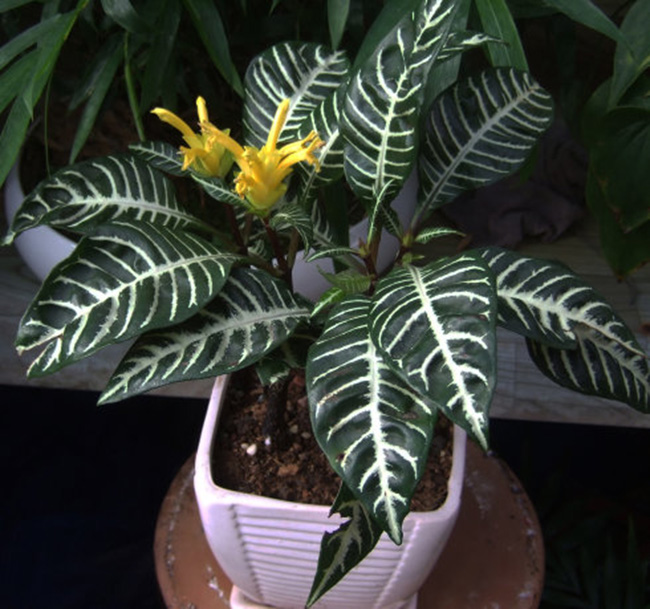
Growing Environment of Aphelandra squarrosa 'Dania'
It prefers a warm and humid environment and likes light, but avoids direct sunlight and is sensitive to cold. The optimal growing temperature is 20-28°C, and the overwintering temperature is 10°C
Distribution Range of Aphelandra squarrosa 'Dania'
Aphelandra squarrosa 'Dania' is mainly produced in the vast region from Mexico to Brazil in tropical America
Cultivation Techniques for Aphelandra squarrosa 'Dania'
Substrate
For potting soil, you can use leaf mold, garden soil, and river sand, with a small amount of cake fertilizer as base fertilizer; you can also use perlite, peat soil, and vermiculite mixed in a ratio of 12211 as the growing substrate.
Fertilizer and Water
Fertilization should follow the principle of "light fertilizer applied frequently." During the growing period, apply diluted liquid fertilizer 1-2 times per month, or apply diluted MS macronutrient nutrient solution. Stop fertilizing in winter. When fertilizing, be careful to avoid the stems and leaves of the plant to prevent fertilizer burn. During the growing season, keep the potting soil moist frequently; in summer, spray water on the leaves 1-2 times daily. If the potting soil lacks water, the lower leaves are prone to drying out and dropping. In winter, watering should be appropriately controlled to increase the plant's cold resistance.
Light
Aphelandra squarrosa 'Dania' grows well under bright scattered light and avoids exposure to scorching sun, so in hot summer it should be placed in a semi-shaded, humid environment, especially with proper shading around midday. Excessive strong light can easily cause the markings on the leaves to fade, affecting the ornamental effect, but insufficient light can also easily cause leggy growth and darkened leaf color, affecting normal flowering of the plant. In addition, during maintenance, pay attention to proper ventilation to prevent leaf drop and avoid affecting the ornamental effect.
Temperature
The suitable growing temperature for Aphelandra squarrosa 'Dania' is 20 C ~ 25 C. It likes a warm and humid climate, and the winter room temperature must not be lower than 10 C. In summer, pay attention to ventilation and cooling; temperatures above 30 C will cause leaf damage
Pest and Disease Control for Aphelandra squarrosa 'Dania'
Pests
Aphelandra squarrosa 'Dania' is mainly harmed by scale insects, which often cause leaves to turn black and develop spots, ultimately leading to yellowing and leaf drop. Control methods: first, pay attention to ventilation; second, promptly remove diseased leaves; third, spray with 2,000-fold abamectin solution.
Diseases
The main disease is black spot disease. In the early stage, dark brown or black spots appear on the leaves at the base of the stem, and then gradually expand into black round lesions. Control methods: promptly remove diseased leaves and branches and burn them centrally, place the plant in a ventilated area, or use 65% zineb 600-fold solution or 75% carbendazim 800-fold solution for control.
Growing Methods for Aphelandra squarrosa 'Dania' Complete Variety List of Aphelandra squarrosa 'Dania'
The veins of Aphelandra squarrosa 'Dania' are pale yellow and very beautiful, and the flower spikes are golden yellow, with a flowering period that can last several weeks. So how do you grow Aphelandra squarrosa 'Dania'? What varieties are there? Let's learn about them together below.
I. Growing Methods for Aphelandra squarrosa 'Dania'
Aphelandra squarrosa 'Dania' likes high temperatures and humid environments, likes sunlight, is slightly tolerant of shade, and avoids direct strong light. It is not cold-tolerant. The optimal growing temperature is 20~28°C, and the overwintering temperature must be above 10°C. It prefers well-drained fertile soil.
Propagation is usually done by cuttings, preferably in May~June or after flowering. When taking cuttings, cut tip-bearing branches about 10 cm long, remove the lower leaves and 1/2 of the upper leaves, and insert them into a substrate of half river sand and half vermiculite; roots can form after about 1 month.
For pot cultivation, use a growing mix prepared by mixing 4 parts leaf mold, 4 parts garden soil, and 2 parts river sand. During the growing period, generally apply a diluted liquid fertilizer containing chlorine and phosphorus once every 1~2 weeks, and at the same time keep the potting soil moist frequently. When the winter room temperature is low, control watering, and keep the potting soil slightly moist. Aphelandra squarrosa 'Dania' is a light-loving flowering shrub, suitable for placement outdoors in semi-shade in spring and autumn, and indoors near a south-facing windowsill in summer and winter, with attention to ventilation. If placed in insufficient light for a long time, it tends to grow leggy, and the leaf color lacks luster. Repot once every early spring, and prune and shape the plant along with repotting to control plant height.
II. Varieties of Aphelandra squarrosa 'Dania'
1. Aphelandra squarrosa 'Louisae', also called zebra plant and silver-vein flower. The main vein and pinnate lateral veins are silvery white, and other traits are similar to Aphelandra squarrosa 'Dania'.
2. Aphelandra pulcherrima is a trailing plant, with elliptical leaves, dark green leaf surfaces, yellow-white main veins and pinnate lateral veins, and green leaf undersides with a purple tinge. Terminal spike inflorescences, with small yellow flowers.
The above isGrowing Methods for Aphelandra squarrosa 'Dania'andVarieties of Aphelandra squarrosa 'Dania'introduction. It is suitable for home, hotel and shop window displays. I hope everyone will like it.
How to Grow Aphelandra squarrosa 'Dania' Growing Methods for Aphelandra squarrosa 'Dania'
Aphelandra squarrosa 'Dania' is a perennial shrub-like herbaceous plant in the Acanthaceae family, native to the Atlantic coastal forests of Brazil. It is an excellent indoor potted flower that can be enjoyed for both its leaves and flowers, and many flower enthusiasts now grow it. Below, the editor will introduce to everyone how to grow Aphelandra squarrosa 'Dania', growing methods for Aphelandra squarrosa 'Dania', and related knowledge.
Introduction to Aphelandra squarrosa 'Dania'
Aphelandra squarrosa 'Dania' is a perennial shrub-like herbaceous plant in the Acanthaceae family. Stems upright, branched; leaves large, ovate or ovate-elliptic, opposite, green, glossy, with distinct pale yellow veins. Terminal spike inflorescences, bracts golden yellow, corolla bilabiate, yellow, flowering from August~October. Aphelandra squarrosa 'Dania' is native to the Atlantic coastal forests of Brazil. It is an excellent indoor potted flower that can be enjoyed for both its leaves and flowers, suitable as a small to medium-sized potted plant. Among the same genus, a variety with high ornamental value is Aphelandra squarrosa 'Louisae'.
I. Morphological Characteristics
Aphelandra squarrosa 'Dania' is a perennial evergreen shrub-like herb, 25-30 cm tall, with purplish-black, semi-succulent stems. Simple leaves opposite, oblong-elliptic, 10-12 cm long and 5-8 cm wide, margins entire and slightly rolled inward in a tortoise-shell shape, apex acuminate, base cuneate; leaf color deep green.
Aphelandra squarrosa 'Dania' has upright, square stems, and the plant is sturdy and somewhat succulent. Leaves opposite, ovate or elliptic-ovate, apex pointed, with short petioles, leaves 15 cm to 30 cm long and about 10 cm wide. Leaf apex pointed, leaf blades dark green, glossy, with obvious white striped veins on the leaf surface, and both veins and leaf margins are undulate. Spike inflorescences terminal or axillary, flower clusters pyramid-shaped, bracts yellow, sometimes with red edges, alternately wrapping the pedicel, somewhat overlapping layer upon layer like roof tiles; flowers bilabiate, with five sepals, pale yellow, and under suitable conditions can open throughout the year. The main vein and pinnate lateral veins of Aphelandra squarrosa 'Dania' are obviously yellow-white; leaves leathery, glossy. Spike inflorescences terminal, small flowers golden yellow, overlapping layer upon layer and opening gradually from bottom to top, lasting for several weeks.
Aphelandra squarrosa 'Dania' blooms from August~October.
II. Ecological Habits
Aphelandra squarrosa 'Dania' prefers warm, humid and semi-shaded environments and a warm, humid climate. It likes light, is slightly tolerant of shade, is not cold-tolerant, avoids waterlogging, and avoids direct sunlight. In hot summer it should be placed in semi-shade.
Aphelandra squarrosa 'Dania' is not cold-tolerant. The optimal growing temperature is 20~25°C, and the overwintering temperature must be above 10°C. It prefers well-drained fertile soil.
Only terminal buds can form flower buds and bloom. The winter temperature should not be lower than 15°C, and the soil is best as loose, fertile leaf mold.
Cultivation Techniques for Aphelandra squarrosa 'Dania'
Aphelandra squarrosa 'Dania' (zebra plant) is native to the tropical and subtropical regions of South America. It likes a warm, humid, semi-shaded environment, is not cold-tolerant, fears drought, and although it likes sufficient sunlight, it also fears strong direct sunlight, so it can be grown in a place with bright light but no direct sunlight.
1. Light
Usually for indoor cultivation it can be placed in front of a south-facing window with relatively sufficient light. In summer, proper shading should be provided around midday to avoid direct strong sunlight.
2. Temperature
The optimal growing temperature is 20~25°C. Flower buds can form only when the temperature is above 20°C. In winter, the room temperature must not be lower than 10°C. If the room temperature is too low, it is prone to cold damage and may even cause leaf drop.
3. Fertilizer
From early summer to early autumn, during flower bud differentiation to bud formation, apply a compound liquid fertilizer once every half month to promote robust growth and abundant green leaves and flowers.
4. Water
Because the zebra plant has a large leaf area, apply a fully decomposed diluted liquid fertilizer or compound fertilizer about once every 10 days. In winter, place it indoors in bright light, appropriately reduce watering, and keep the room temperature above 10°C. If there is heating in the room, spray the plant with water close to room temperature to avoid affecting plant growth due to dry air. After the flowering period, the plant has a dormant period of 4 to 6 weeks, during which watering should be restricted and fertilization stopped; excessive watering can easily cause root rot and leaf drop. At the end of the dormant period, repot once. The potting soil should be rich in humus and have good air permeability.
5. Soil
The potting soil should be rich in humus and have good air permeability. It can be prepared by mixing leaf mold or peat soil with 1/3 vermiculite or perlite. After repotting, place the plant in a warm, semi-shaded place, keep the soil and air moist, and wait for new branches to sprout.
6. Pruning
Because the zebra plant rarely grows side branches on its own, during cultivation you can pinch or prune it to control plant height, keep the plant shape attractive, and promote side buds, so as to achieve the goal of more flowering. After the flowers fade, promptly cut off the spent flowers to avoid consuming too many nutrients and affecting plant growth.
Growing Methods for Aphelandra squarrosa 'Dania'
1. Pot Cultivation
You can use a growing mix prepared by mixing 4 parts leaf mold, 4 parts garden soil, and 2 parts river sand. During the growing period, generally apply a diluted liquid fertilizer containing chlorine and phosphorus once every 1~2 weeks, and at the same time keep the potting soil moist frequently. When the winter room temperature is low, control watering, and keep the potting soil slightly moist. Aphelandra squarrosa 'Dania' is a light-loving flowering shrub, suitable for placement outdoors in semi-shade in spring and autumn, and indoors near a south-facing windowsill in summer and winter, with attention to ventilation. If placed in insufficient light for a long time, it tends to grow leggy, and the leaf color lacks luster. Repot once every early spring, and prune and shape the plant along with repotting to control plant height.
Repot every spring or after flowering in autumn. Aphelandra squarrosa 'Dania' is one of the more light-loving types among foliage plants. Usually keep it in a place with sufficient light. When grown outdoors in summer, shade it to avoid scorched leaves; when light is too weak, it easily causes internode elongation and dull, lusterless leaf color. During the growing period, watering should be increased to keep the potting soil moist, and water should often be sprayed on the leaf surface and surrounding environment. If it is dry and lacks water, leaf drop will occur, causing disjunction of part of the stem and reducing ornamental value; avoid water accumulation in the potting soil, so as not to cause root and stem rot. In winter, reduce watering and keep the potting soil slightly dry to enhance cold resistance. During the growing period, apply a diluted liquid fertilizer or compound fertilizer granules once every half month, and try not to let the fertilizer solution contact the stems and leaves. Stop fertilizing in winter. Because its ability to branch on its own is relatively weak, during the growing period it should be pruned or pinched regularly to lower plant height, prompt more side branches, and keep the plant shape full. Move it indoors in late autumn, and the temperature should be above 10°C.
2. Soil
The planting soil can be made by mixing equal amounts of garden soil and leaf mold, with a little river sand added to improve drainage. In spring, pruning and repotting can be combined with cuttings. During the growing period, keep the soil moist frequently, and apply a compound granular fertilizer with an N-P-K content of 1:1:1 once a month, applying it at the edge of the pot, and do not let the fertilizer contact the stems and leaves. During the growing period, water thoroughly to prevent the soil from cracking. Fertilize once every ten days, applying more phosphorus and potassium fertilizer and less nitrogen fertilizer, applying it at the edge of the pot, and do not let the fertilizer contact the stems and leaves. Scattered light is best. In summer, place the pot in semi-shade; excessive sunlight easily causes scorched leaves. Prune or pinch regularly to lower plant height and promote more branching and flowering. In summer, spray more water on the leaf surface; in winter, keep it slightly dry and expose it to more sunlight.
3. Diseases
For control: when the weather is hot and stuffy, it is prone to damage by scale insects, red spiders, and others, mostly concentrated on the petioles and leaf undersides. Ventilation needs to be strengthened, and 40% omethoate emulsifiable concentrate 1000-1500-fold solution should be sprayed promptly for control.
Propagation Methods for Aphelandra squarrosa 'Dania'
Propagation is usually done by cuttings, preferably in May~June or after flowering. Select robust branches, cut off the top shoots or stem segments with 3-4 nodes as cuttings, remove the lower leaves and 1/3-1/2 of the upper leaves, and insert them into a moist sand bed. Never let the river sand be too wet, so as to avoid rotting of the cuttings. The optimal rooting temperature is 20-25°C. Keep moist and shaded; roots can form in about 1 month, and they can be transplanted after new leaves grow.
Cuttings are best taken in May~June or after flowering. Roots can form in about a month. They can be transplanted after new leaves grow.
The planting soil can be made by mixing equal amounts of garden soil and leaf mold, with a little river sand added to improve drainage. In spring, pruning and repotting can be combined with cuttings. During the growing period, keep the soil moist frequently, and apply a compound granular fertilizer with an N-P-K content of 1:1:1 once a month, applying it at the edge of the pot, and do not let the fertilizer contact the stems and leaves. During the growing period, water thoroughly to prevent the soil from cracking. Fertilize once every ten days, applying more phosphorus and potassium fertilizer and less nitrogen fertilizer, applying it at the edge of the pot, and do not let the fertilizer contact the stems and leaves. Scattered light is best. In summer, place the pot in semi-shade; excessive sunlight easily causes scorched leaves. Prune or pinch regularly to lower plant height and promote more branching and flowering. In summer, spray more water on the leaf surface; in winter, keep it slightly dry and expose it to more sunlight.
The conventional propagation of the zebra plant uses cuttings. You can take leafy stem segments for cuttings in early summer, or use root buds or bud eyes at the roots for cuttings in winter and spring. After insertion, keep the soil moist and the air humidity high. Under conditions of 25°C, rooting is easy. If the temperature is unsuitable, the sprouting ability is not strong and the propagation rate is low.
You can also use test-tube culture technology for propagation, with good results. The specific method is: take tender buds from vigorously growing plants, routinely disinfect them with 0.1% mercuric chloride, and inoculate them into MS medium. The medium is supplemented with cytokinin 6——BA 1.0——2.0 mg/L and auxin IBA about 0.4 mg/L. The proliferation pathway is buds producing buds or callus differentiating into plantlets. After growing into tender shoots about 2 cm long, they can be transferred to 1/2MS+IBA 0.5——1.0 mg/L rooting medium, and roots can form after about 40 days. Transplanting can be done throughout the year except in the high-temperature summer season, with a survival rate above 90%. The substrate is preferably loose fine sand, perlite, vermiculite, etc. The transplanted surviving plantlets grow relatively quickly, and after about half a year of cultivation they can meet the requirements of commercial potted flowers. During maintenance, attention should be paid to keeping the leaf surface clean; otherwise, it is prone to leaf spot disease, causing leaf drop and affecting the ornamental effect. For plants that have lost leaves, retractive pruning can be used to compensate, prompting new buds to sprout from the base.