How to Grow Variegated Cassava? Detailed Guide to Cultivation Methods and Precautions
Variegated Cassava Morphological Characteristics
An upright shrub, about 1.5 m tall, with long tuberous roots that are fleshy. Leaves palmately 3-7 deeply lobed, lobes lanceolate, entire, with irregular[1] yellow patches in the center of the lobes. Leaf surface green, petioles red, inflorescences axillary, with several flowers.
Prefers a warm and sunny environment, not cold-tolerant, afraid of frost, tolerant of semi-shade; the growing environment should not be too dry or too wet.
The optimum growth temperature is: 25-30°C from March to September; 18-20°C from September to March; the overwintering temperature must be above 15°C. If the room temperature is below 10°C, the plant will stop growing and drop its leaves. Variegated Cassava grows rapidly and has strong sprouting ability. After potting rooted cuttings, when they reach 20-25 cm tall, pinching is needed to encourage more branching. Potted plants should be repotted once a year, and combined with pruning of the above-ground branches, leaving 3-4 main branches per pot. Lower the plant height, cut off forked branches and dead branches, and keep the plant in an attractive shape.
An upright shrub, about 1.5 m tall, with long tuberous roots that are fleshy. Leaves palmately 3-7 deeply lobed, lobes lanceolate, entire, with irregular yellow patches in the center of the lobes. Leaf surface green, petioles red, inflorescences axillary, with several flowers.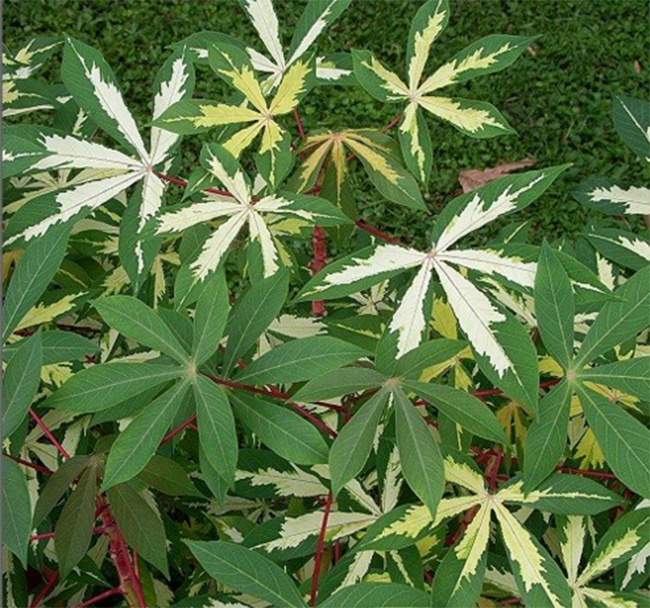
Variegated Cassava Growing Environment
Prefers a warm and sunny environment, not cold-tolerant, afraid of frost, tolerant of semi-shade; the growing environment should not be too dry or too wet.
The optimum growth temperature is: 25-30°C from March to September; 18-20°C from September to March; the overwintering temperature must be above 15°C. If the room temperature is below 10°C, the plant will stop growing and drop its leaves. Variegated Cassava grows rapidly and has strong sprouting ability. After potting rooted cuttings, when they reach 20-25 cm tall, pinching is needed to encourage more branching. Potted plants should be repotted once a year, and combined with pruning of the above-ground branches, leaving 3-4 main branches per pot. Lower the plant height, cut off forked branches and dead branches, and keep the plant in an attractive shape.
Variegated Cassava Cultivation Methods
Variegated Cassava prefers a warm, dry and sunny environment. It is relatively cold-tolerant, drought-tolerant, and not tolerant of waterlogging. It has no strict soil requirements, and grows better in fertile sandy loam.
The winter temperature should not be lower than 5°C. After the cuttings have rooted, they should be potted up promptly, otherwise rooted cuttings are prone to rot. The potting soil can be half compost and half loam, with 5% eggshell powder added and mixed well for best results. For repotting in spring or newly planted specimens, do not water immediately; just mist to make the potting soil slightly moist.
Variegated Cassava should not be watered too much; it is better dry than wet. During the growing season it needs plenty of sunlight, and should be fertilized once a month. Fertilizer should be applied lightly and frequently, but be careful not to pour the fertilizer solution on the leaves; if it has been poured on the leaves, rinse immediately with clean water to avoid rot and loss of ornamental value.
Growing Variegated Cassava indoors can absorb carbon monoxide, carbon dioxide and nitrogen oxides from the air and purify it. It can also increase the concentration of negative ions in the air, keeping the air fresh and benefiting health.
Variegated Cassava Pest and Disease Control
Common brown spot and anthracnose damage: spray with 65% zineb wettable powder at 500 times dilution. Pests include whiteflies and scale insects: spray with 40% omethoate emulsifiable concentrate at 1000 times dilution.
Common Types of Variegated Cassava
Shield-leaf Cassava (M. peltata): leaves peltate, entire, leaf surface grayish green. Leaf veins prominently raised, pink. Variegated Cassava, also known as spotted-leaf cassava, is native to tropical America. It prefers warmth and plenty of sunlight, is not cold-tolerant, and the growing environment should not be too dry or too wet. The soil should be fertile, loose, well-drained, slightly acidic loam, and the winter temperature should not be lower than 15°C.
Main Value of Variegated Cassava
Variegated Cassava has palmately deeply lobed leaves, green leaf surfaces inlaid with yellow patches, and red petioles, making it very colorful and a highly attractive foliage plant.
Potted plants can adorn balconies, windowsills and small courtyards. Large potted plants placed in public places such as hotels, shopping malls and railway stations present a festive and joyful atmosphere that makes people linger.
In the south, placing them in pavilions, by ponds, among rocks and so on is also especially pleasant.
Cultivation Methods for Variegated Cassava
Variegated Cassava prefers a warm, dry and sunny environment. It is relatively cold-tolerant, drought-tolerant, and not tolerant of waterlogging. It has no strict soil requirements, and grows better in fertile sandy loam.
The winter temperature should not be lower than 5°C. After the cuttings have rooted, they should be potted up promptly, otherwise rooted cuttings are prone to rot. The potting soil can be half compost and half loam, with 5% eggshell powder added and mixed well for best results. For repotting in spring or newly planted specimens, do not water immediately; just mist to make the potting soil slightly moist.
Variegated Cassava should not be watered too much; it is better dry than wet. During the growing season it needs plenty of sunlight, and should be fertilized once a month. Fertilizer should be applied lightly and frequently, but be careful not to pour the fertilizer solution on the leaves; if it has been poured on the leaves, rinse immediately with clean water to avoid rot and loss of ornamental value.
Growing Variegated Cassava indoors can absorb carbon monoxide, carbon dioxide and nitrogen oxides from the air and purify it. It can also increase the concentration of negative ions in the air, keeping the air fresh and benefiting health.
A Guide to Growing Courtyard Flowers
Living in a 21st-century city, many people have moved into spacious, bright apartment buildings, but quite a few still live in courtyard houses. And the right to grow flowers and plants is equal for everyone. For flower lovers living in courtyards, how to use the not-so-spacious space to grow a pot of flowers they are satisfied with, surrounded by high-rise buildings, is really not an easy task.Growing flowers at home is now quite common, but there are still many flower-growing enthusiasts who, because they do not grasp the key points, grow their flowers sickly and lopsided, or even kill them. They want to be a "flower guardian," but end up being a "flower killer," with mixed feelings of sorrow and joy, grief deeper than heartbreak.
Growing flowers in the courtyard can beautify the environment and enrich people's lives. Flowers are a source of color; they not only have rich colors, but can also give people different color experiences as the seasons change.
A Guide to Growing Courtyard Flowers
I.Types of Courtyard Flowers and Trees
In May, at the turn of spring and summer, temperatures across the country rise substantially, and sunlight grows stronger day by day, so the variety of potted ornamental plants that can be displayed in courtyards increases, such as Chinese rose, Norfolk Island pine, Hall crabapple, Canary Island date palm, rubber tree, five-needle pine, Buddhist pine, nandina, amaryllis, jasmine, bamboo palm, sago palm, king coconut, areca palm, variegated dracaena, windmill palm, bottle palm, cinnamon, beautiful phoenix palm, European primrose, lily (dwarf potted), pomegranate, Chinese peony, banana shrub, red maple, orange jasmine, four-season osmanthus, bitter orange, etc.
A Guide to Growing Courtyard Flowers
II.Propagation of Courtyard Flowers
1. Sowing
Herbaceous flower species suitable for sowing in May include: common primrose, garden balsam, globe amaranth, etc. Woody flowers include: loquat, Japanese fatsia, leatherleaf mahonia, areca palm, bottle palm, sweet osmanthus. Among them, the seeds of the first 5 flowers can be washed clean and sown immediately after collection; only sweet osmanthus, whose mature fruits turn black, soften and become covered with white powder, should have the peel and pulp washed off, then be stored in clean moist sand until February of the following year, and sown when the seeds crack open and show white. For seeds sown immediately after collection, the following points should be noted at sowing: first, keep the seedbed moist, but not waterlogged; second, cover with grass to prevent the seeds from "sprouting back"; third, after the seeds emerge, remove the grass cover in 2 to 3 stages, and promptly build a shade shed to prevent the sun from scorching the seedlings. In addition, although loquat has large seeds, its young shoots have weak soil-piercing ability and are prone to bending; sowing too deep will affect the emergence rate and seedling survival rate, so shallow sowing is advisable, generally with a furrow depth of 2-3 cm and soil covering to fill the furrow.
At this time, planting gladiolus corms in the ground can bring blooms in August; planting tuberose in the ground can bring blooms between August and September.
2. Cuttings
Herbaceous ornamental plants suitable for cuttings in May include: scarlet sage, pansy, chrysanthemum, spiderwort, dragon's mouth flower, wax begonia, shrimp begonia, Swiss cheese plant (stems), clearweed, arrowhead plant, anthurium, white net-veined grass, globe amaranth, marigold, coleus, peperomia, geranium, coral flower, etc. Succulent ornamental plants include: night-blooming cereus, orchid cactus, cactus (as rootstock), three-ribbed column cactus (as rootstock), echeveria, graptopetalum, etc. Woody ornamental plants include: azalea, pearl orchid, jasmine, crown of thorns, Chinese rose, fuchsia, hibiscus, bleeding heart vine, nandina, red-back excoecaria, mahonia, rubber tree, dragon tree, red mulberry, hydrangea, pomegranate, rose of Sharon, lantana, ti plant, bougainvillea, schefflera, firethorn, purple magnolia, butterfly bush, etc.
3. Grafting
In May, wild rose etc. can be used as rootstock for bud-grafting Chinese rose; 1- to 2-year-old purple magnolia seedlings or cuttings can be used as rootstock for approach-grafting white orchid; 2- to 3-year-old single-trunk rubber trees can be used as rootstock for side-grafting variegated weeping fig; green maple seedlings can be used as rootstock for soft-tip grafting red maple; finger-thick wintersweet seedlings can be used as rootstock for approach-grafting superior wintersweet cultivars; sweet osmanthus seedlings or small-leaf privet can be used as rootstock for approach-grafting superior sweet osmanthus; red camellia or single-petaled camellia seedlings can be used as rootstock for softwood grafting camellia; vigorously growing rhododendron can be used as rootstock for cleft-grafting Western azalea; yellow sagebrush can be used as rootstock for grafting chrysanthemum cultivars; in early May, cactus and three-ribbed column cactus can be used as rootstock for grafting Christmas cactus; three-ribbed column cactus can be used as rootstock for grafting Gymnocalycium mihanovichii etc.
4. Division
Flower species that can be propagated by division in May include: hosta, purple hosta, iris, cast-iron plant, autumn zephyr lily, silver-veined lilyturf, Haworthia, Chinese evergreen, orchid grass, jasmine, pearl orchid, black-eyed Susan, purple loosestrife, wax begonia, Boston fern, etc.
5. Layering
Flower species that can be propagated by layering in May include: banana shrub, pearl orchid, plum blossom, winter jasmine, Chinese rose, Hall crabapple, cherry blossom, white orchid, rubber tree, Belgian azalea, sweet osmanthus, purple magnolia, croton, Buddhist pine, Chinese cypress, true cypress, gardenia, wisteria, Chinese trumpet creeper, orange jasmine, etc.
A Guide to Growing Courtyard Flowers
III.Management of Courtyard Ground-planted Flowers
1. Transplanting
In early May, after the flowers of white magnolia, Yulan magnolia etc. have faded, transplant when they have just sprouted but not yet unfurled leaves; the survival rate is relatively high. Some flowers and trees that sprout later can also be transplanted in May, such as crape myrtle, redbud, rose of Sharon, pomegranate, silk tree, etc.
Herbaceous flower species that can be planted out in the ground in May include: cockscomb (5-6 leaves), globe amaranth (3 pairs of leaves), marigold (5-7 leaves), zinnia (4-5 leaves), five-color pepper, petunia, verbena, ageratum, etc.
2. Shaping
① Pinching
For ground-planted herbaceous flowers such as China aster, garden balsam, phlox, wallflower, dahlia, coleus, etc., pinch off the tips in mid-to-late May to encourage branching. For woody flowers such as plum blossom, wintersweet, gardenia, etc., pinching can also promote the growth of side branches.
② Pruning
For ground-planted flowers and trees in the courtyard, such as redbud, crape myrtle, firethorn, snowball viburnum, pomegranate, etc., continue to prune away dead branches, diseased and pest-infested branches, weak branches, etc., to adjust the plant shape.
3. Fertilizing
For ground-planted flower and tree species that continuously form flower buds and can bloom continuously, such as pomegranate (a type of flowering pomegranate), Chinese rose, hypericum, etc.; for species that bloom in summer, such as gardenia, hibiscus, crape myrtle, hydrangea, snowball viburnum, butterfly bush, summer azalea, etc.; and for species that begin flower bud differentiation around June, such as camellia, plum blossom, tree peony, sweet osmanthus, etc., from May onward, apply a quick-acting fertilizer balanced in nitrogen, phosphorus and potassium once every half month.
4. Pest and Disease Control
In May, special attention should be paid to controlling the damage of red spider mites, cottony cushion scale, red wax scale, aphids, etc. For the larvae of the box tree pyralid found on ground-planted boxwood hedges, pesticides can be sprayed promptly for control.
5. Seed Collection
Ground-planted herbaceous flowers such as cornflower, ornamental kale, daisy, pot marigold, corn poppy, wallflower, etc., can have their seeds collected in May.
A Guide to Growing Courtyard Flowers
IV.Management of Courtyard Potted Flowers
1. Repotting
In northern regions, some potted flowers brought out from indoors or sheds can be repotted. Species such as: camellia, azalea, rubber tree, schefflera, Norfolk Island pine, bird of paradise, orchids, dragon tree, areca palm, fishtail palm, etc.
2. Shaping
In northern regions, for white orchid, orange jasmine, banana shrub, bitter orange, camellia, etc. that have just been moved outdoors, prune away dead branches, weak branches, etc., to keep a good plant shape; for potted plum blossom, wintersweet, firethorn, crabapple, etc., pinch the tips of overly vigorous shoots to promote healthy plant development; for Chinese rose, Hall crabapple, tree peony, coral tree, deutzia, etc. that have finished flowering, carry out shortening pruning.
3. Watering
As temperatures rise in May, for potted flowers placed in the courtyard, increase the amount of watering, which can be controlled to once a day. On fine days, pay attention to misting around the plants to raise air humidity; if there is continuous rainy weather, check the potting soil frequently, and if water accumulates in the pot, drain it promptly and repot as soon as possible. In northern regions, when watering potted flowers that prefer acidic soil conditions, such as gardenia, camellia, azalea, white orchid, banana shrub, pearl orchid, daphne, sago palm, bamboo palm, Swiss cheese plant, etc., a small amount of ferrous sulfate can be added to the water to prevent physiological yellowing of the plants. For cyclamen, calla lily, etc. that have entered dormancy, stop watering and simply place them in a moist, cool location.
A Guide to Growing Courtyard Flowers
4. Fertilizing
May is the season of vigorous growth for potted flowers. For those flower and tree species grown for their flowers, fruits and fragrance, such as white orchid, orange jasmine, Chinese rose, bitter orange, gardenia, pearl orchid, jasmine, camellia, plum blossom, wintersweet, tree peony, etc., apply a compound fertilizer balanced in nitrogen, phosphorus and potassium once every half month; a small amount of monopotassium phosphate can also be added to the applied cake fertilizer water to help the plants' restorative growth, flower bud differentiation, or continuous budding and blooming. For those species grown mainly for foliage, such as Swiss cheese plant, Philodendron bipinnatifidum, Philodendron 'Little Angel', rubber tree, red (green) gem, sago palm, bamboo palm, giant taro, green emperor, cast-iron plant, Chinese evergreen, etc., apply fully decomposed cake fertilizer water once every half month; for variegated foliage plants, such as snake plant 'Laurentii', bromeliads, Dracaena fragrans 'Massangeana', three-colored ti plant, Dieffenbachia, croton, coleus, arrowhead plant 'White Butterfly', shell ginger, variegated cassava, aucuba, golden bamboo, net-veined grass, variegated schefflera, golden pothos, inch plant, etc., while applying dilute cake fertilizer liquid, also apply 0.2% monopotassium phosphate as a foliar feed, which can make their leaf color appear more vivid and bright.
5. Shading
From May onward, potted plants that prefer semi-shade or shade should be moved into shade sheds or under tree shade, such as Swiss cheese plant, bamboo palm, calathea, Philodendron bipinnatifidum, giant taro, red (green) gem, green emperor, Dieffenbachia, arrowhead plant, orchids, azalea, camellia, camellia sasanqua, bird of paradise, pearl orchid, clivia, tuberous begonia, shrimp begonia, nandina, spider plant, Boston fern, areca palm, anthurium, peperomia, pothos, Boston fern, etc. For light-loving flowers and trees, sufficient light must be given, such as sago palm, pomegranate, Chinese rose, jasmine, wintersweet, firethorn, leatherleaf mahonia, etc.
6. Pest and Disease Prevention
For potted Chinese rose, floribunda rose, miniature rose, etc. grown in the courtyard, pay attention to preventing and controlling powdery mildew and brown spot disease. If leaf-eating pests are found, promptly use 90% trichlorfon crystals at 1000 times dilution for control. For the larvae of the citrus swallowtail butterfly appearing on plants of the Rutaceae family such as bitter orange, kumquat, finger citron, lemon, etc., also catch and kill them promptly or use fenvalerate for control.